
Tasmanian Freight Equalisation Scheme Monitoring Report 2024
The Tasmanian Freight Equalisation Scheme (TFES) provides financial assistance for costs incurred by shippers of eligible non-bulk goods moved by sea across Bass Strait. This report is BITRE's second 4-yearly monitoring review of all components of the TFES. The focus is the volume and value of eligible claims for goods shipped between Tasmania and the mainland in the 4 years from 2019–20 to 2022–23.
Consultation Draft Tasmanian Freight Equalisation Scheme Monitoring Report 2024
Consultation Draft Tasmanian Freight Equalisation Scheme Monitoring Report 2024.
Tasmanian Freight Equalisation Scheme Monitoring Report 2020
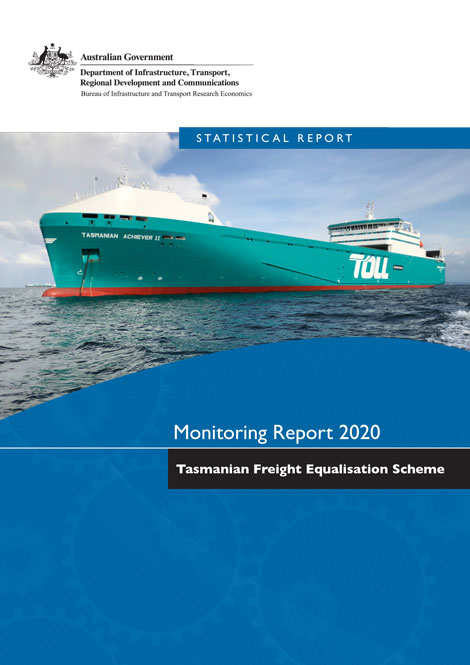
This report presents results of the first 4-yearly review of all components of the Tasmanian Freight Equalisation Scheme (TFES) as directed under Clause 10.5.2 of the TFES Ministerial Directions (Department of Infrastructure, Transport, Regional Development and Communication 2020).
Tasmanian Freight Equalisation Scheme - review of the expanded component: Final Report
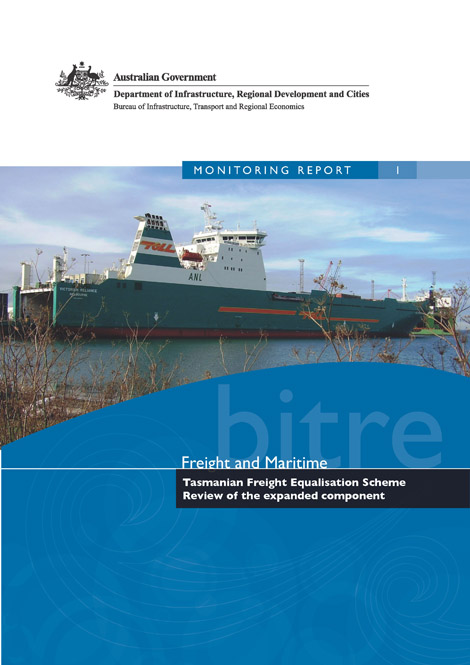
In March 2015 the Australian Government responded to the Productivity Commission's (2014) Tasmanian Shipping and Freight Report by announcing the Tasmanian Freight Equalisation Scheme (TFES) would be expanded from 1 January 2016 to provide assistance to goods going to markets not previously covered by the Scheme.
The announcement included a new monitoring process, with the Bureau of Infrastructure, Transport and Regional Economics (BITRE) to conduct an initial review of the expanded component in 2017 (this review). Thereafter, monitoring of the expanded component will become part of the BITRE's general TFES monitoring reviews commencing in 2019.
In terms of the level and appropriateness of the flat rate for the expanded component, BITRE's finding in this 2017 review are that:
- There is little relevant information on overall rate trends for freight shipped due to a limited claims history and many destinations.
- The appropriate benchmark for freight costs is the shipping cost across Bass Strait as, to be eligible, freight must be transhipped via an Australian mainland port.
BITRE sought public comment on a draft of this review in December 2017. Two submissions were received (including one after the finalisation of the report).
The Australian Government's response is available here.
Tasmanian Freight Schemes—Parameter Review 2013
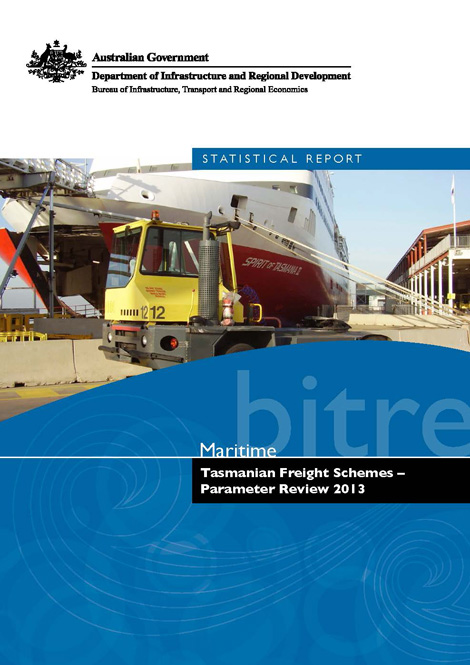
The Tasmanian Freight Equalisation Scheme operates according to Ministerial Directions (2012) using parameters recommended by the TFES Review Authority (1998). The Tasmanian Wheat Freight Scheme operates under separate Ministerial Directions approved on 25 January 2006.
Tasmanian Freight Equalisation Scheme: Recommended Northbound Assistance Rates at 1 January 1978
When the Commonwealth Government introduced the Tasmanian Freight Equalisation Scheme on 1 July 1976 it directed the Bureau of Transport Economics to recalculate the rates of assistance by December 1977.
This report presents the recommended new rates of assistance calculated on the basis of the freight rates prevailing at the end of December 1977. The method of recalculation was based on that used by the Nimmo Commission although with some modifications.
The new assistance rates were calculated as the difference between the costs of moving a consignment from Tasmania to mainland destinations and the costs of moving a similar consignment on comparable mainland routes.
Tasmanian Freight Equalisation Scheme: Recommended Rates of Assistance for Southbound Cargoes, Livestock and Timber at 31 January 1979
This Report sets out recommended new rates of assistance to be paid under the Tasmanian Freight Equalisation Scheme on eligible southbound cargoes and on northbound shipments of livestock and timber.
The southbound rates were recalculated to meet a direction issued by the Commonwealth Government when the Freight Equalisation Scheme was first introduced, while the direction to recalculate timber rates arose from recommendations made in the 1978 BTE report giving new northbound TFES rates.
The investigation of northbound livestock rates was initially directed towards determining whether higher rates of assistance should be paid on consignments of stud animals, but during the course of the study the terms of reference were widened to cover all livestock shipments.
Tasmanian Freight Equalisation Scheme: A 'Landbridge' Approach to the Estimation of Subsidy Rates
In order to provide information to assist with the continuing administration of the Tasmanian Freight Equalisation Scheme, the Minister for Transport directed the BTE to undertake studies of the costs incurred by Australian industries on Mainland interstate long distance freight transport, and the factors determining the freight rates charged between Tasmania and the Mainland and the potential for cost reductions.
Tasmanian Freight Equalisation Scheme: Discussion Paper September 1996
This report examines the appropriateness of established rates of assistance for the shipping of cargo to and from Tasmania and proposes rate amendments for different commodities and different units for the shipment of those commodities. It was undertaken by BTCE as a preliminary analysis to assist the Tasmanian Freight Equalisation Scheme Review Authority to undertake a more thorough examination of these issues at the request of the Minister for Transport and Regional Development.
Tasmanian Freight Schemes—Parameter Review 2008
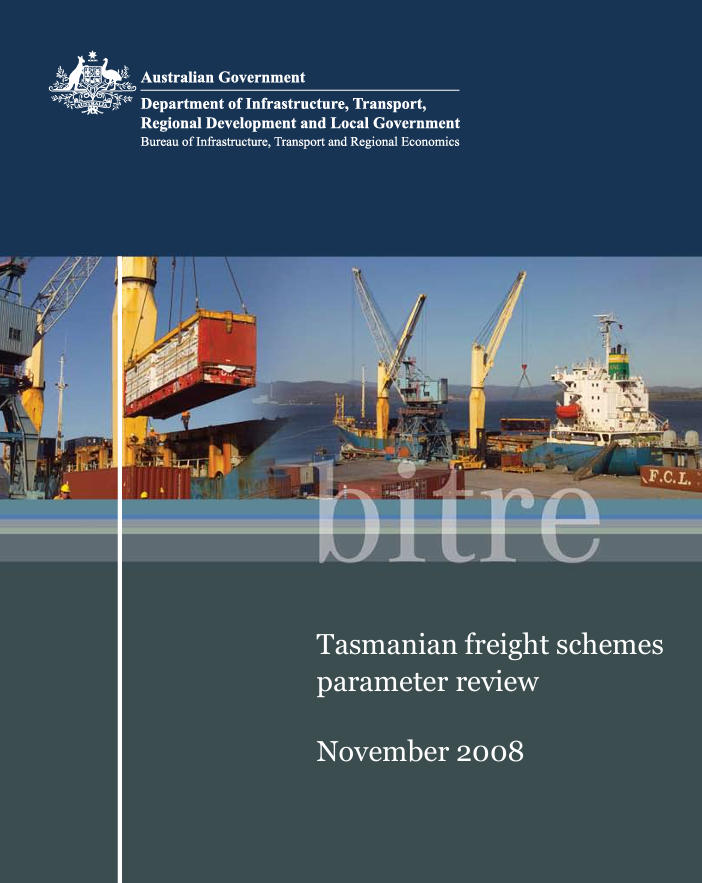
In March 2006 the Productivity Commission was asked to 'report on the merits and weaknesses of the current arrangements for subsidising containerised and bulk shipping between the mainland and Tasmania and provide recommendations on an appropriate future approach and/or arrangements.' This review covered both the Tasmanian Freight Equalisation Scheme and Tasmanian Wheat Freight Scheme.