
Containerised and non-containerised trade through Australian ports to 2032–33
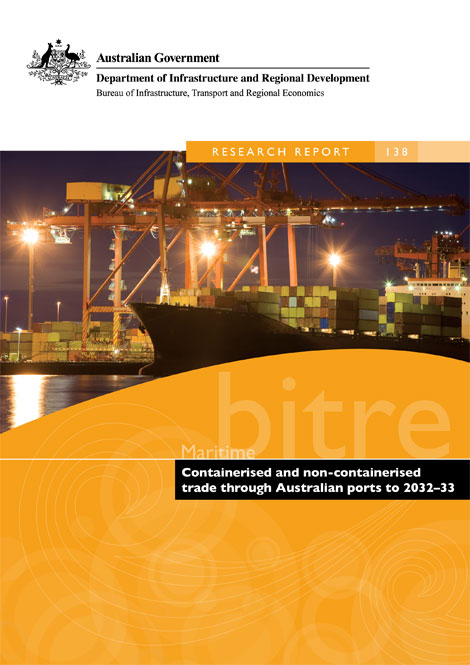
This report presents 20-year forecasts of exports and imports of containerised and non-containerised freight and sea passenger movements through Australia's 5 largest capital city ports and, in aggregation, all other ports. The forecasts, which update those previously published by BITRE in 2002, 2006 and 2010, are driven by population, real income, exchange rates, import prices and export prices. The most recent economic outlook and population growth forecasts for Australia and its major trading partners have been used to derive the forecasts. The forecasts imply that Australia's sea trade will double over the next 20 years, largely due to the continuing positive economic outlook for Australia and its major trading partners. The long-term outlook for the cruise shipping industry is also positive, largely due to the projected economic growth in source countries of cruise passengers, particularly the USA.
Ports: job generation in the context of regional development
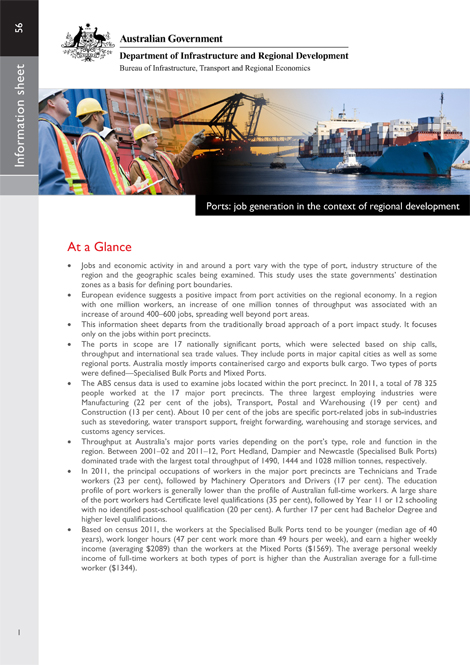
This paper presents recent evidence on jobs at Australian ports, based on ABS Census of Population and Housing data. It examines 17 major ports that are of national economic significance, based on the level of activity as measured by ship visits, throughput and the value of trade. It presents the number of jobs located at port precinct, the industry structure, median age, educational qualifications and skill mix of that employment.
- Ports: job generation in the context of regional development
Australian sea freight 2012-13
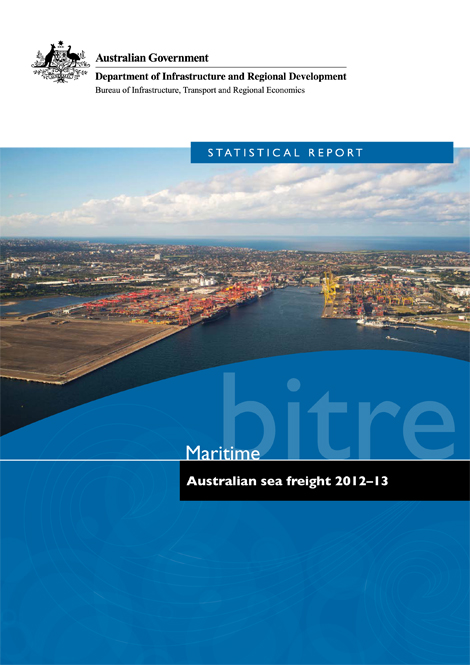
This is the latest in a series of BITRE reports that presents statistics on maritime freight in Australia and shows the trend of Australian sea freight over the most recent 10 years. The information presented comprises international and coastal freight statistics, the use of coastal voyage permits, vessel activity at Australian ports and the size and composition of the Australian trading fleet from 2003-04 to 2012-13.
Waterline 54—August 2014
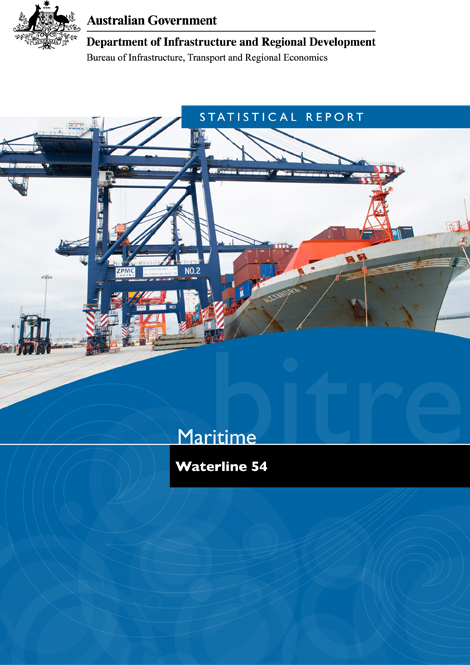
Waterline reports on trends in throughput, container handling productivity on the waterfront and landside of ports in Australia, and the cost of importing and exporting containers. It covers the unloading of container ships and the transport of containers from container terminals. In Waterline 54, rail throughput data provided by port authorities is incorporated in calculating the throughput and productivity indicators. This issue covers port terminal activity up to the December quarter 2013.
Infrastructure, transport and productivity
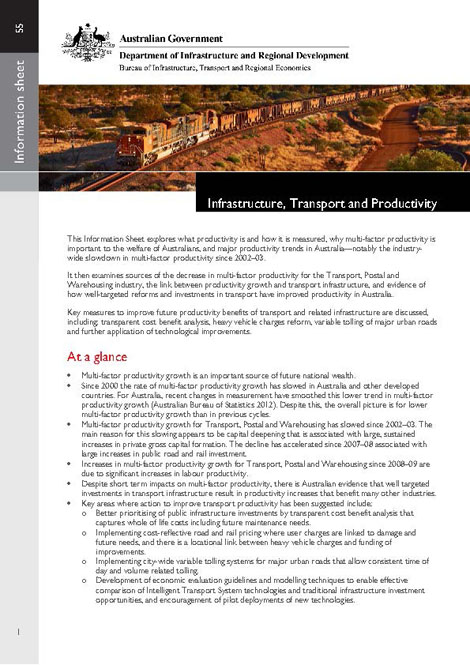
This information sheet reviews trends in Australian productivity with a focus on the transport sector.
Well targeted investments in transport infrastructure result in productivity increases that benefit many other industries. The paper provides for specific examples that cover trucks, freight, waterfront and rail productivity enhancements.
- Infrastructure, transport and productivity
Waterline 53—January 2014
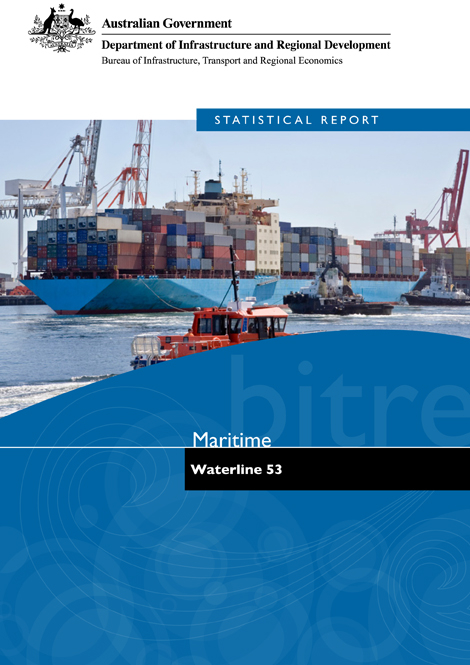
Waterline reports on trends in throughput, container handling productivity on the waterfront and landside of ports in Australia and the cost of importing and exporting containers. It covers the unloading of container ships and the transport of containers from container terminals. In Waterline 53, the format of the report has been revised and several new productivity measures have been introduced following consultation with industry. This issue covers port terminal activity up to the June quarter 2013.
Bass Strait Passenger Vehicle Equalisation Scheme Monitoring Report No. 14
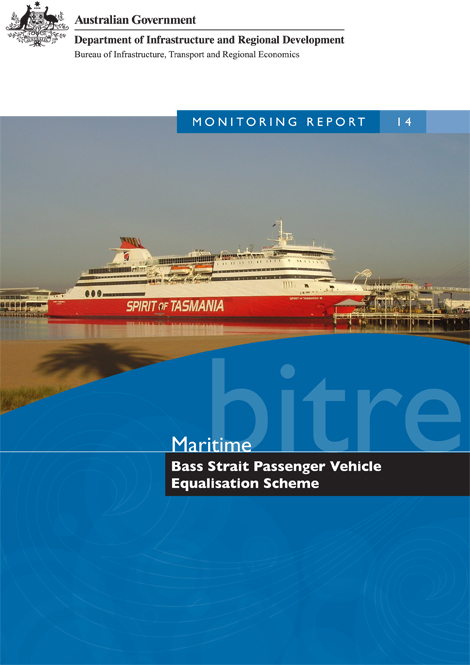
The Ministerial Directions governing the Bass Strait Passenger Vehicle Equalisation Scheme require us to produce a monitoring report every 2 years. The monitoring report pays specific regard to the movement of fare prices and the movement of the number of eligible passengers and the number of eligible passenger vehicles.
Tasmanian Freight Schemes—Parameter Review 2013
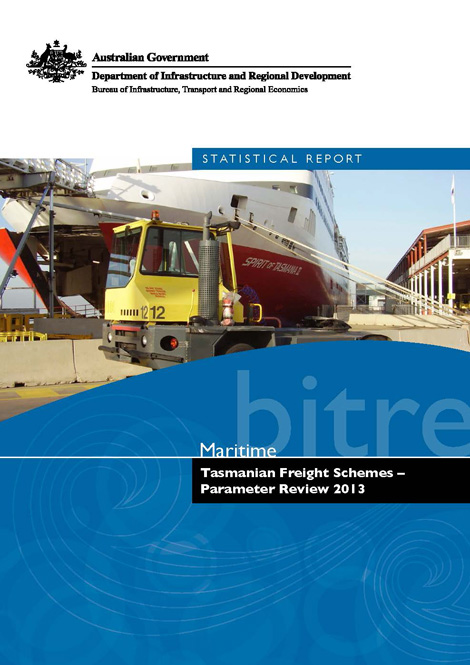
The Tasmanian Freight Equalisation Scheme operates according to Ministerial Directions (2012) using parameters recommended by the TFES Review Authority (1998). The Tasmanian Wheat Freight Scheme operates under separate Ministerial Directions approved on 25 January 2006.
Australian sea freight 2011–12
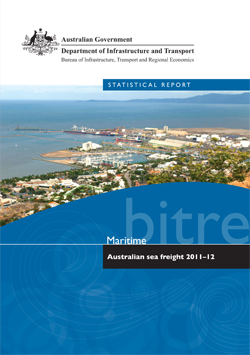
This is the latest in a series of BITRE reports that provide information on Australian sea freight movements, vessel activity, the use of coastal trading licences and the size and composition of the Australian trading fleet. This report contains statistics on maritime freight and shipping activities in Australia from 2005–06 to 2011–12.
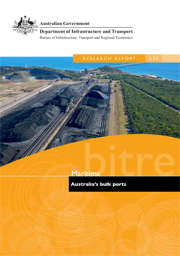
The report provides a profile of Australia's principal bulk ports and the logistics chain that delivers commodities through those ports. Efficient logistics are essential for these volumes, requiring substantial investment as well as good co-ordination of the different links in the logistics chain. These factors have been especially important in the last decade, with tonnage rising by over 75%. The report illustrates the tasks performed at each port using the broad range of data and indicators that are published by port authorities and bulk terminal operators.