
State Spending on Roads
Over the last few years, the Commonwealth has devoted considerable resources to the task of helping local government authorities maintain and upgrade their road systems. The major initiative was an extra $1.2 billion in road funding paid directly to councils through the Roads to Recovery programme but federal authorities have also been directed to work with their local government counterparts to improve road policies and practices. The Bureau of Transport and Regional Economics' main contribution to this initiative has been to carry out two research projects. A regional analysis of council road finances was published last year in BTRE Working Paper 44, Spending on Local Roads, and this report presents a complementary study of State and Territory spending on roads including the assistance they provide to local government. It also identifies the roads for which State and council authorities are respectively responsible in each jurisdiction. The BTRE would like to thank State, Territory and Local Government organisations that assisted in the preparation of this report by providing information or advice on road finances. The data presented in this report is based on the responses provided by the States and Territories to the BTRE's Survey of State Government Spending on Roads. The BTRE has made every effort to ensure the figures are internally consistent and has relied on the State and Territories to ensure the accuracy of the data.
- State Spending on Roads
Rail Infrastructure Pricing: Principles and Practice

Since the early 1990s, railway operations in Australia and in many overseas countries have been radically reformed. One reform has been widespread outsourcing of railway activities such as infrastructure maintenance, to encourage efficient provision through competitive tendering for services. In some cases, entire rail operations have been contracted out or privatised. The major reform, however, has been to introduce regulations to require access to rail infrastructure by outside ("third-party") train operators. This mandated access also supports rail interoperability objectives facilitating train service coordination by streamlining the logistics chain across infrastructure networks.
Prior to these regulations, there were no access charges because the track use was an internal transaction within the railway company the company maintaining the infrastructure had exclusive use of the tracks for its own trains. In essence, the railway's revenue was generated only from tariffs for transporting goods and passengers. However, with mandatory access, rail infrastructure owners offer an additional service non-track owners' access to the infrastructure.
What are fair, equitable and efficient charges for that access? We know that the level and structure of these charges matter, for they account for, perhaps, one-third of the train operator's total operating costs. This report focuses on the rail infrastructure pricing structures that have developed with mandated access around the world, and the lessons that can be drawn from the subsequent experiences.
Our analysis involves consideration of the benefits and costs of mandatory access; the principles of efficient access charges; Australia's systems of access and pricing; international pricing and access systems and the lessons from the experiences with them. While principles of access charges apply equally to freight and passenger trains, mandated access is generally directed only at freight operations. For that reason, in this report we consider only freight operations.
- Rail Infrastructure Pricing: Principles and Practice
Focus on regions No. 1: Industry Structure

Australia, like many other developed countries, has experienced a decline in the importance of the manufacturing and agriculture sectors over recent decades, and strong growth in the services sector. In particular, Business services accounts for a large and growing share of national value added and employment. Between 1991 and 2001, the Business services industry was the single largest source of employment growth in all States and Territories.
- Focus on regions No. 1: Industry Structure
- Industry Structure Database 2003

Appropriateness of a 350 Million Litre Biofuels Target
In July 2003 the Commonwealth Scientific and Industrial Research Organisation, jointly with BTRE and the Australian Bureau of Agricultural and Resource Economics, were asked to investigate the appropriateness of maintaining an objective that biofuels, produced in Australia from renewable resources, contribute at least 350 ML to the total fuel supply by 2010. The joint study was initiated on 5 August 2003 with a final report required to be delivered on 19 December 2003. "Appropriateness" was to be considered in terms of net environmental benefits, net economic benefits, net regional benefits and industry viability. In turn, industry viability was to take into account announced reforms to fuel tax arrangements, including the phase out of effective excise relief.
- Appropriateness of a 350 Million Litre Biofuels Target
Risk in Cost-Benefit Analysis
For cost-benefit analyses (CBA) of public-sector projects, a common misconception is that the discount rate should include a risk premium in consonance with the private-sector practice of doing so. In examining the issue, this report addresses different types of risk separately including downside risk, which arises from optimistic bias in forecasts and pure risk, which is the variation remaining around the mean after removing downside biases.
- Risk in Cost-Benefit Analysis
Skill Shortages in Australia's Regions
Skill shortages are a well documented issue both in Australia and overseas, but the problem itself is not well defined. Most of the previously published work has been conducted on a national or industry wide scale. The BTRE approach focused on the relationship between skill shortages and location, using local skill audits, commissioned reports and industry focused studies.
- Skill Shortages in Australia's Regions
Drivers of Economic Growth in the Greater Sydney Metropolitan Region

The Greater Sydney Metropolitan Region is one of the fastest growing metropolitan areas of Australia. This project improves our understanding of socio-economic drivers of growth in this region. 54 Statistical Local Areas (SLAs) in the region were analysed, and the study covers the period 1991 to 2001. The paper is accompanied by the Drivers of Economic Growth in the Greater Sydney Metropolitan Region database.
- Drivers of Economic Growth in the Greater Sydney Metropolitan Region
- Statistical Index
Submission to the Productivity Commission Road and Rail Freight Infrastructure Pricing Inquiry
The submission commences with a brief general discussion of the economics of road and rail infrastructure and some implications for pricing; examines the relationship between estimates of road infrastructure costs attributable to Australian heavy vehicle operators and charges paid, both at the aggregate level and for particular road corridors; discusses issues in improving the efficiency of both road and rail freight infrastructure pricing, and finally considers the question of charging for freight externalities.
- Submission to the Productivity Commission Road and Rail Freight Infrastructure Pricing Inquiry
Optimising Harmonisation in the Australian Railway Industry
In the last decade, Australia's railways have undergone an ownership, operational and technological revolution. The establishment of national public and private train operators has finally brought seamless rail freight services across the country. There has been a complementary development in track management, with one manager (Australian Rail Track Corporation) rather than five, now controlling most of the interstate track.
The standardisation of the Melbourne-Adelaide railway in 1995 removed the break-of-gauge on the East-West Corridor. This has facilitated the subsequent more than doubling of rail freight task between those cities.
Infrastructure investments and complementary funding of new generation locomotives have enabled train operators to harness train economics of heavier, longer trains, for instance, with Melbourne-Adelaide trains now 50 per cent longer than a decade ago.
These changes are transforming the industry. However, the perception is that the legacy of the separate State-based networks may still draw a long shadow over the performance of the network. This report investigates the extent to which physical, operational and regulatory breaks-of-gauge impede the industry. The report provides guidance to policy makers and industry on those issues.
- Optimising Harmonisation in the Australian Railway Industry
National guidelines for transport system management in Australia
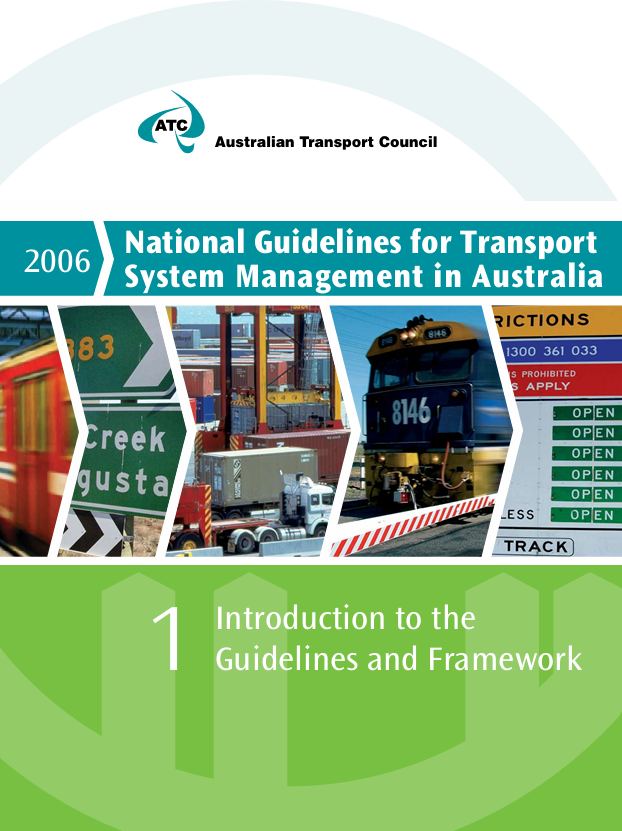
The first edition of the Guidelines (ATC 2004a) was produced by the Guidelines Assessment Methodology Working Group (endorsed by the Standing Committee on Transport). It incorporated a generic framework with an initial focus on non-urban land transport (road, rail, inter-modal).
In 2005, The Australian Transport Council (ATC) established a Guidelines Implementation Committee (GIC) to review, update and improve the Guidelines in line with learnings and feedback received during their implementation. The ATC also asked the GIC to extend the Guidelines to urban transport.
This second edition of the Guidelines has been produced by the GIC in response to the directive of the ATC. The Guidelines have been restructured to make them more concise, accessible and user-friendly, while maintaining rigour. The Guidelines have also been extended to urban transport.