
Focus on regions No. 1: Industry Structure
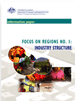
Australia, like many other developed countries, has experienced a decline in the importance of the manufacturing and agriculture sectors over recent decades, and strong growth in the services sector. In particular, Business services accounts for a large and growing share of national value added and employment. Between 1991 and 2001, the Business services industry was the single largest source of employment growth in all States and Territories.
- Focus on regions No. 1: Industry Structure
- Industry Structure Database 2003

Focus on Regions No. 2: Education, Skills and Qualifications
This report analyses trends in educational attainment and occupational status in Australia. It investigates the spatial distribution of skills, qualifications, selected professionals and skilled tradespeople across Australia's regions in the period 1991 to 2001.
- Focus on Regions No. 2: Education, Skills and Qualifications
- Human capital education database
- Human capital occupation database
Focus on Regions No 4: Social Capital
Social capital theory proposes that social networks and norms have a role to play in influencing a community's development. This paper presents and analyses statistical information relating to social capital in Australia and its regions, using a set of 33 social capital indicators for 2001–02. It also explores the relationship between social capital and the economic and social wellbeing of Australia's regions. The paper is accompanied by the BTRE's Social Capital Indicators Database.
- Focus on Regions No 4: Social Capital
- Social capital indicators
About Australia's Regions 2003–06
Back issues of About Australia's Regions from 2003–06
- About Australia's Regions 2006
- About Australia's Regions 2005
- About Australia's Regions 2004
- About Australia's Regions 2003
Economic wellbeing of Australia's regions
This information paper presents and explores new statistical information relating to household wealth at a small area scale. The paper also explores the relationship between wealth and income for Australia's cities and regions.
- Economic wellbeing of Australia's regions
Regional economic growth database update 2005–06
This update of BITRE's regional economic growth database incorporates new data for the 2005–06 financial year, and brings the database in line with the 2006 ABS Australian Standard Geographical Classification (ASGC) boundaries. The accompanying paper includes some descriptive analysis on economic growth since 2004–05.The database contains more than 25 years of small-area level taxable income data. Changes in a region's total taxable income can be used as an indicator of economic growth. The database also provides data on the number of taxpayers and the average amount earned by each taxpayer in a region.The 2007 update was based on 2001 ASGC boundaries, which may be of use to those seeking data based on this geography. To access the older database and its accompanying maps and analysis, visit Regional economic growth–BITRE's taxable income database.
- Regional economic growth in Australia 2004–05 to 2005–06
- Notes on method: the BITRE's economic growth (taxable income) database, update to 2005–06
- BITRE economic growth database update 2008
Northern Australia Statistical Compendium 2009

The Northern Australia Statistical Compendium was prepared by BITRE with the assistance of the Office of Northern Australia, with the aim of compiling a base of factual information that would contribute to improved understanding of the economic and social developments in this region. The compendium discusses essential characteristics of Northern Australia and offers comparisons with the rest of Australia, wherever possible. It provides information on population, the economy, employment, social conditions, education, transport, infrastructure, climate, land use and major industries for Northern Australia as a whole and for the regions within it.
Note: hard copies are not currently available but will be available soon.
- Northern Australia Statistical Compendium 2009–complete report
- Foreword and executive summary
- Chapter 1 Introduction
- Chapter 2 Population
- Chapter 3 Economic activity
- Chapter 4 Workforce
- Chapter 5 Day-to-day living
- Chapter 6 Transport
- Chapter 7 Infrastructure
- Chapter 8 Natural resources
- Chapter 9 Main industries
- Appendix
- Abbreviations and references
- Northern Australia Statistical Compendium Data