
A study of the potential for dedicated freight infrastructure in Australia
The National Ports Strategy was developed by Infrastructure Australia (IA) and the National Transport Commission (NTC) in 2010 at the request of the Council of Australian Governments (COAG).
Recommendation 3.10 of the National Ports Strategy is that 'The Bureau of Infrastructure Transport and Regional Economics (BITRE) should assess the conditions under which the introduction of dedicated freight land transport infrastructure segments related to relevant container ports would be justified'. BITRE engaged consultants Ernst & Young to undertake the task.
The project involved a literature search with a review of overseas experiences, stakeholder consultation, identification of potential projects, and rapid cost–benefit and financial analyses of two case study projects to assess their potential viability.
The project concerned access to major Australian container ports only–Sydney, Melbourne, Brisbane, Adelaide and Fremantle. The term 'dedicated freight land transport infrastructure segments' has been interpreted broadly. It encompasses freight-only road and rail segments, tunnels, and lanes, but extends to infrastructure investments with a freight priority, for example, a road open to freight vehicles at all times but open to cars only during peak hours to relieve congestion.
Part A of the report contains the literature review, principles under which dedicated or priority freight infrastructure might be warranted, a survey of the landside access challenges facing major Australian container ports, and identification of potential case studies for further investigation.
Part B consists of the two case studies
- a new road link between the Port of Melbourne precinct and the West Gate Freeway, and
- a new rail link between the Port of Brisbane and the Surat Basin, which would carry coal and containers.
It should be noted that these are concept projects specified for the purposes of the case studies. They are not intended to replicate actual proposals previously or currently under consideration.
- A study of the potential for dedicated freight infrastructure in Australia
Major transport employment hubs
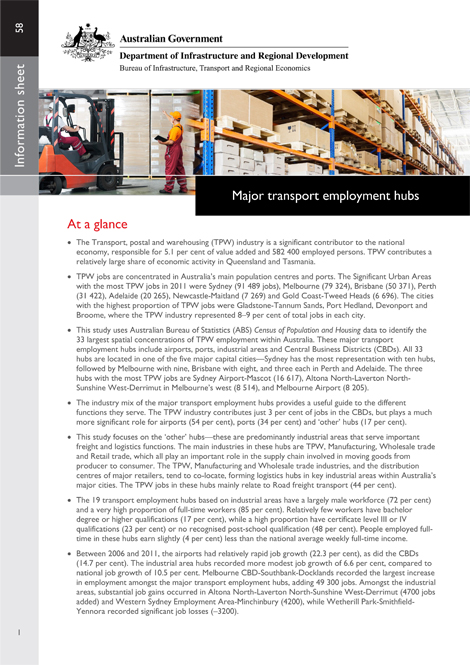
This Information Sheet identifies the 33 largest spatial concentrations of transport industry employment within Australia. These major transport employment hubs are all located within the five most populous capital cities and include airports, ports, CBDs and a range of industrial areas. This study presents evidence on the number of jobs located in each of these transport employment hubs, the industry mix of those jobs, and the characteristics of workers in each location. In particular, it focuses on investigating the nature of employment in the industrial area hubs, many of which serve important freight and logistics functions.
- Major transport employment hubs
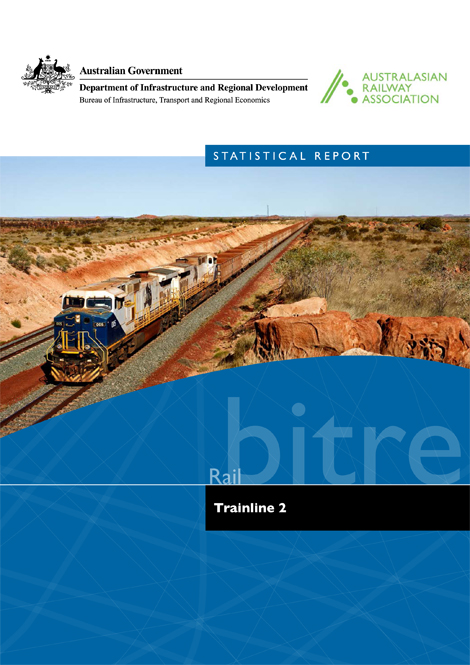
Trainline 2 is a collaborative report between the Australasian Railway Association (ARA) and BITRE. It is a further development of the previous rail freight performance publications series and Trainline 1.
The report provides an overview of freight, urban and non-urban passenger rail. Traffic levels, infrastructure and rolling stock provision and railway performance are considered.
Australian road freight estimates: 2014 update
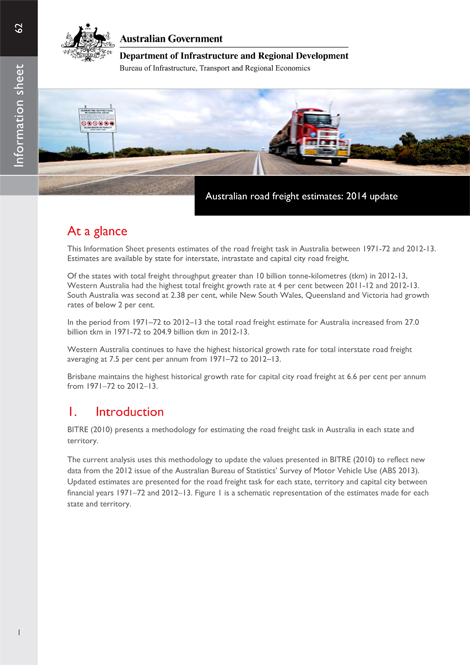
This information sheet provides updated road freight estimates previously reported in Chapter 2 of BITRE Research Report 121. It gives estimates for interstate, intrastate, capital city and total road freight for each state/territory for the period between 1971–72 and 2012–13.
- Australian road freight estimates: 2014 update
Australian sea freight 2012-13
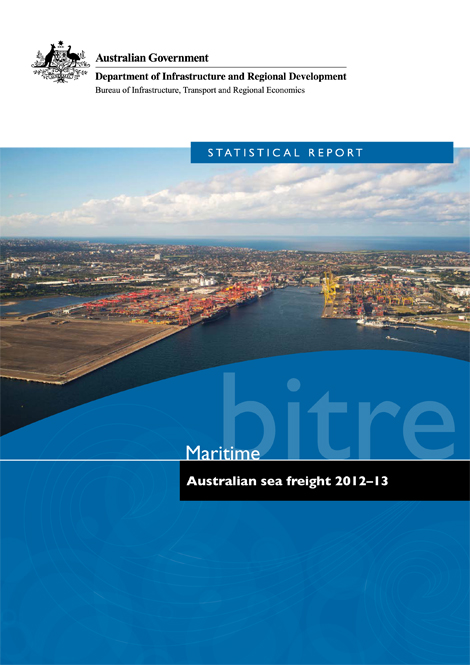
This is the latest in a series of BITRE reports that presents statistics on maritime freight in Australia and shows the trend of Australian sea freight over the most recent 10 years. The information presented comprises international and coastal freight statistics, the use of coastal voyage permits, vessel activity at Australian ports and the size and composition of the Australian trading fleet from 2003-04 to 2012-13.
Waterline 54—August 2014
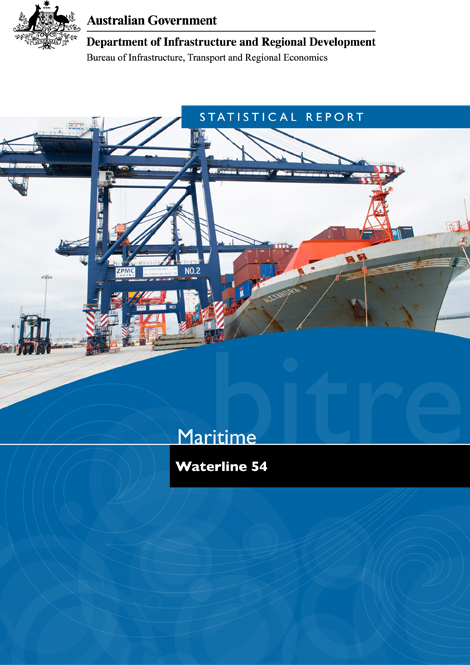
Waterline reports on trends in throughput, container handling productivity on the waterfront and landside of ports in Australia, and the cost of importing and exporting containers. It covers the unloading of container ships and the transport of containers from container terminals. In Waterline 54, rail throughput data provided by port authorities is incorporated in calculating the throughput and productivity indicators. This issue covers port terminal activity up to the December quarter 2013.
Infrastructure, transport and productivity
This information sheet reviews trends in Australian productivity with a focus on the transport sector.
Well targeted investments in transport infrastructure result in productivity increases that benefit many other industries. The paper provides for specific examples that cover trucks, freight, waterfront and rail productivity enhancements.
- Infrastructure, transport and productivity
Freightline 1—Australia freight transport overview
The Freightline series is intended to provide information on interregional freight movements across Australia, filling a major gap in Australian transport-related data and information, to help better inform and support policy development and infrastructure planning. The Freightline series begins with a broad overview of the freight task, followed by separate commodity-specific issues that provide more detailed information about the size and location of major freight movements, supply chain composition and key infrastructure components. Freightline 1 (this issue) provides a broad overview of freight movements in Australia, highlighting some of the major commodity flows.
- Freightline 1–Australia freight transport overview
Freightline 2—Australia iron ore freight transport
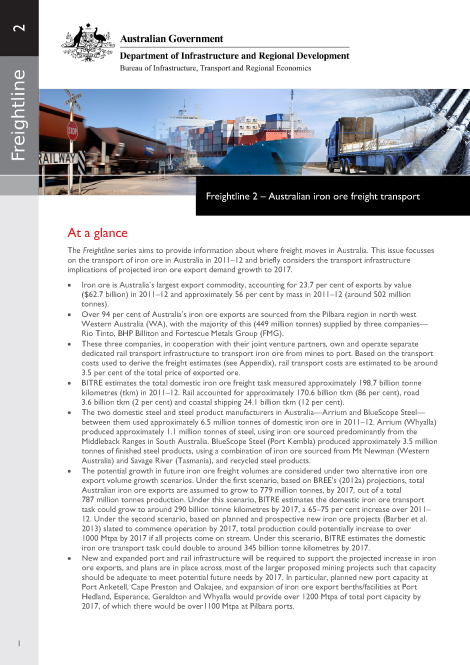
The Freightline series is intended to provide information on interregional freight movements across Australia, filling a major gap in Australian transport-related data and information, to help better inform and support policy development and infrastructure planning. The Freightline series begins with a broad overview of the freight task, followed by separate commodity-specific issues that provide more detailed information about the size and location of major freight movements, supply chain composition and key infrastructure components. Freightline 2 (this issue) focusses on Australian iron ore transport supply chains and freight movements in 2011–12.
- Freightline 2–Australia iron ore freight transport
Waterline 53—January 2014
Waterline reports on trends in throughput, container handling productivity on the waterfront and landside of ports in Australia and the cost of importing and exporting containers. It covers the unloading of container ships and the transport of containers from container terminals. In Waterline 53, the format of the report has been revised and several new productivity measures have been introduced following consultation with industry. This issue covers port terminal activity up to the June quarter 2013.