
Tasmanian Freight Schemes—Parameter Review 2013
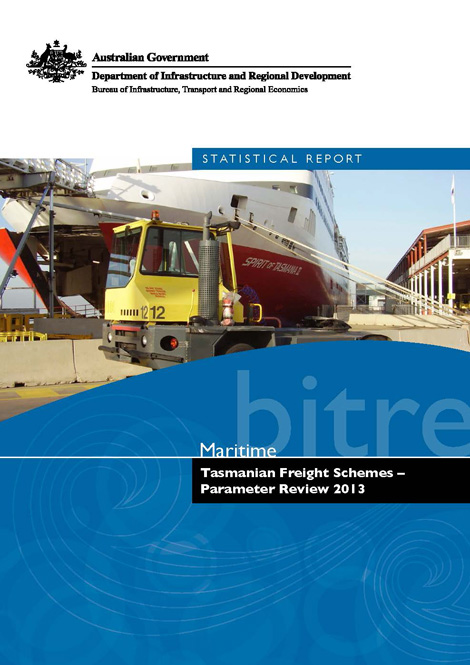
The Tasmanian Freight Equalisation Scheme operates according to Ministerial Directions (2012) using parameters recommended by the TFES Review Authority (1998). The Tasmanian Wheat Freight Scheme operates under separate Ministerial Directions approved on 25 January 2006.
Infrastructure Investment Macromonitor
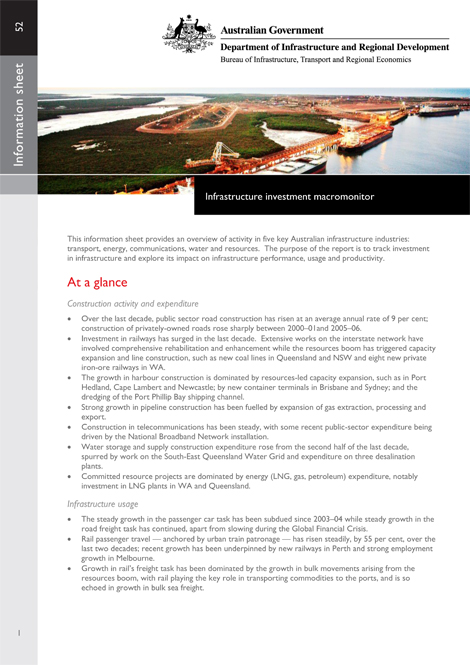
This information sheet provides an overview of activity in five key Australian infrastructure industries: transport, energy, communications, water and resources.
The purpose of the report is to track investment in infrastructure and explore its impact on infrastructure performance, usage and productivity.
- Infrastructure Investment Macromonitor
Tasmanian Passenger and Freight movements
This information sheet provides a summary of Tasmanian passenger and freight movements in 2011–12. It brings together key data about Tasmanian transport from other Bureau publications and unpublished data sources.
- Tasmanian Passenger and Freight movements
Waterline 52—April 2013
This Waterline provides the latest data available on stevedoring productivity and landside performance at Australia's major container ports.
Waterline 51—November 2012
This Waterline provides the latest data available on stevedoring productivity and landside performance. Beginning with this issue, a new wharf side indicator is provided for each port. It measures the average number of crane lifts performed per hour spent in berth by a container ship. Waterline is the main container port performance report referred to in the National Port Strategy.
Australian sea freight 2010–11
This report presents comprehensive statistics on maritime freight in Australia. Compared to past issues that focused on data for the most recent year, this issue contains time series to establish the trend of Australian sea freight statistics over the most recent 10 years from 2001–02 to 2010–11. The information presented comprises international and coastal freight statistics, the use of coastal voyage permits, vessel activity at Australian ports and the size and composition of the Australian trading fleet.
TrainLine 1 is a collaborative report between the Australasian Railway Association (ARA) and BITRE. It is a further development of the previous rail freight performance publications series. This report provides an overview of rail freight performance, railway infrastructure standards and freight haulage between 2007–08 and 2009–10. Further development of the range of information is envisaged.
The report is split into 3 sections that provide freight market, freight train and track indicators.
Relative Efficiencies in the Transportation of Commodities
This Report assesses the relative efficiencies of road and rail in the transportation of several bulk commodities. The work explores potential constraints to the efficient transportation of bulk commodities, including the pricing systems applied by road and rail operators.
- Relative Efficiencies in the Transportation of Commodities
Container and Ship Movements Through Australian Ports: 2007–08 to 2029–30, Preliminary Estimates
Paper given to the 31st Australasian Transport Research Forum, 2 October–3 October 2008, Gold Coast. Authors: Godfrey Lubulwa, Rob Bolin, Ben Slatter, Tony Carmody
- Container and Ship Movements Through Australian Ports: 2007–08 to 2029–30, Preliminary Estimates
Road Freight Estimates by State/Territory
Paper given to the 31st Australasian Transport Research Forum, 2 October–3 October 2008, Gold Coast. Authors: David Gargett, Afzal Hossain
- Road Freight Estimates by State/Territory