
Australian infrastructure statistics—Yearbook 2013 and Key Australian infrastructure statistics booklet
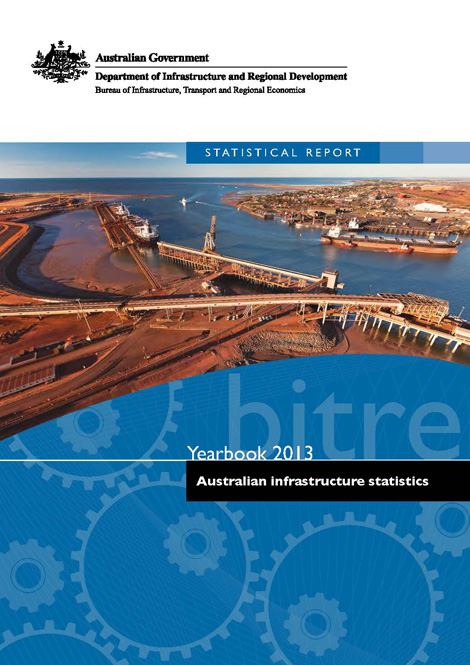
The Yearbook is an important piece of work for the Department and provides a comprehensive evidence base to examine long-term and emerging trends as well as inform policy development and regulatory reform in the transport, energy, water and communications sectors. It is the only comprehensive source of time series statistics for Australia's major areas of economic infrastructure. The Yearbook is accompanied by the first Key Australian Infrastructure Statistics booklet which is a summary of statistics from the Yearbook.
- Yearbook 2013–Australian Infrastructure Statistics
- Key Australian Infrastructure Statistics
- Australian Infrastructure Statistics
Yearbook 2013
Part 1–Infrastructure and the Economy
- Australian Infrastructure Statistics
Yearbook 2013
Part T–Transport
- Australian Infrastructure Statistics
Yearbook 2013
Part E–Energy
- Australian Infrastructure Statistics
Yearbook 2013
Part C–Communication
- Australian Infrastructure Statistics
Yearbook 2013
Part W–Water
Air transport service trends in regional Australia (2013 update)
This information sheet provides a summary of key trends in regional aviation Australia from 1984 to 2012. It is a brief update to Report 130 on Air transport services in regional Australia (2011 update).
- Air transport service trends in regional Australia (2013 update)
Employment Generation and Airports
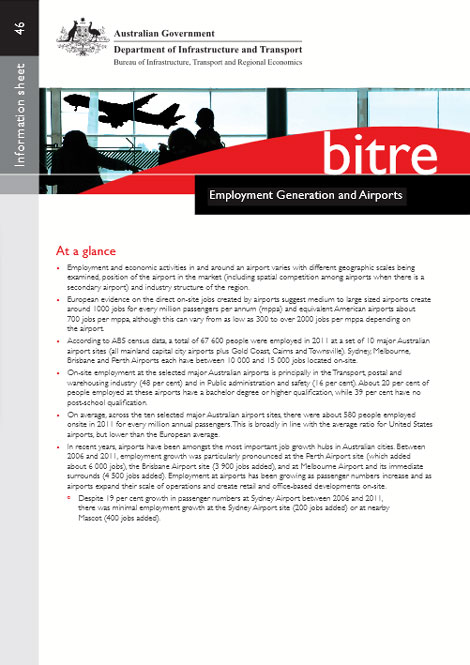
This information sheet provides evidence about the relationship between airport infrastructure and economic activity. It draws together evidence from the international literature and evidence for major Australian airports. It presents estimates of the number of jobs located at major Australian airports in 2011, the industry structure and skill mix of that employment, and recent growth in employment based on the ABS Census of Population and Housing.
- Employment Generation and Airports
Air Passenger Movements Through Capital and Non-Capital City Airports to 2030–31
This report presents forecasts of air passenger movements through Australia's eight capital city airports and five largest non-capital city airports (Newcastle, Cairns, Gold Coast, Townsville and Launceston). The forecasts have been developed using econometric models of domestic and international air passenger travel demand, and incorporating the most recent economic outlook for Australia and its major trading partners. Population, income, airfares, exchange rates and the prices of domestic and overseas travel and accommodation are the principal factors influencing growth in air passenger movements through Australian airports.
- Air Passenger Movements Through Capital and Non-Capital City Airports to 2030–31
Airport traffic data
The files below contain monthly and annual details of passenger and aircraft movement data on scheduled regular public transport services at selected Australian airports.
Australian infrastructure statistics—Yearbook 2012
The Australian Infrastructure Statistics Yearbook provides a single comprehensive source of Australian infrastructure time series statistics for measures of transport, energy, communications and water infrastructure and the use of this infrastructure in Australia. Statistics are presented in a coherent framework that enables comparisons across the four forms of infrastructure and the activities associated with each form of infrastructure.
- Australian Infrastructure Statistics–Yearbook 2012
- Australian Infrastructure Statistics Yearbook 2012
Part I–Infrastructure and the Economy
- Australian Infrastructure Statistics Yearbook 2012
Part T–Transport
- Australian Infrastructure Statistics Yearbook 2012
Part E–Energy
- Australian Infrastructure Statistics Yearbook 2012
Part C–Communication
- Australian Infrastructure Statistics Yearbook 2012
Part W–Water
Brisbane Airport: Interim Report on International Terminal
This Report represents part of a full-scale study by BTE, at the direction of the Minister for Transport, of the development requirements for Brisbane Airport. The full report will be issued at a later date and will present a detailed examination of the civil aviation requirements of the region and the appropriate expansion/replacement program.
- Brisbane Airport: Interim Report on International Terminal
Deregulation of Domestic Aviation—The First Year
The Commonwealth's regulation of interstate aviation, in place for over thirty years, came to an end at midnight on 30 October 1990. This study reviews the developments in the last few months of regulation and in the first year of deregulation.
- Deregulation of Domestic Aviation–The First Year
Air Transport Service Trends in Regional Australia—2011 update
This report updates and supersedes the time series statistics presented in Report 115 and Information sheet 35 on Air transport services in regional Australia: trends and access. It updates the data (to 2012) and the geographic basis of the analysis.
- Air Transport Service Trends in Regional Australia–2011 update
Avline provides a summary of previously released Aviation related data drawing on a range of sources including BITRE, ABS, Airservices Australian and the US Energy Information Administration. In addition, Avline provides a comparison of published airport charges at the five major capital city airports and at a selection of regional airports. Avline 2010–11 covers the financial year 2010–11 and is the third of the series to be published annually instead of biannually.