
Australian Transport Statistics 2008—pocket booklet
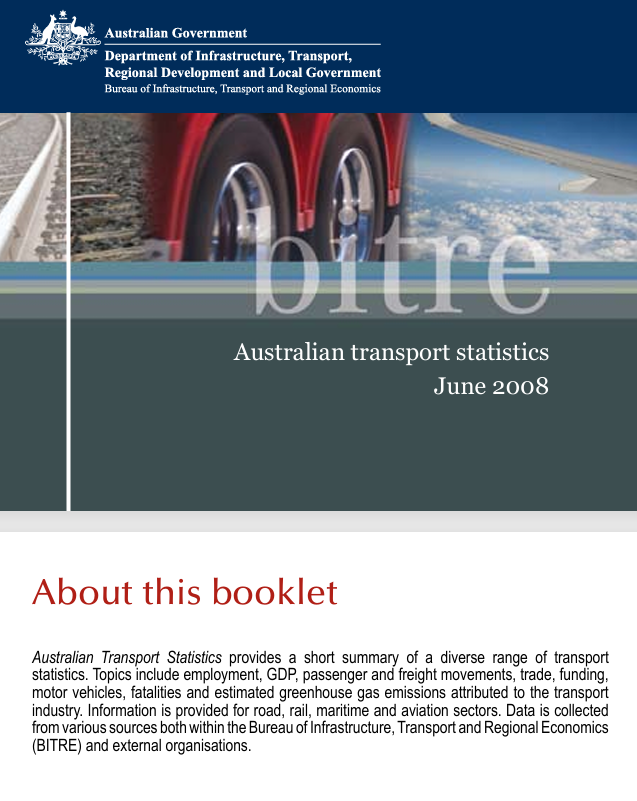
Australian Transport Statistics provides a short summary of a diverse range of transport statistics. Topics include employment, GDP, passenger and freight movements, trade, funding, motor vehicles, fatalities and estimated greenhouse gas emissions attributed to the transport industry.
How do fuel use and emissions respond to price changes? Briefing—1
The first in a new series of BITRE publications, this briefing reviews the responses that have been seen in Australian transport to recent fuel price rises (vehicle sales moving to smaller, more fuel efficient cars, more urban public transport, etc). The responsiveness of the various transport sectors is reviewed, as is the responsiveness of Australia relative to the United States.
- How do fuel use and emissions respond to price changes?
Moving urban Australia: can congestion charging unclog our roads?
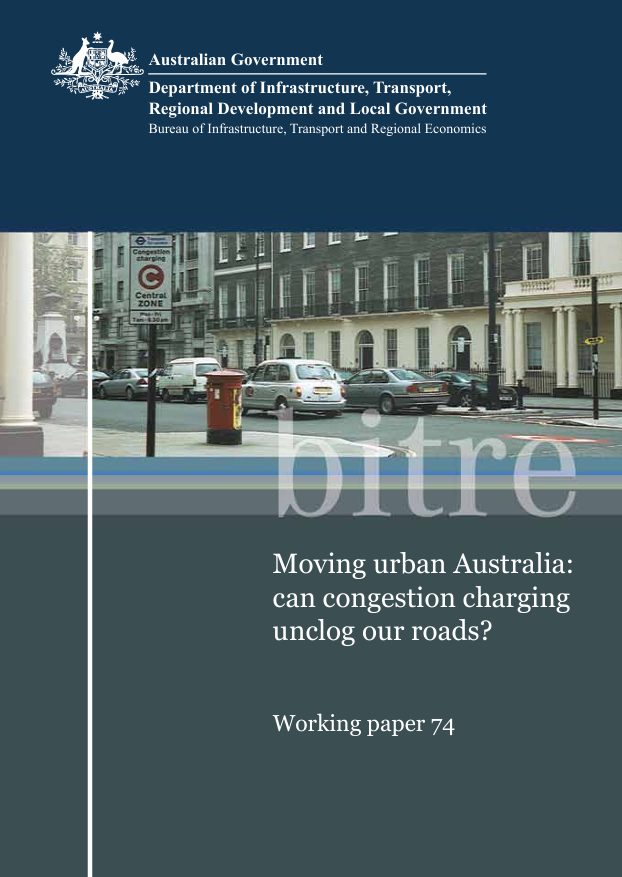
This report reviews the case for congestion charging and provides a policy framework for assessing charging systems. Congestion charging schemes are still in their infancy and evolving in concert with changing policy priorities and system technologies. While individual circumstances determine when and where congestion charging is in the interest of the wider community, some important general lessons can be drawn.
Update August 2009
Responses to the discussion of personalised promotion of alternatives to solo driving (pages 26–7), as one of the existing strategies to manage congestion, have drawn our attention, firstly, to some larger-scale current initiatives of Australian jurisdictions and, secondly, to more recent literature on the effectiveness of the travel behaviour change approach in relation to its various objectives, particularly reducing motorised trips and reducing greenhouse gas emissions.
For information on existing activities in 2 states, see About Travelsmart and Travelsmart General Information. On the effectiveness and impact of the travel behaviour approach, as implemented in Australia and the United Kingdom, see in particular: Australian Greenhouse Office, Evaluation of TravelSmart Projects in the ACT, South Australia, Queensland, Victoria and Western Australia 2001–2005, Department of Environment and Heritage 2006; Brog W. And Ker I., Myths, (Mis)perceptions and reality in measuring voluntary behaviour change, 8th International Conference on Survey Methods in Transport, Annecy, France, May 2008; Department for Transport (United Kingdom), Making Personal Travel Planning Work: Research Report, Integrated Transport Planning Ltd, December 2007; Department for Transport (United Kingdom), Impact assessment of the carbon reduction strategy for transport, July 2009; and Stopher P., Clifford E., Halling B., Evaluating a voluntary travel behaviour change by means of a 3-year GPS panel, Proceedings of the TDM2008 Conference, Vienna, Austria (forthcoming).
Modelling the Road Transport Sector
This report was prepared by BITRE and CSIRO, in discussion with Treasury, to provide additional information on the road transport sector modelling carried out jointly by the two agencies in support of Treasury's broader modelling of the introduction of emissions trading in Australia.
- Modelling the Road Transport Sector
Improving urban congestion information for decision making: report to COAG from the Australian Transport Council
In April 2007, COAG considered the Urban Congestion Review it had commissioned in February 2006, and tasked the Australian Transport Council (ATC) with establishing arrangements to improve urban congestion data, modelling and performance information for decision-making. The following document, 'Improving Urban Congestion Information for Decision-Making', is a progress report to COAG of mid-2008. At its 7 November 2008 meeting, ATC noted further progress with implementing agreed approaches, including establishing a National Transport Modelling Working Group, progressing improved consistency between road-based and public transport congestion indicators, a survey of business sector travel, and analyses of specific congestion initiatives.
- Improving urban congestion information for decision making: report to COAG from the Australian Transport Council
Freight Rates in Australia 1964–65 to 2007–08
This Information Sheet provides indexed trends in average interstate non-bulk freight rates, from 1964–65 to 2007–08, updating the freight rate indexes previously published in Freight Rates in Australia, Information Sheet 19 (BTRE 2002). The estimates show that, following generally declining real freight rates over the previous two decades, real freight rates for road, rail and long-distance coastal shipping have risen since 2000–01 (Table 1 provides nominal and real indexed freight rate series and Figures 1 to 4 illustrate indexed trends in real freight rates). Recent increases in crude oil prices, and flow through to diesel fuel prices, have been an important contributing factor in recent freight rate increases for road, rail and coastal shipping.
- Freight Rates in Australia 1964–65 to 2007–08
National road network intercity traffic projections to 2030
This report provides long-term passenger and freight vehicle traffic projections for intercity corridors of the National Land Transport Network (NLTN) between 2005 and 2030.
- National road network intercity traffic projections to 2030
Urban Congestion Working Group: Australian Capital City Congestion Management Case Studies
This document presents a number of case studies by Australian jurisdictions on interventions they have undertaken to alleviate urban congestion pressures across their transport systems. Good congestion interventions can lead to significant improvements in congestion management and economic, environmental and social savings.
- Urban Congestion Working Group: Australian Capital City Congestion Management Case Studies
Road and Rail Freight: Competitors or Complements?
Up until the early 1960s, railways dominated all but the shortest land-based freight task. Since then, vast improvements in road vehicle productivity and road infrastructure quality, the gradual removal of regulations restricting road freight carriage and the exponential growth in interstate trade has broadened the range of freight tasks for which road is better suited than rail.
Fuel Consumption by New Passenger Vehicles in Australia 1979–2008

BITRE has examined trends in the fuel consumption of new passenger vehicles sold in Australia. Up to 2001, technological advances in engine technology, which improved fuel efficiency, were offset by increases in power, weight and the popularity of 4WD vehicles. Since 2001 the overall trend in fuel consumption has continued to decrease with average new light vehicle fuel consumption down 8.4 per cent to 8.14 litres per 100 kilometres (L/100 km).
- Fuel Consumption by New Passenger Vehicles in Australia 1979-2008