
Social Cost of Road Crashes
Updated content: this report replaces the version uploaded on Friday 14 October. Text and chart changes have been made to the report’s section on age.
The Australian National University (ANU) was engaged by the Bureau of Infrastructure and Transport Research Economics (BITRE) to develop a model to estimate the social cost of road crashes in Australia. The current study replicates and extends the previous BITRE costing study (BITRE, 2009) by using current data, improved methods and broader scope of analysis, including analysis of who bears the burden of road crashes. The current study also set out to aid in addressing three policy questions posed by BITRE by drawing on results of the costing study as well as a rapid review of relevant literature.
The ANU research team members include Emily Lancsar, Ralf Steinhauser, Siobhan Bourke, Robert Breunig, Russell Gruen, Leo Dobes, Liza Munira, Liliana Bulfone, Kathryn Glass, Cameron Gordon, and Jolene Cox.
The BITRE team was Tim Risbey and Dr Gary Dolman, with key contributions from Dr Mark Harvey, Leo Soames and Simon O'Mahony, and Neil Thompson from the Office of Road Safety.
BITRE greatly appreciated the assistance of stakeholders who provided data, participated in the two project workshops, and provided comments on the draft report.
Freight Data Exchange pilot projects—Summary Report 2020
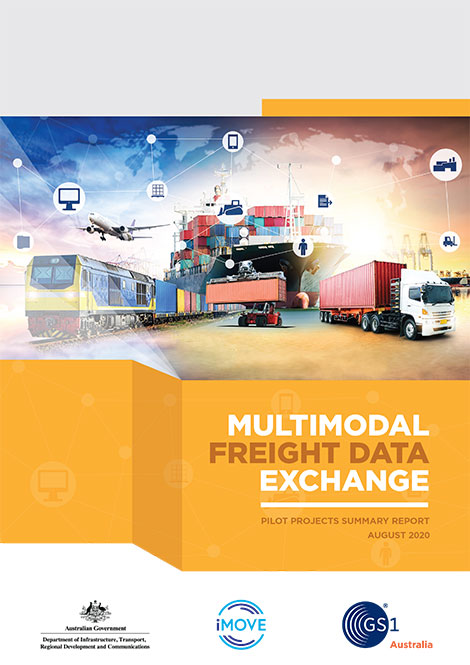
Information technology and data are increasingly essential to modern business operations. The increasing digitalisation of supply chain processes and freight consignment information offers further opportunities to increase the efficiency and productivity of Australian freight supply chains.
For industry, increasing digitalisation can improve visibility of freight consignments and interoperability between supply chain partners, and aid industry in responding to supply chain delays, bottlenecks or errors – and thereby improve overall freight industry efficiency and productivity. For governments and transport planning agencies, the increasing digitalisation of freight supply chain information can potentially provide more timely strategic-level information to help inform planning and investment, and at less cost.
In 2019-20, the Australian Government, in cooperation with iMOVE and selected industry partners, undertook an initial round of Freight Data Exchange pilot projects to investigate, develop and demonstrate the capability for supply chain partners to share freight consignment information in real time and also assess the feasibility of aggregating freight consignment event/message data to produce aggregate outputs that help inform infrastructure planning and policy priorities.
This report briefly outlines some of the key outcomes of the three projects and suggests directions for further work.
The report was produced in collaboration between BITRE and iMOVE Australia, and with the support and assistance of participating industry partners.
General Aviation Study
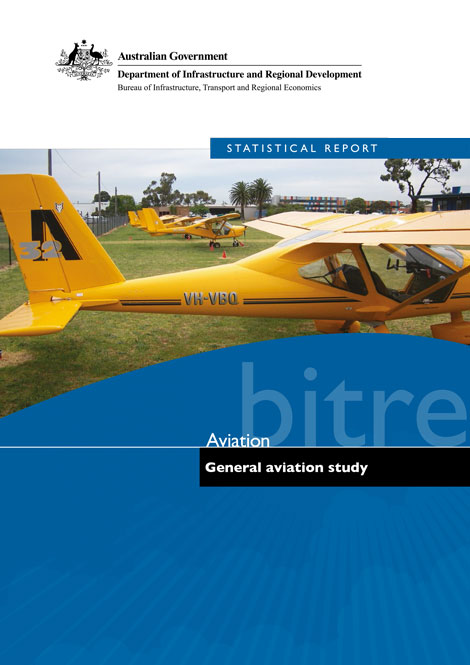
General aviation is a diverse sector that is undergoing change. While overall GA activity appears to be declining slowly, it is not accurate to say that all parts of GA are declining.
Those parts of GA that are discretionary in nature, such as pleasure flying, appear to decline in more conservative economic times, while those parts of GA that are a key part of an expanding industry, such as aerial mustering, have been growing strongly. Detailed economic analysis of these relationships is not currently possible due to the current lack of financial statistics for GA, however this report outlines some of the key challenges facing GA and identifies some key opportunities for the industry and Government to respond to these challenges.
- General Aviation Study
Infrastructure benchmarking report
Australian, State and Territory Governments are committed to improving the infrastructure that is critical to efficient, productive and equitable operations of our economy. Achieving this objective requires efficient procurement processes and careful examination of costs to ensure value for money in infrastructure investments. Governments have cooperated to conclude the first national pilot benchmarking of infrastructure procurement processes and construction costs (as recommended by the 2014 Productivity Commission Inquiry into Public Infrastructure and agreed by the Council on 28 August 2014). This report covers the findings of the initial benchmarking and outlines plans for continued and improved future monitoring of infrastructure procurement performance and construction costs.
The analysis was undertaken by the Bureau of Infrastructure, Transport and Regional Economics (BITRE) for the Infrastructure Working Group of the Transport and Infrastructure Council. The report is also available on the Transport and Infrastructure Council website.
- Infrastructure Benchmarking Report
Developing productivity elasticities for estimating WEBs in Australia—Scoping Study
Estimates of Wider Economic Benefits (WEBs) are increasingly featuring in cost-benefit analyses (CBAs) of major urban transport infrastructure projects. Governments are particularly interested in WEBs because they relate to productivity. The parameters used to estimate WEBs in Australia to date have been estimated using methodologies that are inconsistent and not in line with international best-practice. Thus the reliability and comparability of WEBs estimates in Australian CBAs is questionable. The report proposes a way to develop a robust set of parameters for practitioners to use when estimating WEBs.
The report was commissioned by BITRE on behalf of Steering Committee oversighting the Review of the National Guidelines for Transport System Management. If a robust set of parameters can be developed, it will be published in the Guidelines. BITRE engaged consultants KPMG to undertake the task.
- Developing productivity elasticities for estimating WEBs in Australia–Scoping Study
A study of the potential for dedicated freight infrastructure in Australia
The National Ports Strategy was developed by Infrastructure Australia (IA) and the National Transport Commission (NTC) in 2010 at the request of the Council of Australian Governments (COAG).
Recommendation 3.10 of the National Ports Strategy is that 'The Bureau of Infrastructure Transport and Regional Economics (BITRE) should assess the conditions under which the introduction of dedicated freight land transport infrastructure segments related to relevant container ports would be justified'. BITRE engaged consultants Ernst & Young to undertake the task.
The project involved a literature search with a review of overseas experiences, stakeholder consultation, identification of potential projects, and rapid cost–benefit and financial analyses of two case study projects to assess their potential viability.
The project concerned access to major Australian container ports only–Sydney, Melbourne, Brisbane, Adelaide and Fremantle. The term 'dedicated freight land transport infrastructure segments' has been interpreted broadly. It encompasses freight-only road and rail segments, tunnels, and lanes, but extends to infrastructure investments with a freight priority, for example, a road open to freight vehicles at all times but open to cars only during peak hours to relieve congestion.
Part A of the report contains the literature review, principles under which dedicated or priority freight infrastructure might be warranted, a survey of the landside access challenges facing major Australian container ports, and identification of potential case studies for further investigation.
Part B consists of the two case studies
- a new road link between the Port of Melbourne precinct and the West Gate Freeway, and
- a new rail link between the Port of Brisbane and the Surat Basin, which would carry coal and containers.
It should be noted that these are concept projects specified for the purposes of the case studies. They are not intended to replicate actual proposals previously or currently under consideration.
- A study of the potential for dedicated freight infrastructure in Australia
Urban Pollutant Emissions from Motor Vehicles: Australian Trends to 2020
This report presents the results of a BTRE study to estimate likely future levels of noxious pollutant emissions from motor vehicles in Australian metropolitan areas.
Appropriateness of a 350 Million Litre Biofuels Target
In July 2003 the Commonwealth Scientific and Industrial Research Organisation, jointly with BTRE and the Australian Bureau of Agricultural and Resource Economics, were asked to investigate the appropriateness of maintaining an objective that biofuels, produced in Australia from renewable resources, contribute at least 350 ML to the total fuel supply by 2010. The joint study was initiated on 5 August 2003 with a final report required to be delivered on 19 December 2003. "Appropriateness" was to be considered in terms of net environmental benefits, net economic benefits, net regional benefits and industry viability. In turn, industry viability was to take into account announced reforms to fuel tax arrangements, including the phase out of effective excise relief.
- Appropriateness of a 350 Million Litre Biofuels Target
Impact of climate change on road infrastructure
There is an increasing body of evidence that the earth's climate is changing with some of the changes attributable to human activities. Climate change can have direct and indirect impacts on road infrastructure.
- Impact of climate change on road infrastructure
Greenhouse Gas Emissions From Australian Transport: Base Case Projections to 2020
This report presents the results of a Bureau of Transport and Regional Economics (BTRE) study to update base case projections of greenhouse gas emissions from the Australian transport sector. This work updates previous projections provided to the Australian Greenhouse Office (AGO) in July 2003 as an unpublished consultancy report–Aggregate Greenhouse Gas Emissions from Australian Transport: Base Case Projections (Bottom-Up Approach) to 2020.
- Greenhouse Gas Emissions From Australian Transport: Base Case Projections to 2020