
This Excel sheet provides summary series of hospitalised injuries (injury resulting in confirmed admission to hospital, but not in-hospital death) from road traffic crashes from calendar years 2011 to 2021. These series are produced by the Road Safety Data Hub using data sourced from the Australian Institute of Health and Welfare, with that raw data also included in the file.
The latest 2023 updates have added new data for 2020 and 2021, and new detailed tables on States and Territories:
Developing national road safety indicators for injury
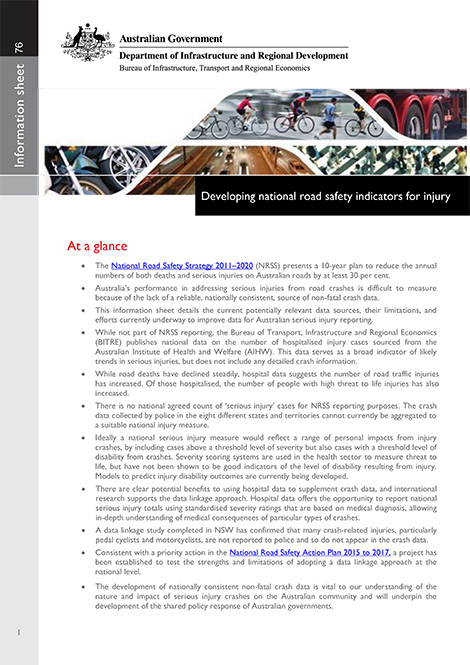
The National Road Safety Strategy 2011–2020 (NRSS) presents a 10-year plan to reduce the annual numbers of both deaths and serious injuries on Australian roads by at least 30 per cent.
Australia's performance in addressing serious injuries from crashes is difficult to measure because of the lack of a reliable, nationally consistent, source of non-fatal crash data.
This information sheet details the current data sources, their limitations, and efforts currently underway to improve data for serious injury reporting.
- Developing national road safety indicators for injury
Australian cycling safety
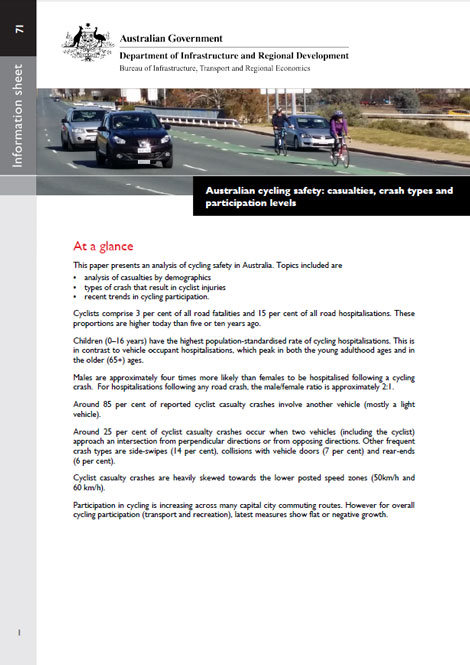
In this paper, several sources of bicycle crash data and exposure data are used to provide an overview of cycling safety and data sources in Australia. Recent trends are identified. Section 1 presents latest casualty and fatality statistics, including tabulations by jurisdiction and age group. Section 2 presents analyses of crash type, vehicles-involved and location characteristics for crashes involving a cyclist casualty, and Section 3 explores recent Australian cycling exposure data.
- Australian cycling safety
Pedestrians and road safety
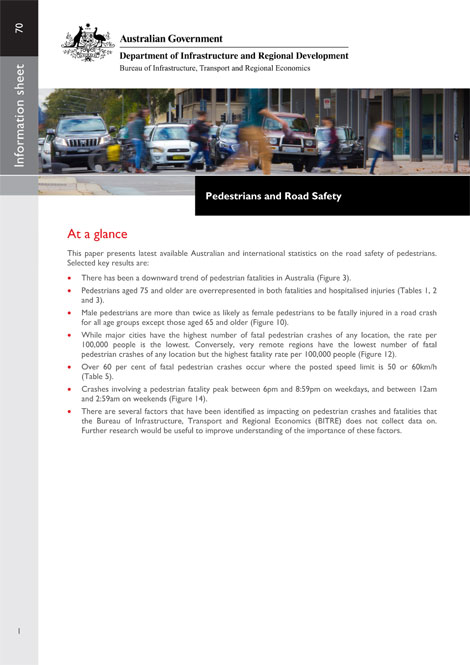
Pedestrians comprise the largest single road user group because almost everyone is a pedestrian at some point. People walk for leisure, to go to work, school or local shops, and to access other modes of transport. In Australia, there has been a consistent downward trend in total road fatalities, including pedestrian fatalities. Since 2005, pedestrian fatalities as a percentage of all road fatalities have remained relatively stable.
- Pedestrians and road safety
The impact of airbags and electronic stability control on Australian light vehicle fatalities
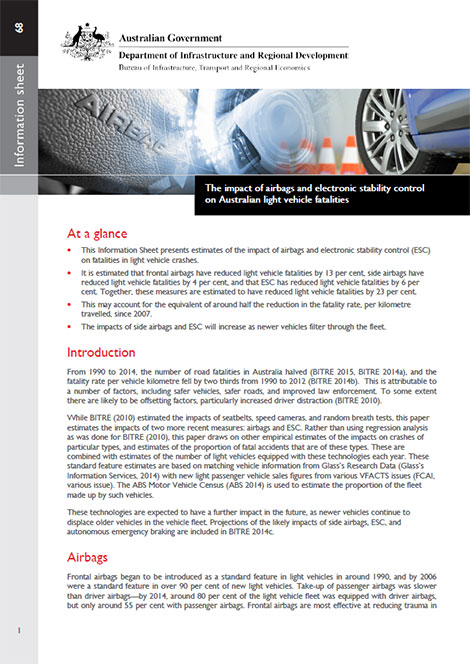
This Information Sheet presents estimates of the impact of airbags and electronic stability control (ESC) on fatalities in light vehicle crashes. It is estimated that frontal airbags have reduced light vehicle fatalities by 13 per cent, side airbags have reduced light vehicle fatalities by 4 per cent, and that ESC has reduced light vehicle fatalities by 6 per cent. Together, these measures are estimated to have reduced light vehicle fatalities by 23 per cent. This may account for the equivalent of around half the reduction in the fatality rate, per kilometre travelled, since 2007. The impacts of side airbags and ESC will increase as newer vehicles filter through the fleet.
- The impact of airbags and electronic stability control on Australian light vehicle fatalities
Archived Road Deaths In Crashes Involving Heavy Vehicles—Quarterly Bulletins
Older issues of Road Deaths In Crashes Involving Heavy Vehicles – Quarterly Bulletins are available below.
Formerly entitled ‘Fatal heavy vehicle crashes Australia—Quarterly Bulletins’.
- Apr-Jun 2024
- Jan-Mar 2024
- Oct-Dec 2023
- Jul-Sep 2023
- Apr-Jun 2023
- Jan-Mar 2023
- Oct-Dec 2022
- Jul-Sep 2022
- Apr-Jun 2022
- Jan-Mar 2022
- Oct-Dec 2021
- Jul-Sep 2021
- Apr-Jun 2021
- Jan-Mar 2021
- Oct-Dec 2020
- Jul-Sep 2020
- Apr-Jun 2020
- Jan-Mar 2020
- Oct-Dec 2019
- Jul-Sep 2019
- Apr-Jun 2019
- Jan-Mar 2019
- Oct-Dec 2018
- Jul-Sep 2018
- Apr-Jun 2018
- Jan-Mar 2018
- Oct-Dec 2017
- Jul-Sep 2017
- Apr-Jun 2017
- Jan-Mar 2017
- Oct-Dec 2016
- Jul-Sep 2016
- Apr-Jun 2016
- Jan-Mar 2016
- Oct-Dec 2015
- Jul-Sep 2015
- Apr-Jun 2015
- Jan-Mar 2015
- Oct–Dec 2014
- Jul–Sep 2014
- Apr–Jun 2014
- Jan–Mar 2014
- Oct–Dec 2013
- Jul–Sep 2013
- Apr–Jun 2013
- Jan–Mar 2013
- Oct–Dec 2012
- Jul–Sep 2012
- Apr–Jun 2012
- Jan–Mar 2012
- Oct–Dec 2011
- Jul–Sep 2011
- Apr–Jun 2011
- Jan–Mar 2011
- Oct–Dec 2010
- Jul–Sep 2010
- Apr–Jun 2010
- Jan–Mar 2010
- Oct–Dec 2009
- Jul–Sep 2009
- Apr–Jun 2009
Impact of road trauma and measures to improve outcomes
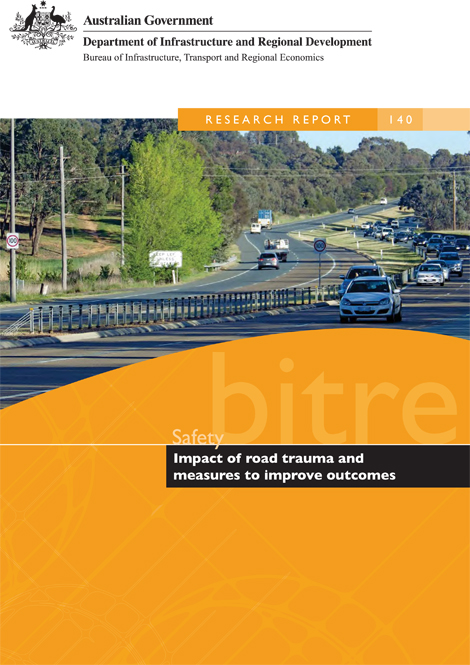
Report 140 presents the results of a BITRE review of the impacts of road trauma. This review evaluated different road safety approaches, both internationally and domestically, and provided a timely stock take of ways that road safety experts believe deaths and serious injuries on our roads can be reduced.
Internationally, the annual number of road deaths fell nearly 40 per cent between 2000 and 2012. However, there has been limited success in saving lives among vulnerable road users, and the share of fatalities among elderly road users is slowly increasing in many countries.
In 2008, International Transport Forum and the Organisation for Economic Co-operation and Development published a research report Towards Zero: ambitious road safety targets and the Safe System approach, which was the first international effort in defining and promoting the adoption by all countries of a Safe System approach.
Australia was amongst the first to adopt a Safe System approach, which underpins the National Road Safety Strategy 2011–2020 (NRSS).
In Australia significant progress has been made towards the NRSS target of a 30 per cent reduction in casualties. While vehicle occupant deaths have trended down, the analysis confirms the relatively high risk for motorcyclists, pedal cyclists, older drivers and remote communities. This, combined with population increases, makes the search for new ways to further reduce road trauma even more challenging.
BITRE has focused on four priorities identified by road safety experts: infrastructure, intersections, distraction from mobile phones, and autonomous emergency braking. The report found:
- Roadside barriers, median barriers and rumble strips reduce road trauma. To maximise road safety benefits they need to be implemented taking account of road conditions.
- Lower speed limits can be a valuable option to help achieve improved road safety outcomes where low traffic volumes mean upgrades are not currently economically justified.
- Intersection treatments can be very effective, with roundabouts particularly effective–reducing casualty crashes by over 70 per cent.
- There is value in a comprehensive mobile phone strategy.
- Autonomous emergency braking will save lives as it is introduced to the vehicle fleet.
The Bureau is grateful for the help of road safety experts who participated in both the survey and workshop to identify new measures with the most potential to further reduce road trauma.
- Impact of road trauma and measures to improve outcomes
Road safety of older Australians: recent statistics
This information sheet collates the latest available national data on casualty road crashes involving older Australians.
Population data in Table 3 was amended in January 2016.
- Road safety of older Australians: recent statistics
Road Trauma Involving Heavy Vehicles—Annual Summaries
This report presents detailed information on fatal crashes involving heavy vehicles and forms an important part of the evidence base. See also the Quarterly bulletins.
Latest Year: 2021
- Road Trauma Involving Heavy Vehicles 2021 - Dashboard
2021 : At a glance
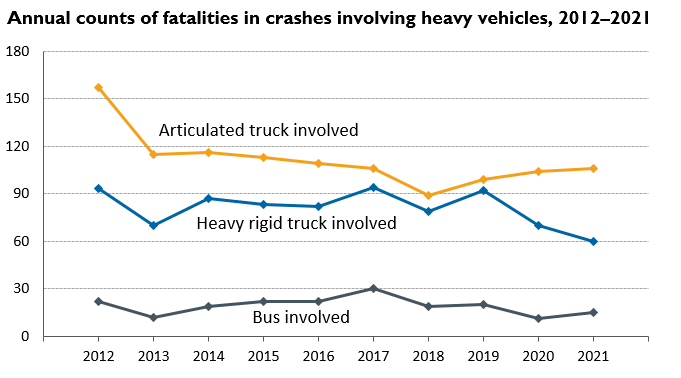
Annual counts of fatalities in crashes involving heavy trucks, 2012–2021
- In 2021, a total of 163 people were killed in crashes involving heavy trucks. This represents 15.4 per cent of total road deaths.
- Of the people killed in these fatal crashes, approximately 50 per cent are occupants in a light vehicle, 25 per cent are occupants in the heavy truck and 25 per cent are other road users (pedestrian, motorcyclist or pedal cyclist).
- The latest hospitalisation data (2019) shows that approximately 510 heavy truck occupants are hospitalised from road crashes each year.
Annual counts of fatalities in crashes involving a bus, 2012–2021
- There was a total of 15 people killed in crashes involving a bus. The trend over the last three years shows a reduction of 13.4 per cent per year.
- Of the people killed in these bus-involved fatal crashes, approximately 11 per cent are occupants of the bus, 33 per cent are occupants of a light vehicle and 57 per cent are other road users.
- Approximately 254 bus occupants are hospitalised from crashes each year.
Data presented in this publication was correct as at January 2023. Due to normal ongoing revisions in road deaths data, comparisons between this publication and later reports will result in minor discrepancies.
Archives
Road safety: modelling a global phenomenon
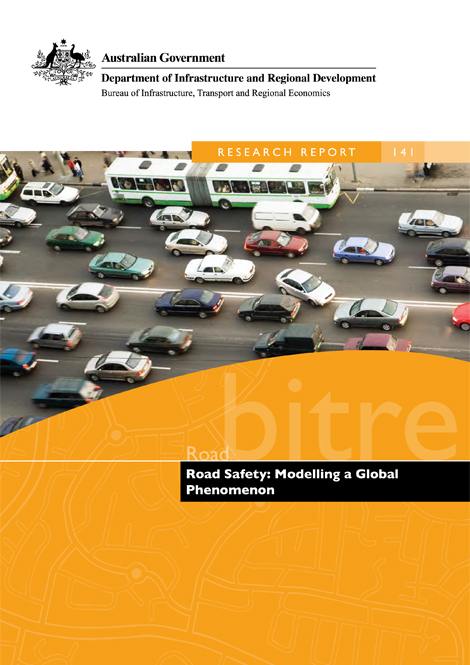
This report provides an overview of the different patterns of road fatality and injury rates in 21 countries, and their determinants.
The main result of the study are models of road fatality rates as a function of seat belt wearing rates, enforcement activities regarding speed (using speed cameras) and alcohol (with random breath testing), and economic influences (principally unemployment). Experience from around the world also shows that laws lowering speed limits and legal blood alcohol limits are effective in saving lives.
- Road safety: modelling a global phenomenon