
Modelled Road Construction and maintenance Price Index
This information sheet presents estimates of the BITRE Road Construction and maintenance Price (RCMP) from 1910-11 and a model of its movements tied to the Australian diesel price, average weekly earnings and the capital expenditure to GDP ratio. Also included is a forecast to 2030.
- Modelled Road Construction and maintenance Price Index
Traffic on the national road network, 2013–14
This Information Sheet presents 2013–14 road traffic volumes across the Australian National Land Transport Network (NLTN)–the integrated network of land transport linkages of strategic national importance. It is an update on estimates presented for 2011–12 in BITRE Information Sheet 63.
- Traffic on the national road network, 2013–14
This paper provides an overview of toll roads in Australia based on available information. It covers a range of subjects including information on traffic performance, industry structure and benefits of toll roads and future challenges.
- Toll Roads in Australia
The research provides a solid evidence-base to understand who is undertaking lengthy commutes (those longer than 45 minutes one way), their prevalence and trends. It also explores whether some individuals undertake lengthy commutes for long periods or whether it tends to be temporary.
- Lengthy commutes in Australia
- Data figures from report 144
New passenger vehicle fuel consumption trends, 1979 to 2013
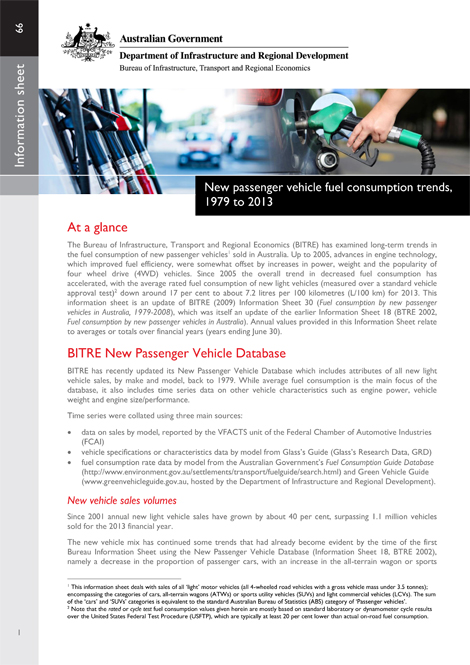
The trends evident in BITRE's earlier Information Sheet (BITRE 2009) have continued since 2008. Vehicle sales have increased, with the SUV and LCV categories continuing to increase their shares. With the introduction of compact and more fuel-efficient 4WDs, the growing SUV category has shown a considerable reduction in rated fuel consumption. LCV sales have also been increasing, though not as strongly as SUVs, along with a similarly decreasing level (since about 2006) in rated fuel consumption.
In the past (before 2008), Australian consumers' preference for vehicle characteristics that typically increased fuel consumption (such as higher power, larger size, more accessories or 4WD capability), meant that potential reductions in fuel consumption made possible by technological advances were not fully realised. This has been a worldwide trend in the automobile sector. However, that said, the long-term downward trend in energy intensity has increased in recent years as the latest generation of more fuel efficient light vehicles (including hybrids) entered the market, and with some buyers moving to smaller vehicles as petrol prices rose. The result has been a marked acceleration, over recent years, of the downward trend in the rated fuel consumption (tested L/100km) of new vehicles sold.
- New passenger vehicle fuel consumption trends, 1979 to 2013
Traffic on the national road network, 2011–12

This Information Sheet presents recent road traffic volumes across the Australian National Land Transport Network in 2011–12, based on data provided by States and Territories. It includes charts showing volumes of heavy and light vehicle traffic for all 21 non-urban corridors, and maps for the urban corridors.
- Traffic on the national road network, 2011–12
Urban public transport: updated trends
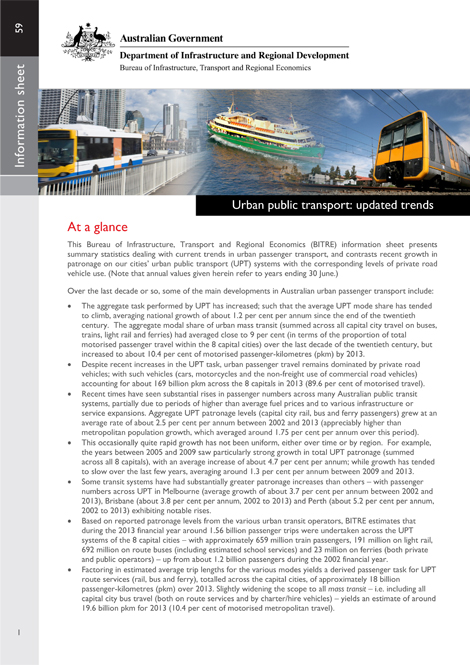
BITRE Information Sheet 59 summarises recent trends in Australian urban passenger transport–contrasting strong growth in urban public transport (UPT) over the last decade (with 2013 task levels almost 30 per cent higher than 2004) with that of private road vehicle use (with car travel in 2013 only about 3 per cent higher than 2004). Details or trend statistics are provided, across the State and Territory capital cities, for modal composition, travel growth rates, UPT cost recovery and transit service levels.
- Urban public transport: updated trends
- Urban Transport Summary for 2013
- Latest urban transport statistics
Who's using the roads: variations in usage by drivers
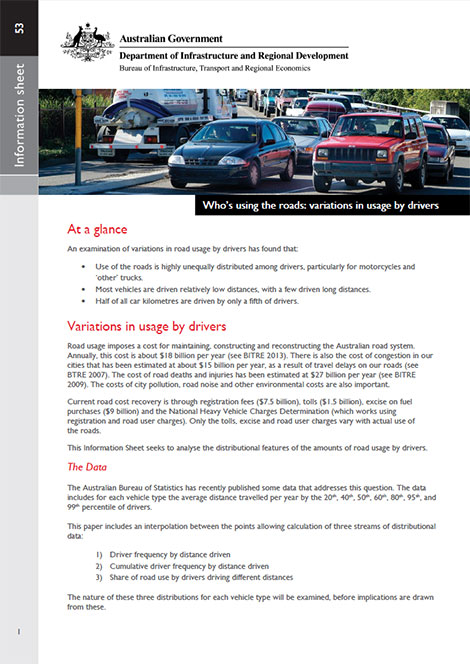
This information sheet presents estimates of the variation in use of roads by drivers.
It finds that road use is highly unequally distributed among motorists, with most vehicles driven relatively low distances while a few drive long distances. The uneven distribution is particularly pronounced for motorcycles and 'other' trucks.
- Who's using the roads: variations in usage by drivers
National Highways Linking Hobart, Launceston and Burnie: Appraisal of Penguinto Burnie Section, 1978
The main issue relating to the section of the National Highway linking Hobart, Launceston and Burnie between Penguin and Burnie is whether to retain the coastal alignment for the National Highway or to adopt an alternative inland route. This appraisal covers both options and provides a recommendation for the future.
- National Highways Linking Hobart, Launceston and Burnie: Appraisal of Penguinto Burnie Section, 1978
Commercial Road Supply with Incentive Regulation
Paper published in the International journal of sustainable transportation, 2015, 9(4):241-53. Author: Mark Harvey
- Commercial Road Supply with Incentive Regulation