
How do fuel use and emissions respond to price changes? Briefing—1

The first in a new series of BITRE publications, this briefing reviews the responses that have been seen in Australian transport to recent fuel price rises (vehicle sales moving to smaller, more fuel efficient cars, more urban public transport, etc). The responsiveness of the various transport sectors is reviewed, as is the responsiveness of Australia relative to the United States.
- How do fuel use and emissions respond to price changes?
Moving urban Australia: can congestion charging unclog our roads?
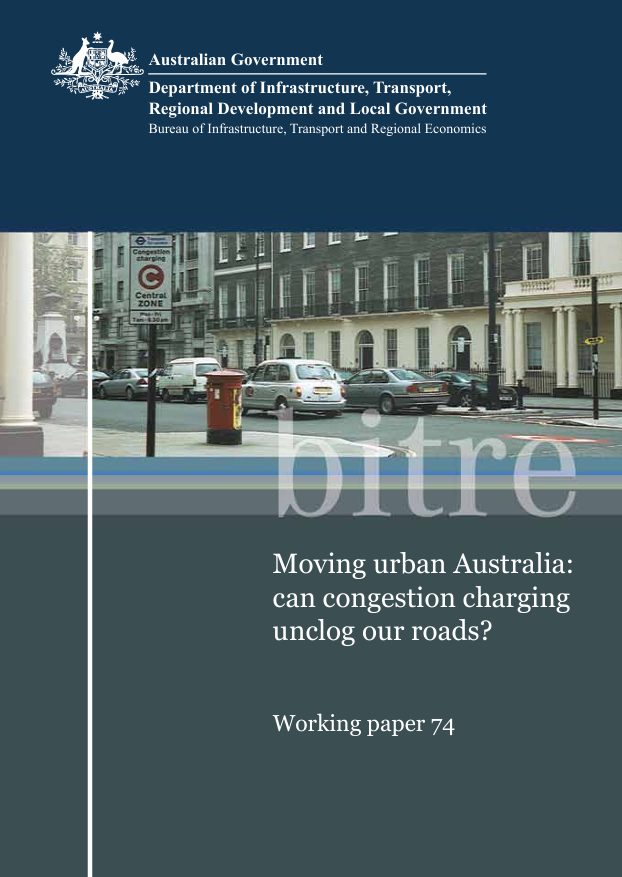
This report reviews the case for congestion charging and provides a policy framework for assessing charging systems. Congestion charging schemes are still in their infancy and evolving in concert with changing policy priorities and system technologies. While individual circumstances determine when and where congestion charging is in the interest of the wider community, some important general lessons can be drawn.
Update August 2009
Responses to the discussion of personalised promotion of alternatives to solo driving (pages 26–7), as one of the existing strategies to manage congestion, have drawn our attention, firstly, to some larger-scale current initiatives of Australian jurisdictions and, secondly, to more recent literature on the effectiveness of the travel behaviour change approach in relation to its various objectives, particularly reducing motorised trips and reducing greenhouse gas emissions.
For information on existing activities in 2 states, see About Travelsmart and Travelsmart General Information. On the effectiveness and impact of the travel behaviour approach, as implemented in Australia and the United Kingdom, see in particular: Australian Greenhouse Office, Evaluation of TravelSmart Projects in the ACT, South Australia, Queensland, Victoria and Western Australia 2001–2005, Department of Environment and Heritage 2006; Brog W. And Ker I., Myths, (Mis)perceptions and reality in measuring voluntary behaviour change, 8th International Conference on Survey Methods in Transport, Annecy, France, May 2008; Department for Transport (United Kingdom), Making Personal Travel Planning Work: Research Report, Integrated Transport Planning Ltd, December 2007; Department for Transport (United Kingdom), Impact assessment of the carbon reduction strategy for transport, July 2009; and Stopher P., Clifford E., Halling B., Evaluating a voluntary travel behaviour change by means of a 3-year GPS panel, Proceedings of the TDM2008 Conference, Vienna, Austria (forthcoming).
Modelling the Road Transport Sector
This report was prepared by BITRE and CSIRO, in discussion with Treasury, to provide additional information on the road transport sector modelling carried out jointly by the two agencies in support of Treasury's broader modelling of the introduction of emissions trading in Australia.
- Modelling the Road Transport Sector
A regional economy: a case study of Tasmania
The Department of Infrastructure, Transport, Regional Development and Local Government is committed to the prosperity of Australia's regions. In order to promote economic and social development it is important that we understand the environment in which regional economies operate. This study provides an analytical investigation of the challenges facing regional Australia. BITRE's study takes a multifaceted and holistic approach. The underlying principle is that economies do not work in isolation and a complex mix of interacting drivers affects a region's economic performance. Tasmania's economic performance has experienced changing fortunes over the past two decades. This development provided a unique opportunity to investigate the drivers of this change and to find out if there are lessons for regional policy.
- A regional economy: a case study of Tasmania
The files available from this website may not be suitable for users of assistive technology on all devices.
If you experience difficulties and require assistance, please contact us using the feedback page. Please include which device and assistive technology you are using.
Improving urban congestion information for decision making: report to COAG from the Australian Transport Council
In April 2007, COAG considered the Urban Congestion Review it had commissioned in February 2006, and tasked the Australian Transport Council (ATC) with establishing arrangements to improve urban congestion data, modelling and performance information for decision-making. The following document, 'Improving Urban Congestion Information for Decision-Making', is a progress report to COAG of mid-2008. At its 7 November 2008 meeting, ATC noted further progress with implementing agreed approaches, including establishing a National Transport Modelling Working Group, progressing improved consistency between road-based and public transport congestion indicators, a survey of business sector travel, and analyses of specific congestion initiatives.
- Improving urban congestion information for decision making: report to COAG from the Australian Transport Council
Household Wealth
This information paper presents and explores new statistical information relating to household wealth at a small area scale. The paper also explores the relationship between wealth and income for Australia's cities and regions.
- Household Wealth–Information Paper
- Household wealth

- Staff paper–economic wellbeing of Australia's regions

- Mapping wealth in cities
Economic wellbeing of Australia's regions
This information paper presents and explores new statistical information relating to household wealth at a small area scale. The paper also explores the relationship between wealth and income for Australia's cities and regions.
- Economic wellbeing of Australia's regions
National road network intercity traffic projections to 2030
This report provides long-term passenger and freight vehicle traffic projections for intercity corridors of the National Land Transport Network (NLTN) between 2005 and 2030.
- National road network intercity traffic projections to 2030
Seminar: The future isn't what it used to be—how technology and society will change the face of urban transport 7 April 2009
Transport planner Todd Litman will be in Canberra to share his insights into the changing face of transport. Todd is director and founder of Canada's Victoria Transport Policy Institute and is the author of the Transportation Demand Management Encyclopaedia. Todd presents his case for public transport-friendly cities. He argues that a number of economic, social and technological patterns are emerging that will change and diversify travel demand, weakening the dominance of the motor car. These changes have fundamental implications for the way we should think about transport technology and the ways we plan our transport systems and infrastructure.
- Seminar: The future isn't what it used to be–how technology and society will change the face of urban transport 7 April 2009
Northern Australia Statistical Compendium 2009

The Northern Australia Statistical Compendium was prepared by BITRE with the assistance of the Office of Northern Australia, with the aim of compiling a base of factual information that would contribute to improved understanding of the economic and social developments in this region. The compendium discusses essential characteristics of Northern Australia and offers comparisons with the rest of Australia, wherever possible. It provides information on population, the economy, employment, social conditions, education, transport, infrastructure, climate, land use and major industries for Northern Australia as a whole and for the regions within it.
Note: hard copies are not currently available but will be available soon.
- Northern Australia Statistical Compendium 2009–complete report
- Foreword and executive summary
- Chapter 1 Introduction
- Chapter 2 Population
- Chapter 3 Economic activity
- Chapter 4 Workforce
- Chapter 5 Day-to-day living
- Chapter 6 Transport
- Chapter 7 Infrastructure
- Chapter 8 Natural resources
- Chapter 9 Main industries
- Appendix
- Abbreviations and references
- Northern Australia Statistical Compendium Data