
Changes in Australia's Industry Structure: Main Cities 2001–06
BITRE's Industry Structure Database and information sheet 32 present the latest regional industry trends. The study analyses the shifting geography of employment and highlights the dynamics of industry structure in Australia's main cities between 2001 and 2006. This is an update of the first Industry Structure study (and the database) which was published in 2003.
- Changes in Australia's Industry Structure: Main Cities 2001–06
- Industry Structure Database 2009

Urban Congestion Working Group: Australian Capital City Congestion Management Case Studies
This document presents a number of case studies by Australian jurisdictions on interventions they have undertaken to alleviate urban congestion pressures across their transport systems. Good congestion interventions can lead to significant improvements in congestion management and economic, environmental and social savings.
- Urban Congestion Working Group: Australian Capital City Congestion Management Case Studies
The global economic downturn—some implications for Australian local governments
This paper was developed as background for the meeting of the Australian Council of Local Government in June 2009. It looks at the economic downturn and its implications for local government and regional economies with particular reference to the Australian Government response.
- The global economic downturn–some implications for Australian local governments
Australian container ports in an international context
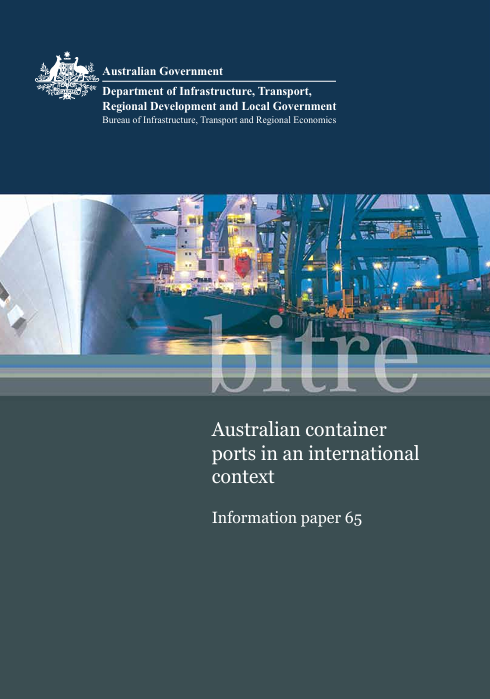
BITRE undertook this study at the request of the Australian Maritime Group (AMG) a senior officer advisory committee with representatives from state governments and the Commonwealth Government. The aim of the study is to provide a better understanding of the productivity and competitiveness of Australia's container ports.
The global economic downturn—some implications for Australian local governments
In undertaking its research, BITRE is often required to estimate the likely consequences of changes in market conditions or potential policy changes. In order to do this, it uses estimates of the likely responsiveness of transport to such changes referred to as elasticities. For example, how is the amount of car travel affected by the costs of running a car, or the price of public transport. To improve how it conducts analysis BITRE has, over the course of many years, systematically collated information on transport elasticity estimates produced by empirical studies. BITRE's database is made freely available here as a resource for transport analysts, policy makers and anyone else interested in transport issues.
- Transport Elasticities Database
Urban Congestion Working Group: Critical transport modelling reviews
Reports commissioned in 2009 by the National Transport Modelling Working Group (NTMWG) critically reviewed the current status of the modelling tools available through each of the government agencies in relation to the various models' capability in each capital city. The work identified a number of enhancements for measuring the potential impacts of demand management approaches on road outcomes such as urban congestion. The NTMWG comprises members from each of the government agencies with ownership of the transport models for the respective capital cities; the Department of Infrastructure, Transport, Regional Development and Local Government; and the Bureau of Infrastructure, Transport and Regional Economics.
- Critical Review of Transport Modelling Tools
- Implementation Options Report
Greenhouse Gas Emissions from Australian Transport: Projections to 2020
This working paper models a base case scenario for emissions projections between 2007 and 2020, assuming no further abatement measures are taken. The underlying data has been used in recent reports prepared by the Department of Climate Change and the Treasury.
- Greenhouse Gas Emissions from Australian Transport: Projections to 2020
Cost of road crashes in Australia 2006
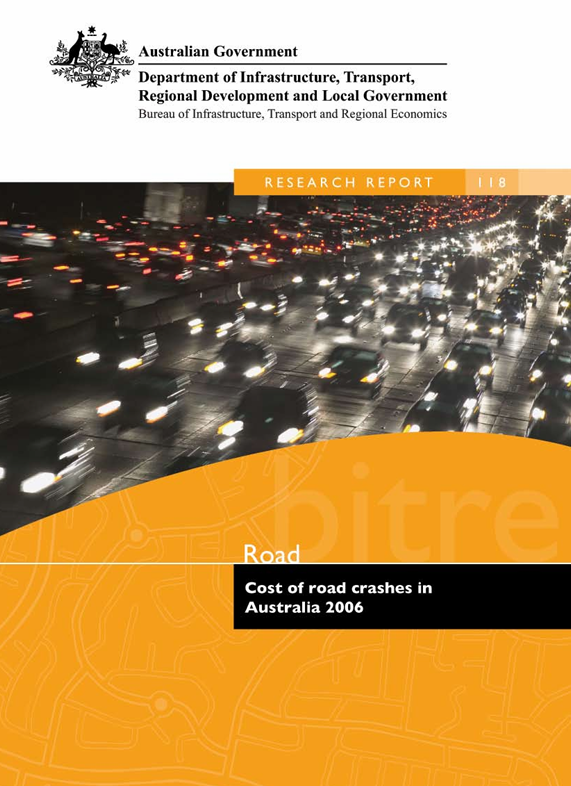
Road crashes impose large human and financial costs on society and substantial investments are made in infrastructure and safety programs to reduce road trauma. The cost of road crashes is important to the safety debate in Australia, and the unit values particularly for a fatality, injury or cost of a fatal crash are key inputs into policy development and cost-benefit analysis for safety programs and infrastructure projects. The social cost of road crashes in 2006 was an estimated $17.85 billion (1.7 per cent of GDP). This was a real decrease of 7.5 per cent compared to 1996 (2006 dollars). Estimated human losses were approximately $2.4 million per fatality, losses for a hospitalised injury were approximately $214 000 per injury (including disability-related costs), and losses for non-hospitalised injury were approximately $2200 per injury. These new estimates of the cost of road crashes update previous estimates for 1996 (Bureau of Transport Economics (BTE) Road crash costs in Australia, Report 102).
Population growth, jobs growth and commuting flows in Perth

This report identifies recent spatial changes in employment and the residential population within Perth, and investigates how commuting behaviour has responded to these changes.
- Population growth, jobs growth and commuting flows in Perth
Brief—A profile of high-speed railways
This paper discusses high-speed train services. The paper sets out what is meant by 'high-speed', explains the objective of introducing services and sets out where they have been introduced. The paper also considers funding experiences and Australian high-speed train proposals.
- Brief–A profile of high-speed railways