
Chapter 2

This chapter provides information on passenger transport activity, including nationally, by city pair, by capital city and by method of travel to work. The data in this chapter comes from a variety of sources, including BITRE estimates, ABS Census and Tourism Research Australia.
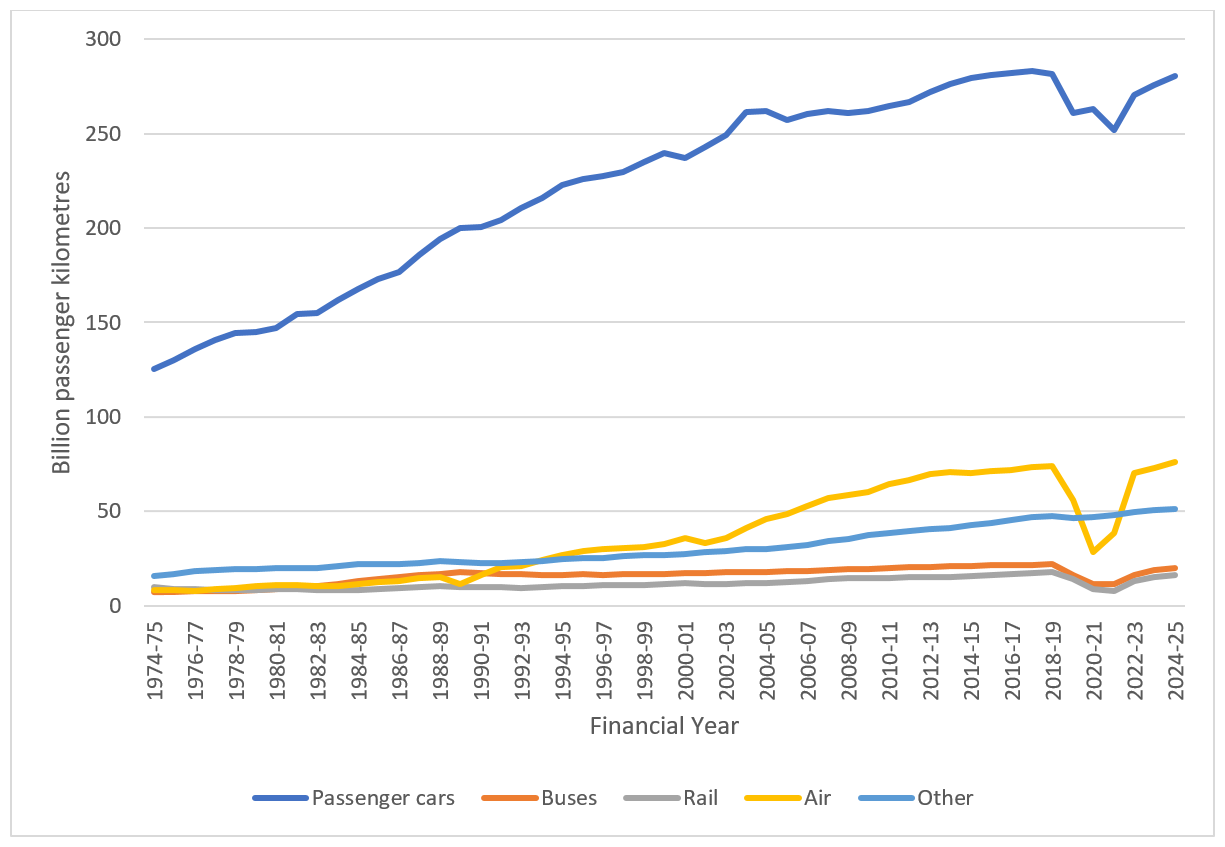
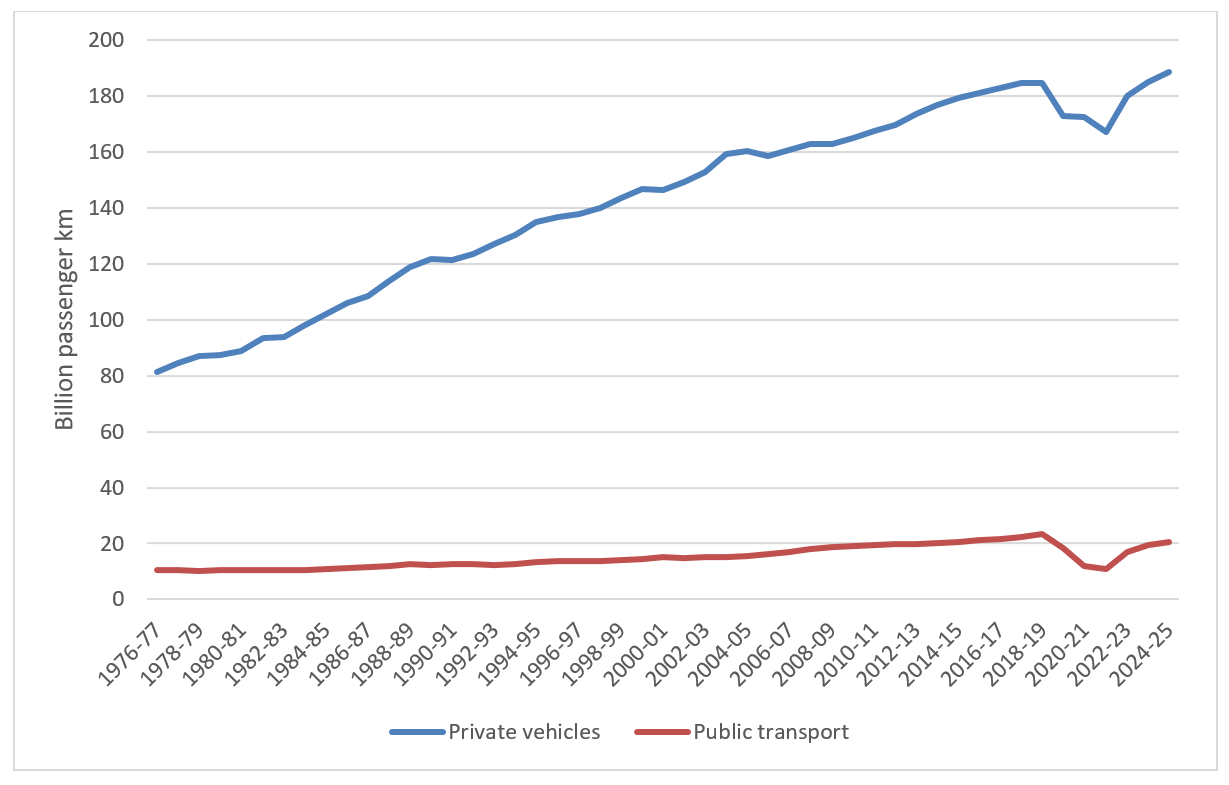
- 166 billion passenger kilometres were travelled by car on capital city roads in 2024-25, of a total of 280 billion passenger kilometres nationwide.
- 16 billion passenger kilometres were travelled on rail in 2024-25 compared to 18 billion in 2018-19, prior to any COVID impacts.
Passenger transport activity is measured by passenger kilometres (the number of kilometres travelled by passenger vehicles multiplied by the number of occupants in the vehicle). As shown in Figure 3, the passenger task is dominated by road transport, mainly passenger cars. Passenger travel on other modes has generally been increasing, albeit with a dip over the pandemic. Air travel fell most significantly, however by 2024-25, it had surpassed its pre-pandemic level. Prior to COVID, public transport use was growing relatively quickly, as shown in Figure 4. By 2024-25 it has returned close to its 2018-19 peak.
Figure 3 Total national motorised passenger travel, by mode
Source: BITRE Estimates
Figure 4 Australian capital city domestic passenger task, by mode
Source: BITRE Estimates
Download data
- Passengers—Yearbook 2025 (188 KB) - Download Excel file
- Australian Infrastructure and Transport Statistics Yearbook 2025 - Download PDF
Also see
Road-related Revenue and Expenditure
Chapter 3
This chapter provides information on the Government’s total expenditures and sources of revenue for road-related activities for the Commonwealth, state and local government (noting only expenditure is shown at the local level).
A general overview for the Commonwealth is presented first, before expenditures and revenues are broken down at state/territory level. A variety of sources are used for this data, including data from the Australian Tax Office, the Australian Bureau of Statistics, the Department of Infrastructure, Transport, Regional Development, Communications, Sport and the Arts, the Commonwealth Budget, BITRE estimates and State and Territory Governments.
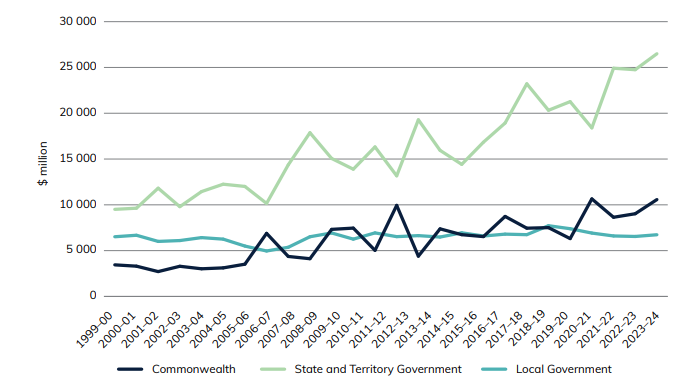
- The public sector (national, state and local) spent $44 billion on roads in 2023-24.
- $36 billion in road-related revenue was collected by all governments (excluding road-related revenue from the Goods and Services Tax, Fringe Benefits Tax and the Luxury Car Tax).
Public sector road-related expenditure over time can be seen in Figure 5.
Figure 5 Road-related expenditure, by level of Government (constant 2023-24 prices, adjusted by CPI)
Sources: ABS (2025), Consumer Price Index, Australia
ABS (2025), Government Finance Statistics, Australia
BITRE estimates
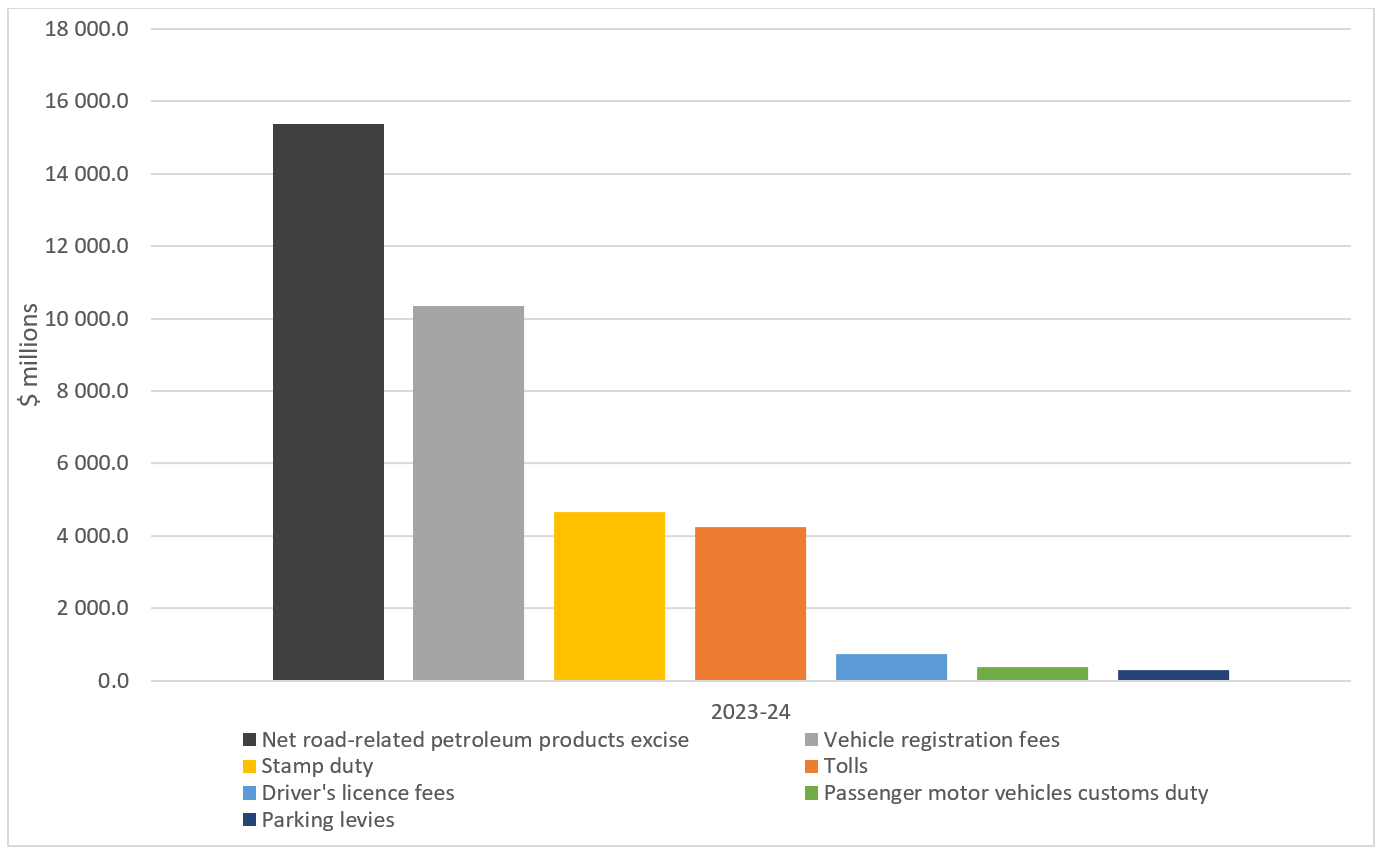
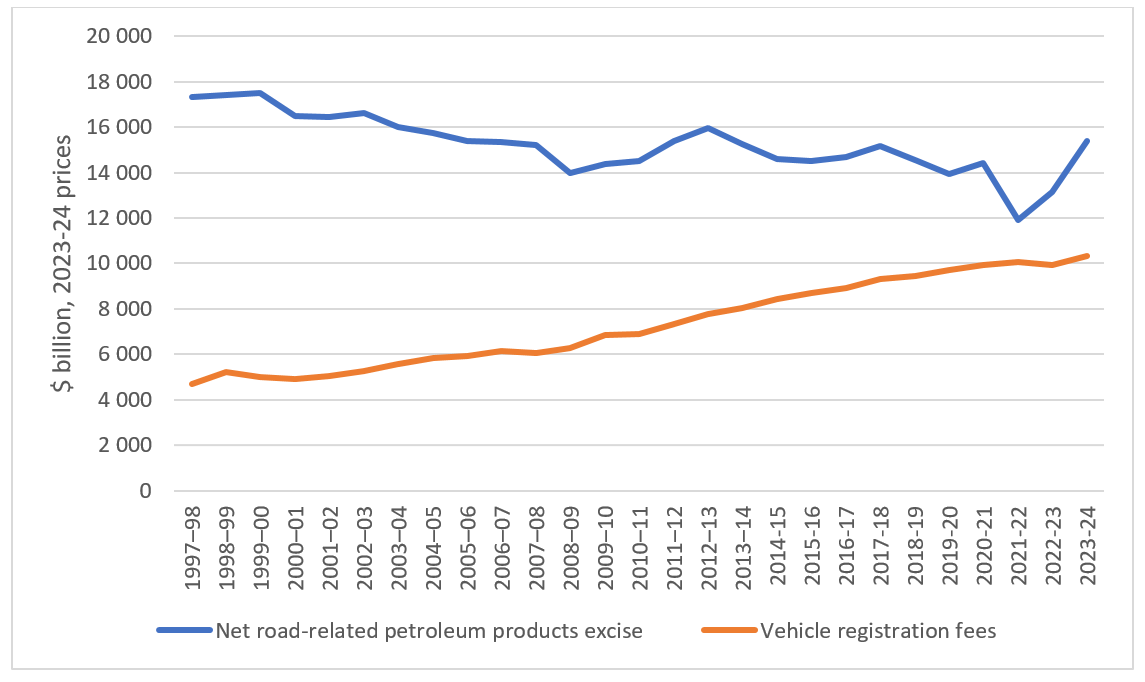
Figure 6 illustrates that the majority of revenue for the states/territories is vehicle registration fees, and Figure 7 shows how road-related excise and registration revenue has changed over time.
Figure 6 Selected road-related revenues
Sources: ATO (2025), Statistical Inquiry Service
ABS (2025), Consumer Price Index, and Taxation Revenue
Treasury (2022), Final Budget Outcomes 2021-22
State Governments and private toll-road operators
Figure 7 Road-related excise and registration revenue (2023-24 prices)
Sources: State and territory Governments, 2025
State Government reports and publications, 2025
ATO, BITRE estimates
Download data
- Road-related Revenue and Expenditure—Yearbook 2025 (153 KB) - Download Excel file
- Australian Infrastructure and Transport Statistics Yearbook 2025 - Download PDF
Also see
Chapter 4
This chapter provides information on Australian roads including length, use, the vehicle fleet, and the number of vehicle licences.
- An estimated 264 billion vehicle kilometres were travelled on Australia's roads in 2024–25.
- In 2024, there were 476,000 km of paved roads in Australia.
- 20 million Australians had vehicle licences at 2024–25.
- In 2024–25, Sports Utility Vehicles (SUVs) comprised 59% of new motor vehicle sales (excluding motorcycles) compared with only 33% ten years earlier.
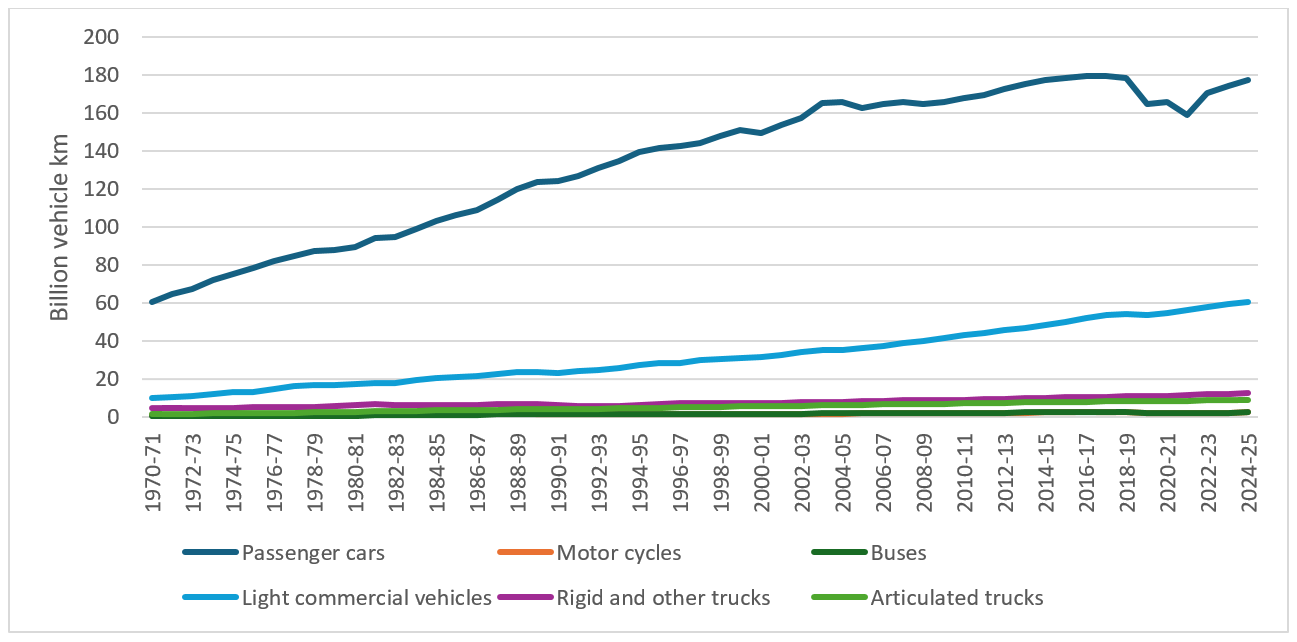
Figure 8 shows total vehicle kilometres by vehicle type. Figure 9 shows Australia’s national road network. Total vehicle kilometres travelled fell significantly during the COVID pandemic, only surpassing their previous 2017–18 peak in 2023–24.
Figure 8 Vehicle kilometres travelled by vehicle type
Source: Table 4.2
Figure 9 Map of national road network
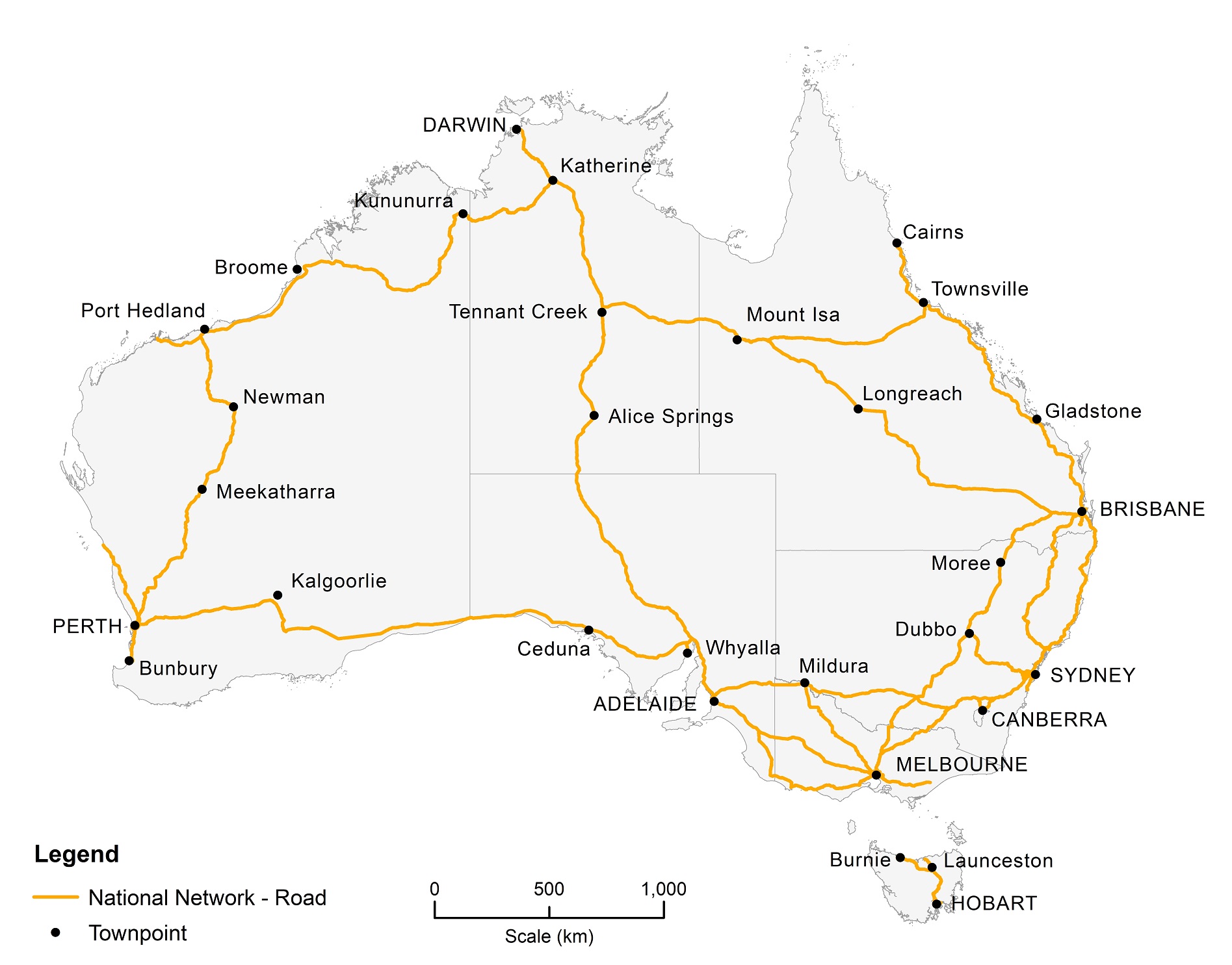
Source: DITRDCSA, 2022
Download data
- Road—Yearbook 2025 (266 KB) - Download Excel file
- Australian Infrastructure and Transport Statistics Yearbook 2025 - Download PDF
Also see
Chapter 5
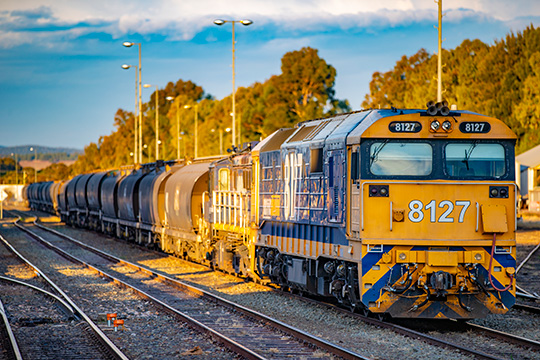
This chapter provides information on rail expenditure, activity and network lengths. Estimates of passenger kilometres up to 2024-25 can be found in Chapter 2 - Passengers.
- People in Melbourne use light rail more than any other city with 155 million passengers in 2023–24.
- People in Sydney use heavy rail more than any other city with 352 million passengers in 2023–24.
- In 2023-24 there were $36 billion of public rail-related expenditure.
Figure 10 shows Australia’s network of railways by gauge and Figure 11 shows rail public transport patronage by million passenger movements. This refers to all trips on suburban rail networks and is based on reporting from train operators. Passenger movements were trending upwards in Sydney, Melbourne, Perth and Adelaide before starting to fall sharply in 2019–20 due to the COVID-19 pandemic. By 2023–24 patronage numbers had generally still not returned to 2018–19 levels.
Figure 10 Australia’s railways, by gauge
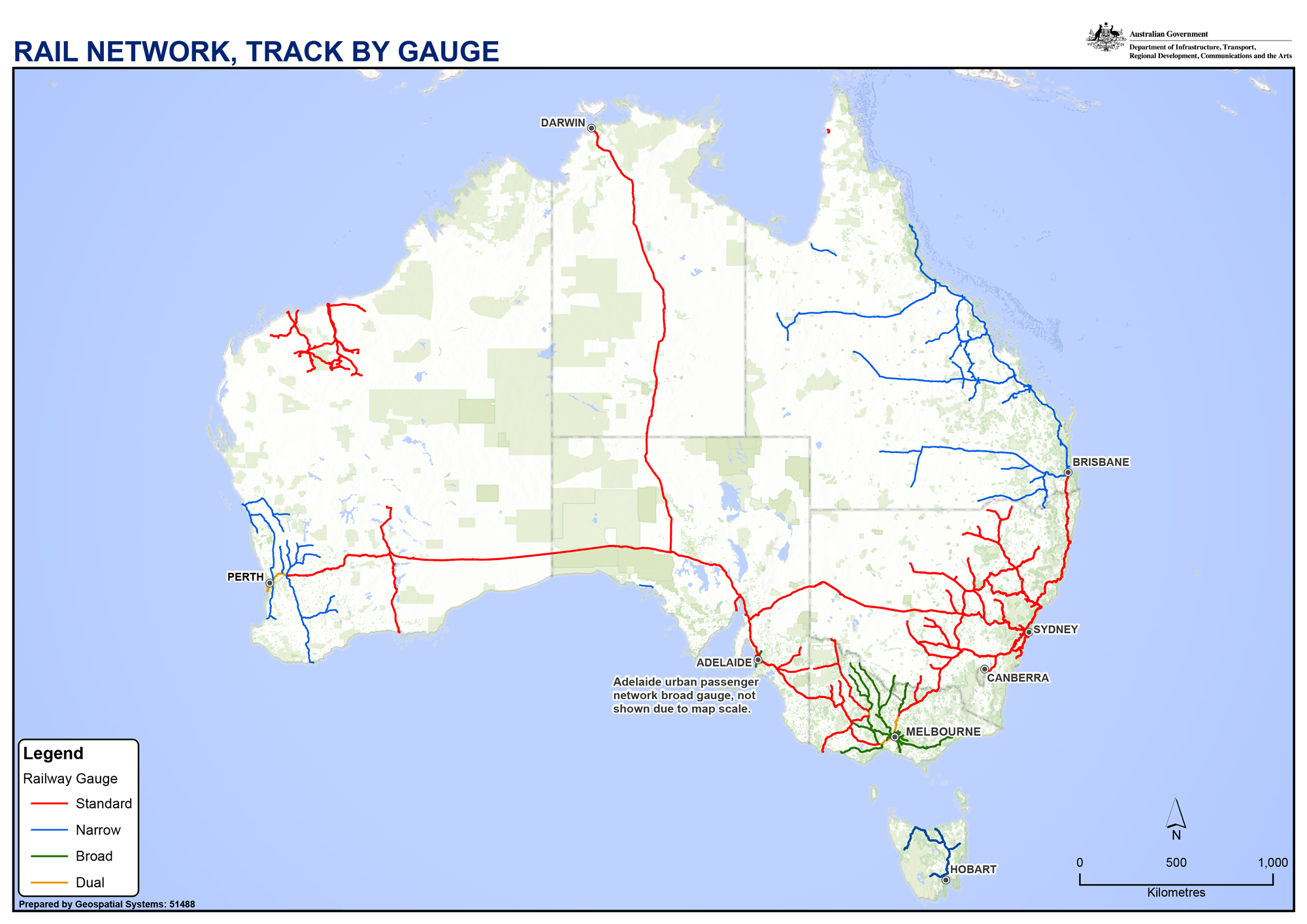
Source: BITRE (2025), Trainline 12
Figure 11 Public transit patronage on heavy rail, Australian capital city networks
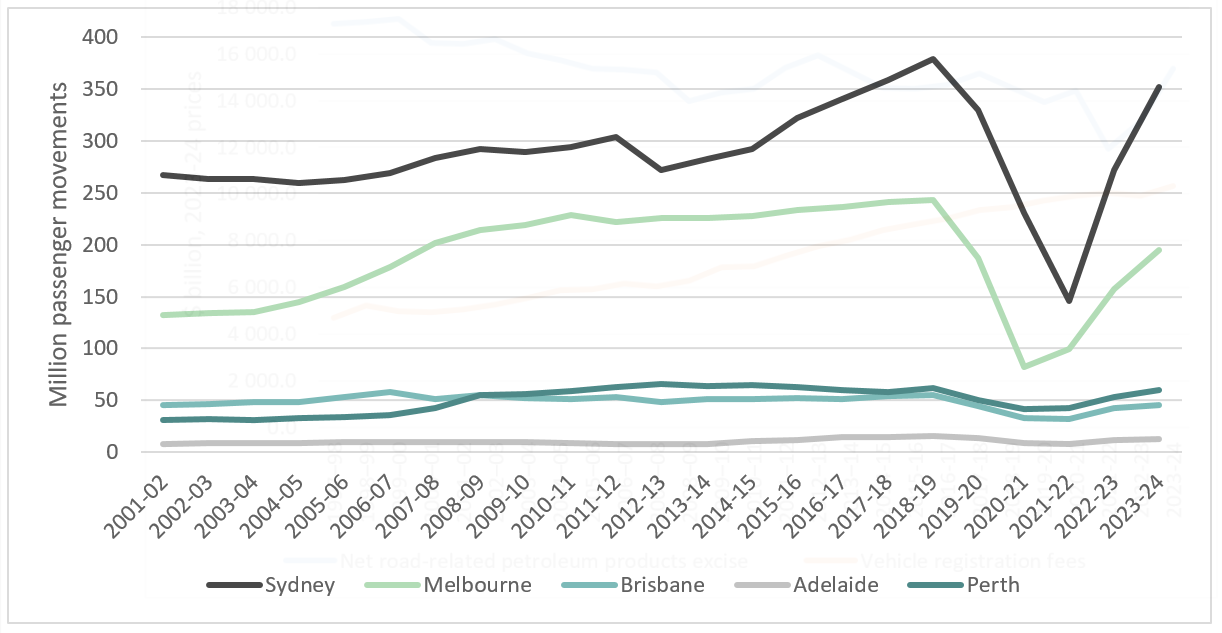
Sources: BITRE (2015), Long-term trends in urban public transport
BITRE (2025), Trainline 12
Prior Trainline publications
Download data
- Rail—Yearbook 2025 (99 KB) - Download Excel file
- Australian Infrastructure and Transport Statistics Yearbook 2025 - Download PDF
Also see
Chapter 6
This chapter provides data on airline activity, aircraft numbers, on time performance and airfare price indexes. Information is provided for both international and domestic airlines, as well as a breakdown of airport traffic by state.
- 602 thousand Australian domestic flights occurred in 2024–25. As with international activity, the full recovery of the aviation industry to pre-COVID levels has not yet occurred. At the height of the pandemic, domestic flights fell to 327 thousand, fewer than flight numbers in 1977–78.
- 11,995 Piston aircraft were registered as of 31 December 2024, which is 163 more than the year before. The number of helicopters registered increased from 2593 to 2730 over the same period.
- Sydney had the highest number of aircraft movements, with 292 thousand in 2024–25.
- International flights from Australia, are steadily recovering from the impacts of COVID. In 2024–25 there were 209 thousand flights, up from only 45 thousand four years earlier.
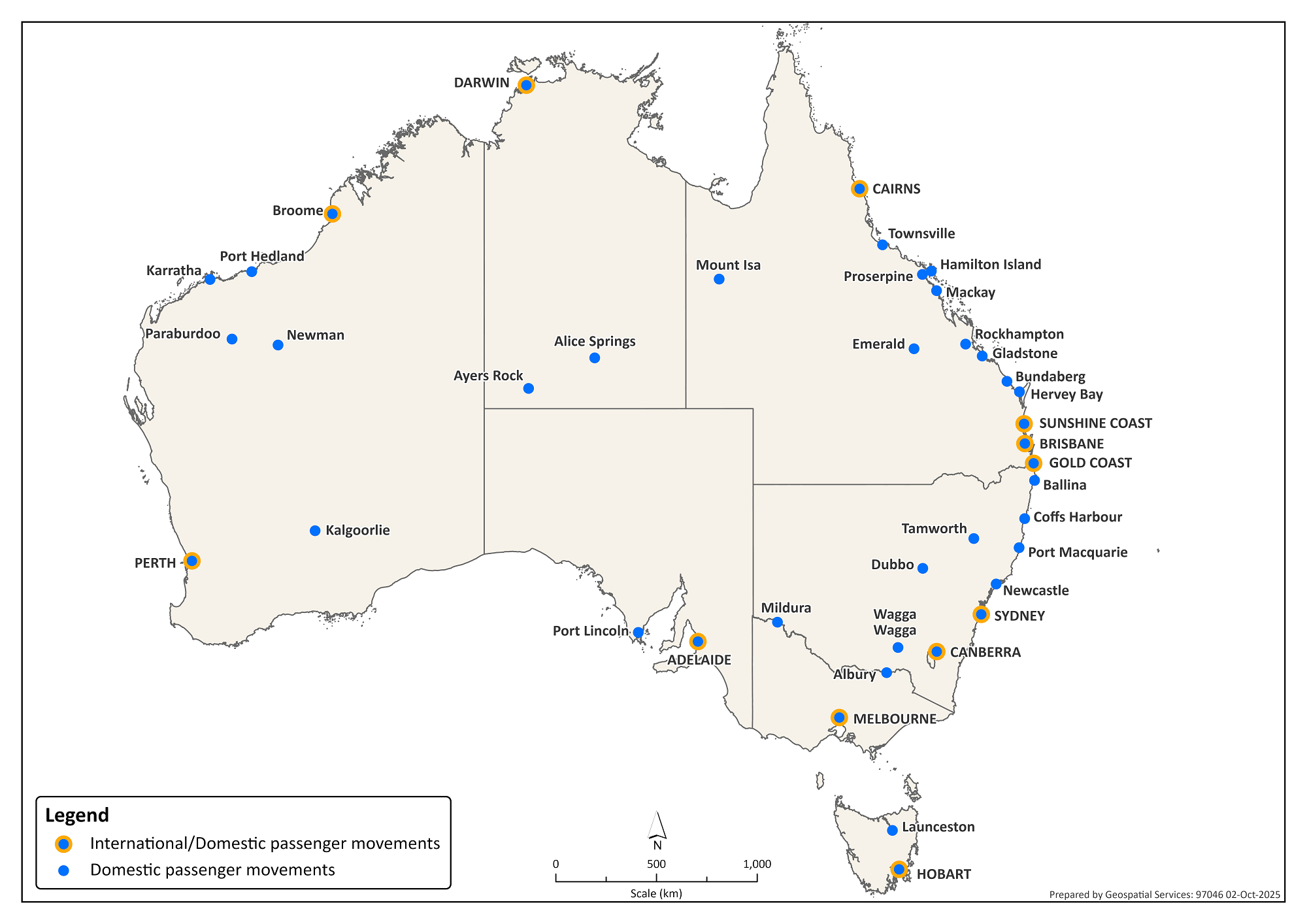
Figure 12 Australia’s top 40 airports in 2024-25, passengers
Source: BITRE (2025) Aviation Statistics - Airport Traffic data
Figure 12 shows Australia’s top 40 airports by domestic and international passenger movements. Sydney, Melbourne and Brisbane are the airports which experienced the most activity, with some regional airports outside of the top 30 entering and exiting the list.
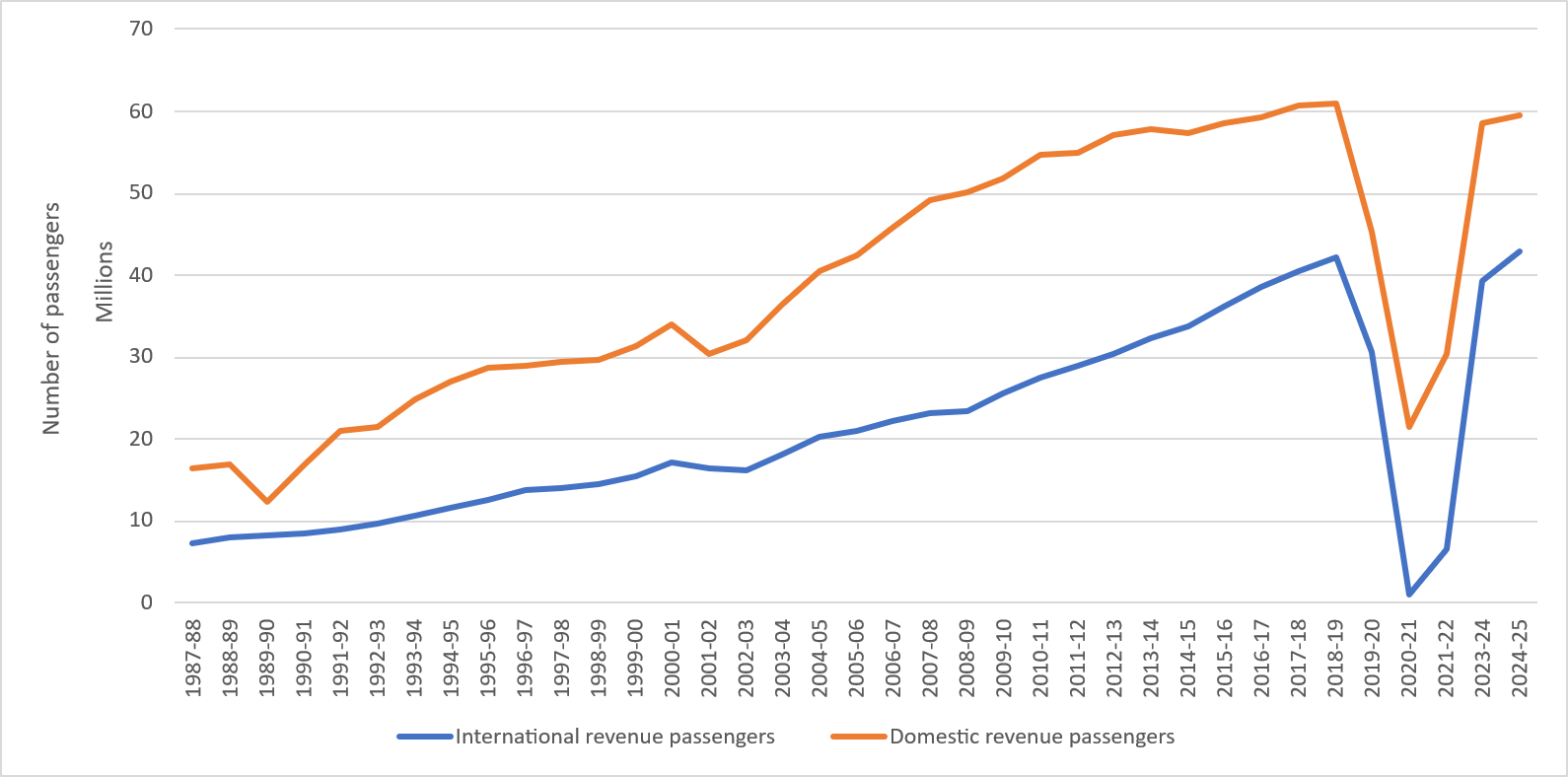
Figure 13 International and Domestic airline revenue passengers
Source: BITRE (2025), Aviation Statistics - International Airline Activity
BITRE (2025), Aviation Statistics - Domestic Airline Activity
Figure 13 shows international and domestic revenue passengers. Since the early 1980s, the number of fare-paying passengers, uplifted and discharged in Australia, was steadily increasing both domestically and internationally, before a sharp drop beginning in 2019–20 and recovering to around pre–COVID levels by 2024–25.
Download data
- Aviation—Yearbook 2025 (133 KB) - Download Excel file
- Australian Infrastructure and Transport Statistics Yearbook 2025 - Download PDF
Also see
Chapter 8
This chapter provides data on Australian safety for road, aviation, rail and maritime transport. This includes data relating to crashes, fatalities, injuries and their rates of occurrence, as well as how this differs for different demographics, states and territories (subject to data availability).
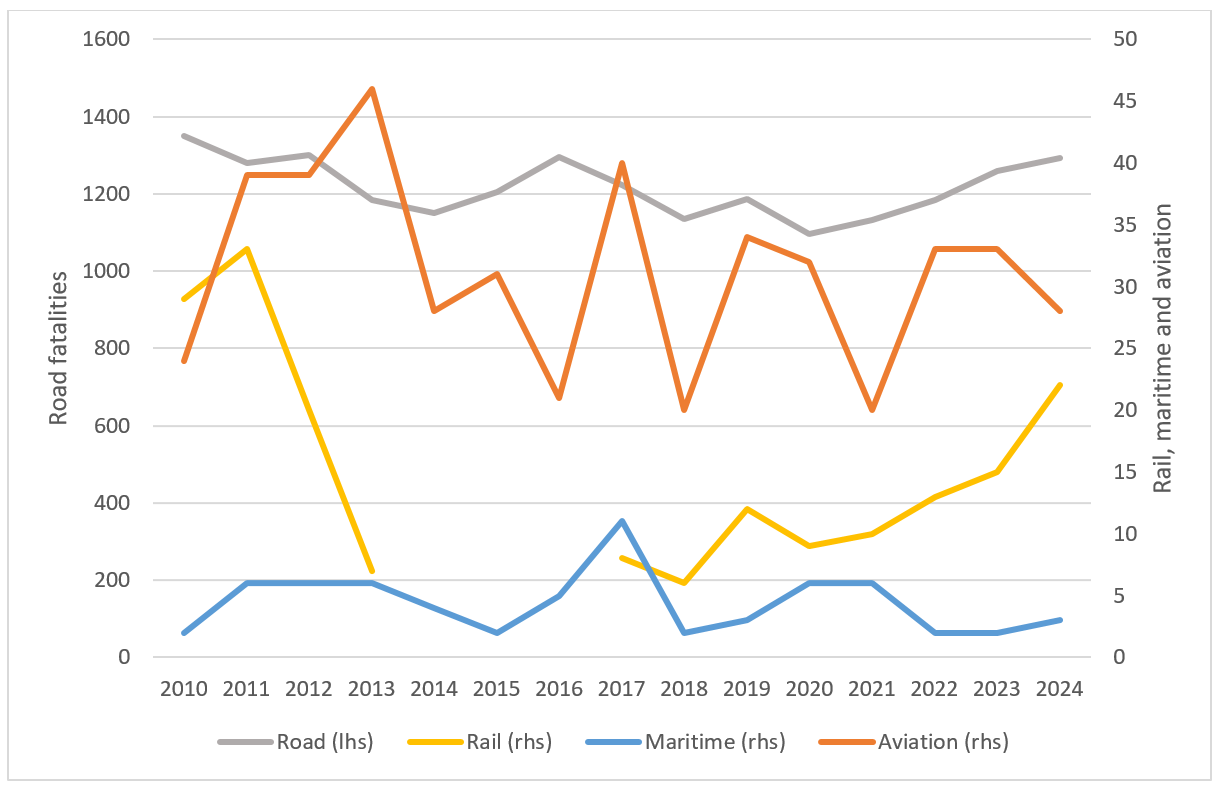
- In 2024, there were 1,294 road deaths, down from 1,737 in 2001.
- 28 aviation fatalities occurred in Australia in 2024.
- Road crashes resulted in approximately 36,000 hospitalised injuries across Australia in calendar year 2022, up from 27,000 in calendar year 2001.
- On Australia’s railways, 22 people died and 66 were seriously injured in 2024 (excludes suspected suicide).
Figure 16 shows the number of fatal crashes over time.
Figure 16 Fatalities by transport mode
Source: Table 8.1
Download data
- Transport Safety—Yearbook 2025 (154 KB) - Download Excel file
- Australian Infrastructure and Transport Statistics Yearbook 2025 - Download PDF
Also see
Transport Energy and Environment
Chapter 9

This chapter provides information on the Australian measures of transport energy and the environment. Data is sourced from industry participants, the Australia Petroleum Statistics, the Australian Energy Statistics, the Department of Environment, Energy, Climate Change and Water and BITRE’s own estimates.
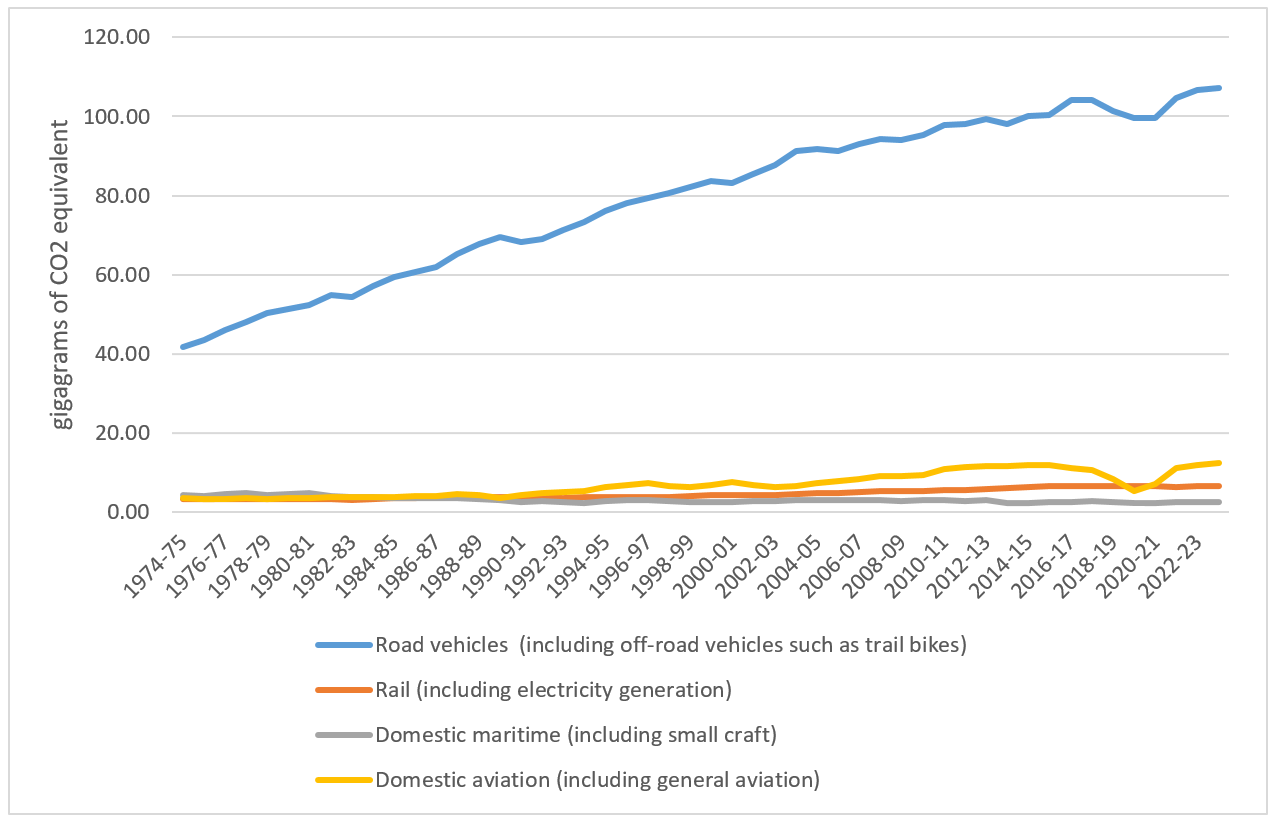
- Road vehicles made up 84 per cent of full fuel cycle greenhouse gas emissions from all domestic transport modes in 2024-25, compared to 10 per cent from aviation.
- In 2024-25, domestic road vehicle full fuel cycle greenhouse gas emissions estimates (carbon dioxide equivalent) reached a record high level of 108 megatonnes of CO2 equivalent.
- The national average price for petrol was 181 cents per litre in the 2024-25 financial year.
- In 2024-25, there was an estimated 59.2 billion litres of transport petroleum sold in Australia.
This chapter provides information on the Australian measures of transport energy and the environment. The methodology for this year’s estimates has been updated to incorporate new data sources and respond to changes in data availability and quality.
Figure 17 shows the full fuel cycle greenhouse gas emissions in megatonnes of CO2 equivalent. Transport emissions in Australia have risen steadily since 1974-75, except over the COVID-19 pandemic period, which saw them dip temporarily for road vehicles and domestic aviation. Transport emissions rose again in 2024-25, but at a slower rate than previous years post-pandemic.
Figure 17 Transport full fuel cycle greenhouse gas emissions
Source: BITRE estimates
Download data
- Transport Energy and Environment—Yearbook 2025 (131 KB) - Download Excel file
- Australian Infrastructure and Transport Statistics Yearbook 2025 - Download PDF
Also see
Infrastructure and the Economy
Chapter 10
- Infrastructure and the Economy—Yearbook 2025 (113 KB) - Download Excel file
- Australian Infrastructure and Transport Statistics Yearbook 2025 - Download PDF
This chapter provides data on the Australian economy, including the gross value added and employment in the transport and storage industry.
- 4.5 per cent of Australia’s GDP was accounted for by Australia’s transport, postal and warehousing industry in 2024-25.
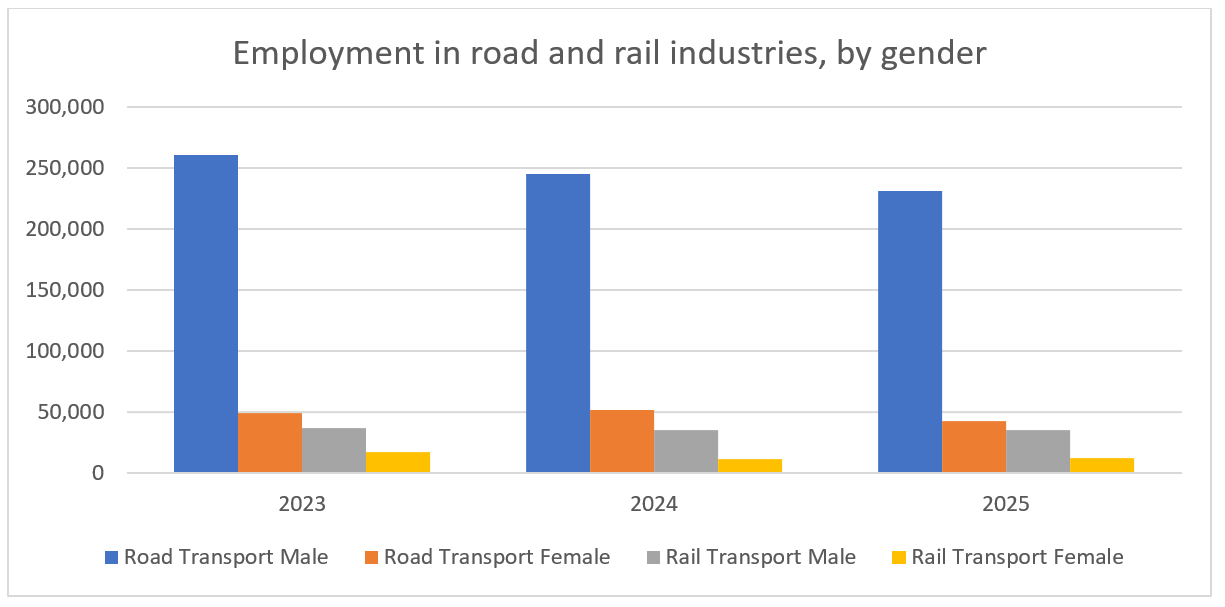
- 273 thousand people were employed in the road transport industry compared to 47 thousand in the rail industry.
- 80 per cent of people employed by the road transport industry identify as male.
The gross value added of transport, postal and warehousing as a percentage of GDP has remained relatively stable since 1974–75, generally ranging between 4-5% of GDP. In terms of employment, although employment in the transport, postal and warehousing industry has grown in overall terms, as a percentage of total Australian employment, it has stayed at around 5% for the last 30 years.
Figure 18 shows employment statistics for various transport industries as at August of each year.
Figure 18 Australian employment numbers in selected major infrastructure industries
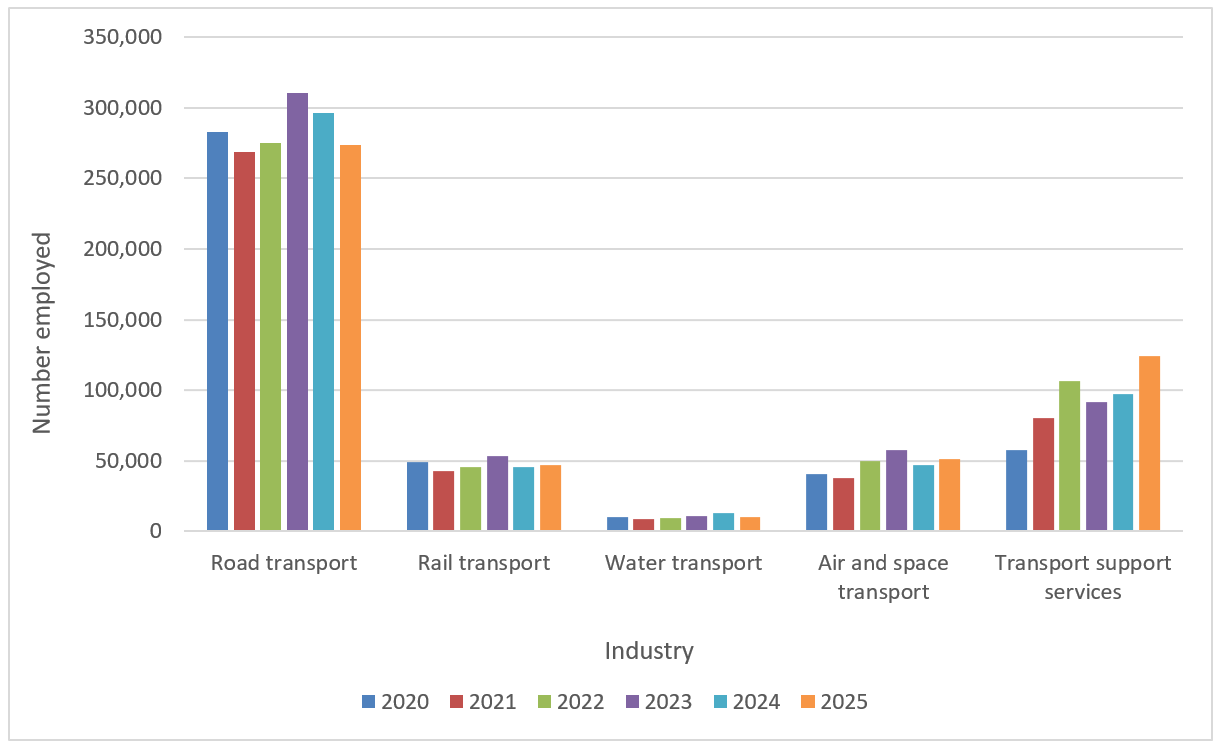
Note: This data refers to employment in August of each reference year.
Source: ABS (2025), Labour Force Australia, detailed, Canberra
Figure 19 shows employment in the road and rail industries by gender from 2023 to 2025. In 2025, there were around 230 thousand male employees compared with fewer than 50 thousand female employees. In contrast, the rail industry has a smaller workforce overall, but displays a somewhat more balanced distribution. Male employment in rail industry is consistently higher than the female employment, though the gap is narrower than in the road transport sector. Over the past three years both road and rail workforces have been declining.
Figure 19 Employment in road and rail industries, by gender
Source: ABS (2025), Labour Force Australia, detailed, Canberra
Infrastructure Construction
Chapter 11
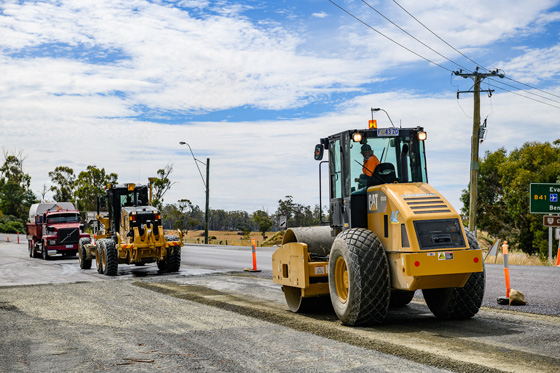
This chapter provides information on Australian measures of infrastructure engineering construction work done for public and private sectors. These are classified as: transport (roads, rail, harbours, etc), energy (electricity and gas transmission networks, etc), telecommunications networks, and water supply and distribution networks. Data is sourced from the Australian Bureau of Statistics, Engineering Construction Activity, Australia publication.
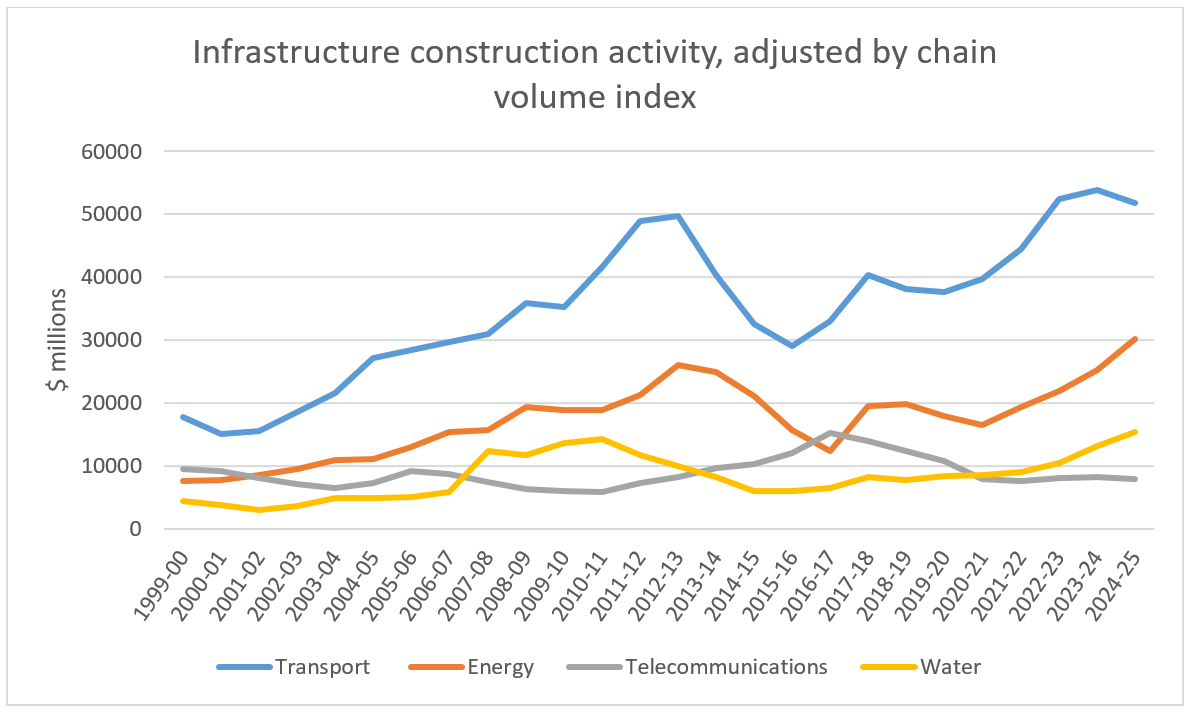
- Transport infrastructure engineering construction work was $52 billion (adjusted by chain volume index) in 2024-25. This accounted for 49 per cent of the value of infrastructure construction work done in Australia (including transport, energy, telecommunications and water).
- In 2024-25, the value of transport engineering construction work done was:
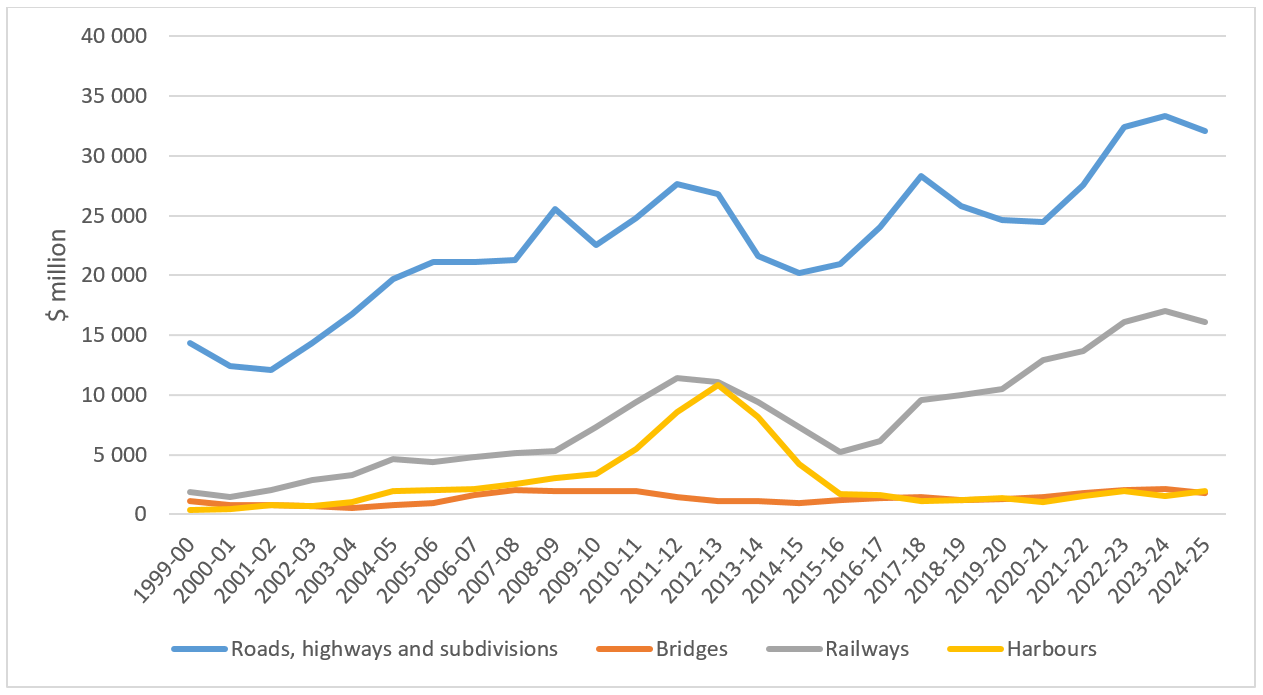
- $34 billion on roads and bridges
- $16 billion on railways
- $1.9 billion on harbours.
Figure 20 and Figure 21 show the change in infrastructure investment activity in Australia over time. Transport, water and energy investment increased relatively consistently until roughly 2012-13, when they each experienced a notable fall. They have recovered in recent years, however, with the Transport sector reaching its highest point of $54 billion in 2023-24 (Figure 20).
Figure 20 Infrastructure construction activity, adjusted by chain volume index
Source: ABS (2025), Engineering Construction Activity, Australia
Figure 21 shows the value of engineering Construction activity on different modes of transport. In 2024-25, both road and rail values dropped slightly after record highs in 2023-24 (at $33 billion for road and $17 billion for rail).
Figure 21 Transport construction activity, adjusted by chain volume index
Source: ABS (2025), Engineering Construction Activity, Australia
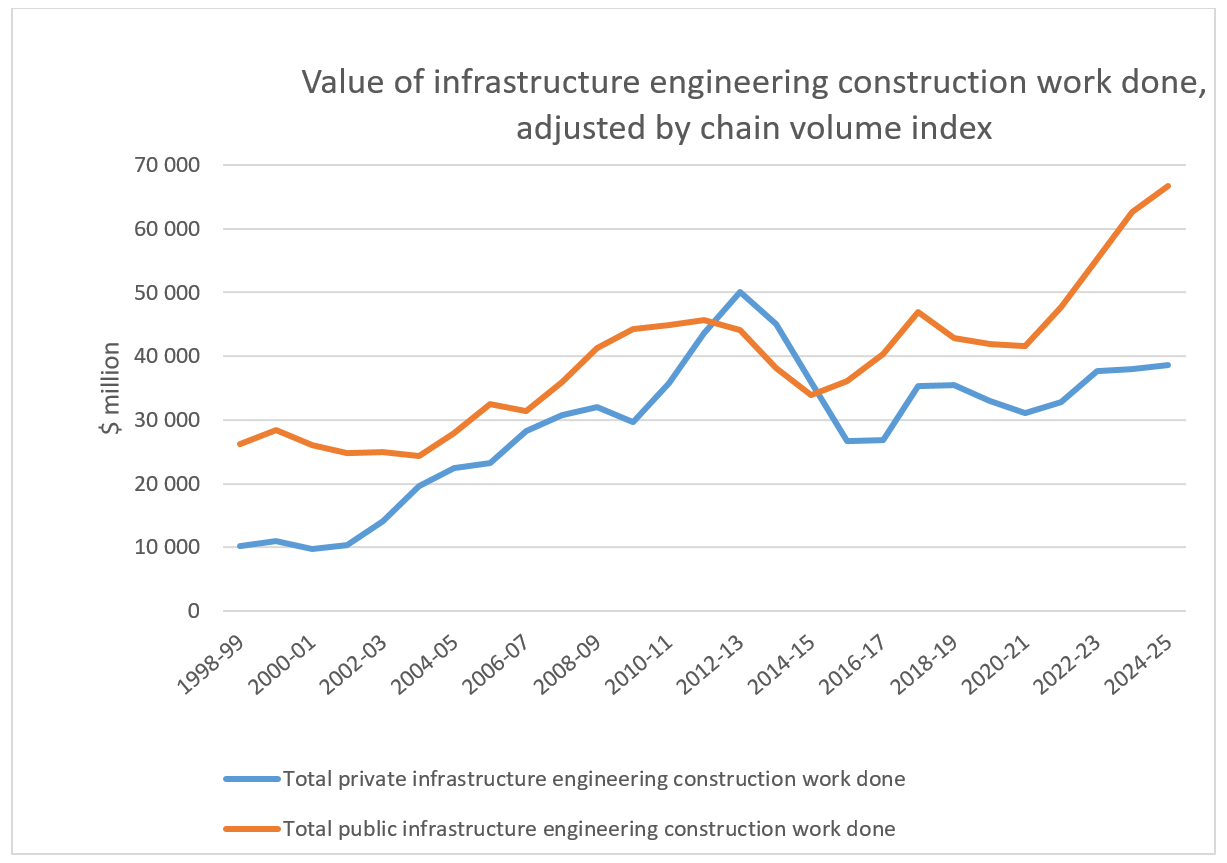
Figure 22 illustrates the private and public sector changes in Australian infrastructure expenditure.
Figure 22 Value of infrastructure engineering construction work done, by sector, adjusted by chain volume index
Source: ABS (2025), Engineering Construction Activity, Australia
Download data
- Infrastructure Construction—Yearbook 2025 (115 KB) - Download Excel file
- Australian Infrastructure and Transport Statistics Yearbook 2025 - Download PDF