
Bass Strait Passenger Vehicle Equalisation Scheme Monitoring Report No. 20
The Australian Government spent $58.3 million under the Scheme in 2023–24 and $53.9 million in 2024–25
Bass Strait Passenger Vehicle Equalisation Scheme Monitoring Report No. 19
The Australian Government spent $101.0 million on the Bass Strait Passenger Vehicle Equalisation Scheme in the 2 years to June 2023 ($41.8 million in 2021–22 and $59.2 million in 2022–23).
Bass Strait Passenger Vehicle Equalisation Scheme Monitoring Report No. 18
The Australian Government spent $77.7 million on the Bass Strait Passenger Vehicle Equalisation Scheme in the 2 years to June 2021 ($40.8 million in 2019–20 and $36.9 million in 2020–21).
Under the scheme passengers travelling with a vehicle across Bass Strait can receive a rebate applied against the vehicle fare charged by a ferry operator.
Population synthesis for travel demand modelling in Australian capital cities
In this research, the proposed synthesis routine has been used to generate full size synthetic populations of households and individuals for Greater Sydney, Melbourne and Brisbane. Two heuristic algorithms have been formulated for data treatment before and after the synthesis process to improve the representation of the synthesised populations. The procedure proposed for data treatment before the synthesis routine ensures the consistency of the input data, whereas the procedure proposed for data treatment after the synthesis routine extends under-synthesised estimates to a complete synthetic population. The synthesis process was tested for its efficacy and the synthesised populations were validated extensively. This research contributes in setting up a replicable population synthesis routine that can be included into a standard methodological toolbox for transport researchers and mainstream social scientists to produce Australian synthetic populations that is essential to microsimulation analysis.
- Population Synthesis for Travel Demand Modelling in Australian Capital Cities
Bass Strait Passenger Vehicle Equalisation Scheme Monitoring Report No. 17
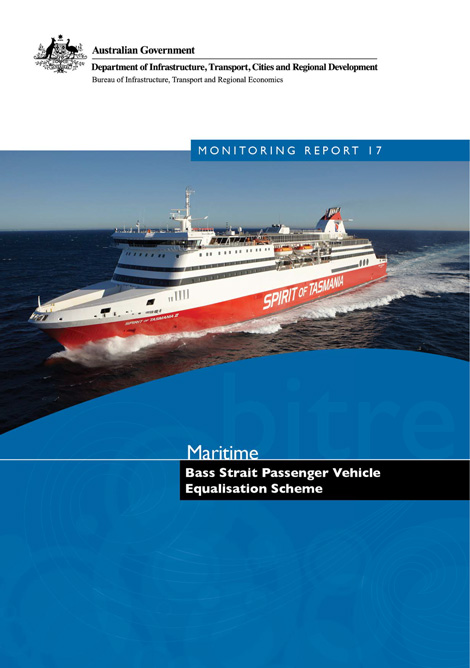
The Australian Government spent $104.1 million in the 2 years to 2018–19 ($51.3 million in 2018–19, and $52.8 million in 2017–18) on the Bass Strait Passenger Vehicle Equalisation Scheme (the Scheme).
Under the Scheme passengers travelling with a vehicle across Bass Strait can receive a rebate applied against the vehicle fare charged by a ferry operator.
Over the two-year monitoring period BITRE estimates that:
- The number of sea passengers with a motor vehicle may have been 29.2% higher than without the Scheme.
- Just under 26 000 additional visitors to Tasmania travelled by sea due to the Scheme in 2018–19 (28 600 new visitors in 2017–18).
These additional visitors to Tasmania spent an estimated $80.6 million in 2018–19 ($88.7 million in 2017–18).
Relationship between transport use and income in Australia
This Information Sheet explores the relationship between income and transport use in Australia by identifying the nature of the relationship between income and different types of transport use and how public transport use (especially rail) varies with income in different locations. The information in this publication will be useful in understanding the equity implications of government investment in transport infrastructure, particularly new urban rail infrastructure and implementation of regional development policy for regional cities located within commuting distance of the capital cities.
Freightline 7—Australian aluminium industry freight transport
The Freightline series is intended to provide information on interregional freight movements across Australia, filling a major gap in Australian transport-related data and information, to help better inform and support policy development and infrastructure planning. Freightline 1 provides a broad overview of the freight task. Subsequent issues consider specific commodity freight tasks, and include more detailed information about the size and location of major freight movements, supply chain composition and key infrastructure components.
This issue (Freightline 7) focusses on Australian aluminium industry transport supply chains and freight movements in 2014–15.
- Freightline 7–Australian aluminium industry freight transport
Freightline 6—Australian rice freight transport
The Freightline series is intended to provide information on interregional freight movements across Australia, filling a major gap in Australian transport-related data and information, to help better inform and support policy development and infrastructure planning. Freightline 1 provides a broad overview of the freight task. Subsequent issues consider specific commodity freight tasks, and include more detailed information about the size and location of major freight movements, supply chain composition and key infrastructure components. This issue (Freightline 6) focusses on Australian rice transport supply chains and freight movements in 2015–16.
- Freightline 6–Australian rice freight transport
Bass Strait Passenger Vehicle Equalisation Scheme Monitoring Report No. 16
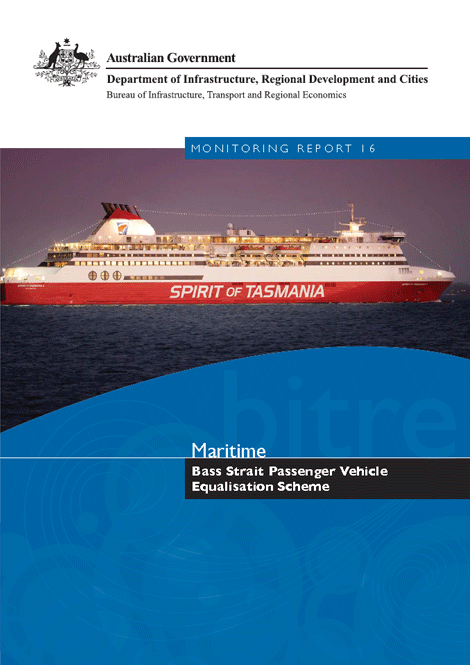
The Australian Government spent $44.7 million in 2016–17 on the Bass Strait Passenger Vehicle Equalisation Scheme (the Scheme), and $44.1 million in 2015–16.
Under the Scheme passengers travelling with a vehicle across Bass Strait can receive a rebate applied against the vehicle fare charged by a ferry operator.
Over the two-year monitoring period we estimate that:
- The number of sea passengers with a motor vehicle may have been 29.0% higher than without the Scheme.
- Just under 26 450 additional visitors to Tasmania travelled by sea due to the Scheme in 2016–17 (27 650 new visitors in 2015–16).
These additional visitors to Tasmania spent an estimated $71.4 million in 2016–17 ($74.6 million in 2015–16).
Freightline 5—Australian cotton freight transport
The Freightline series is intended to provide information on interregional freight movements across Australia, filling a major gap in Australian transport-related data and information, to help better inform and support policy development and infrastructure planning. Freightline 1 provides a broad overview of the freight task. Subsequent issues consider specific commodity freight tasks, and include more detailed information about the size and location of major freight movements, supply chain composition and key infrastructure components. This issue (Freightline 5) focusses on Australian cotton transport supply chains and freight movements in 2015–16.
- Freightline 5–Australian cotton freight transport