
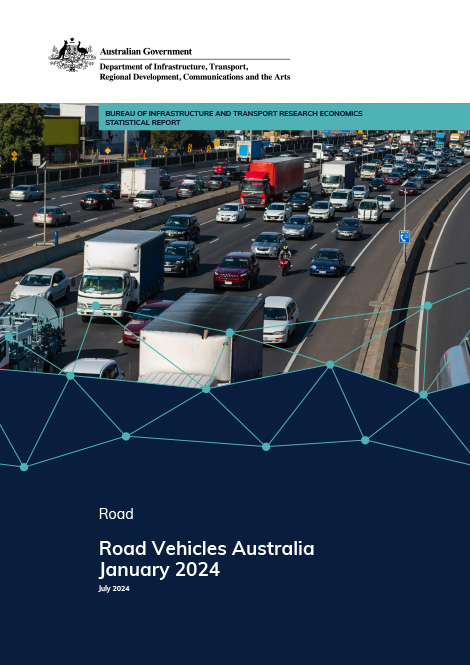
This release provides statistics relating to the number of vehicles registered for road use in Australia on 31 January 2024. The statistics encompass all vehicles that were registered with an Australian state or territory motor vehicle registry for unrestricted use on public roads, and reported by jurisdictions to the National Exchange of Vehicle and Driver Information System (NEVDIS). This is the third annual release of Road Vehicles Australia, which replaces the ABS Motor Vehicle Census, discontinued in 2021. More statistics are available on the BITRE website and data.gov.au.
Freight vehicle congestion in Australian capital cities – 2023
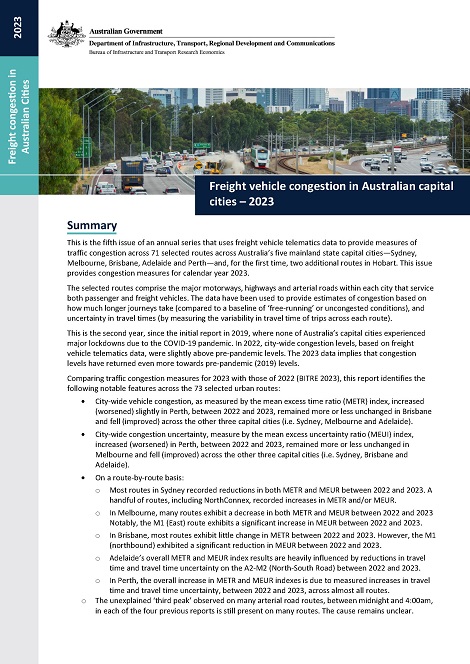
This publication is the fifth in an annual series that uses vehicle telematics data to provide measures of traffic congestion for freight vehicles on selected routes across Australia’s five mainland state capital cities – Sydney, Melbourne, Brisbane, Adelaide and Perth – and, for the first time, two additional routes in Hobart. The selected routes comprise the major motorways, highways and arterial roads within each city that service both passenger and freight vehicles. This release includes congestion measures for 73 separate routes. The estimates presented in this report cover calendar year 2023.
This is the second year, since the initial report in 2019, where none of Australia’s capital cities experienced major lockdowns as part of the COVID-19 pandemic, and city-wide congestion levels have more or less returned to pre-pandemic levels. City-wide freight vehicle congestion, as measured by the mean excess travel time index, increased (worsened) slightly in Perth, remained more or less unchanged in Brisbane, and declined (improved) in the Sydney, Melbourne and Adelaide between 2022 and 2023. Copies of the summary measure data displayed in the report are also available here.
First Nations Peoples road deaths
The excel tables present annual road deaths, population and road death rates per 100,000 population from 2012 to 2021 by state and territory (where data is available), by Indigenous status. The excel tables include road deaths and road death rates per 100,000 population for First Nations Peoples by age group, sex, road user, remoteness area and vehicle type. Additional tables for First Nations Peoples population are available by state and territory and age group and sex.
Road vehicle entry and recall statistics
Monthly statistics on road vehicles being provided to the Australian market, road vehicle recall notices and other road vehicle-related regulatory activities governed under the Road Vehicle Standards Act 2018 (RVSA).
The economics of road maintenance
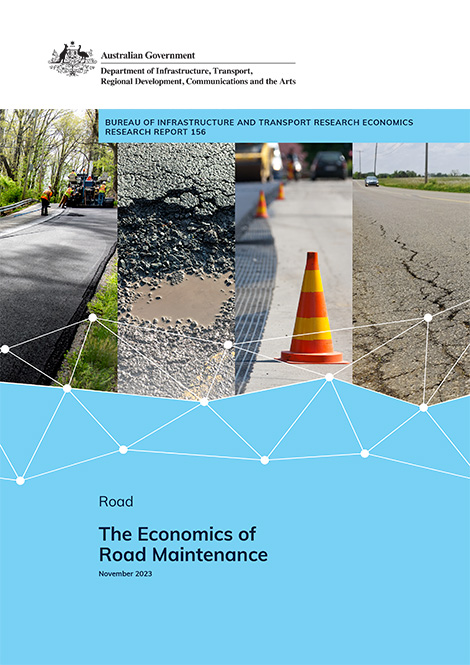
This report discusses the economics of road maintenance. It develops analytical approaches to help ensure that road expenditure is used in the most efficient and cost-effective manner both in terms of dividing funds between construction and maintenance and allocation of maintenance funds between locations, treatment types and treatment timing. The focus is on the impact of timely and adequate maintenance expenditure on the overall costs to society — that is, costs to road agencies, road users and externalities. The analytical approach and case studies demonstrate the potential costs of delayed or deferred maintenance expenditure, which can result in much higher overall costs, reinforcing the adage: ‘a stitch in time save nine’. The report also provides a computer modelling approach to optimising road maintenance expenditure over time so as to minimise the overall cost to society, without and with constraints on road agency spending levels.
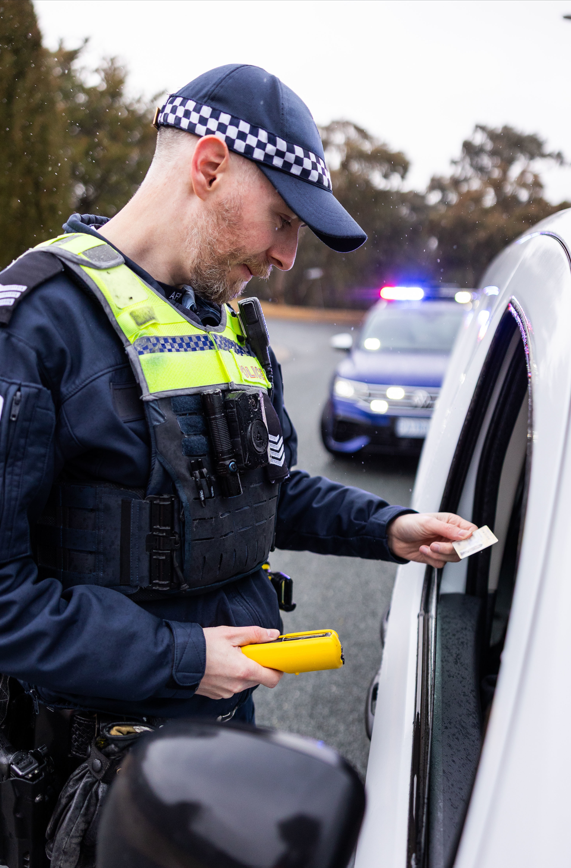
Data on road safety enforcement activities can be found on the National Road Safety Data Hub website.
The data provides information on road safety enforcement activities undertaken across Australian states and territories from 2008, including:
- unlicensed driving
- random roadside alcohol breath tests
- roadside drug tests
- speeding infringements
- mobile phone use while driving infringements
- seatbelt infringements
The series is collated from data collected by multiple organisations with varied definitions and data collection practices are not fully consistent across states and territories. Please see the data dictionary and the dashboard for more information.
BITRE is working with data owners to introduce more consistent definitions, address data gaps and investigate opportunities to streamline data collection and sharing processes. This will improve the value of this data series for policymakers, including for reporting on progress on the National Road Safety Strategy 2021-30 and National Road Safety Action Plan 2023-25.
Road Vehicles Australia, January 2023 (Re-issue)
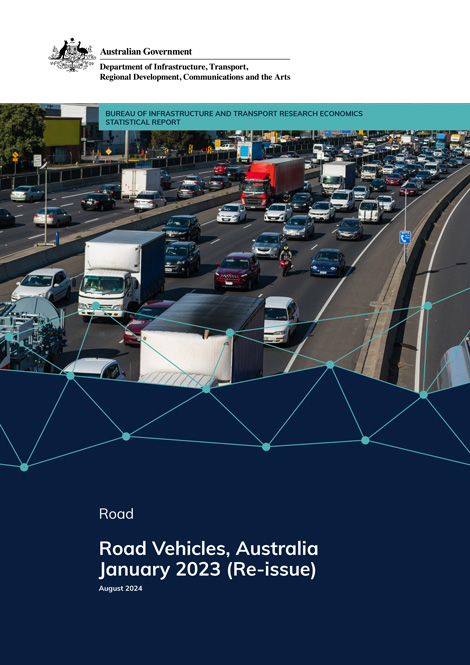
This release provides statistics relating to the number of vehicles registered for road use in Australia on 31st January 2023. The statistics encompass all vehicles that were registered with an Australian state or territory motor vehicle registry for unrestricted use on public roads, and reported by jurisdictions to the National Exchange of Vehicle and Driver Information System (NEVDIS). This is the second annual release of Road Vehicles Australia, which replaces the ABS Motor Vehicle Census, discontinued in 2021. More statistics are available on the BITRE website and data.gov.au.
Freight vehicle congestion in Australia's five major cities – 2022
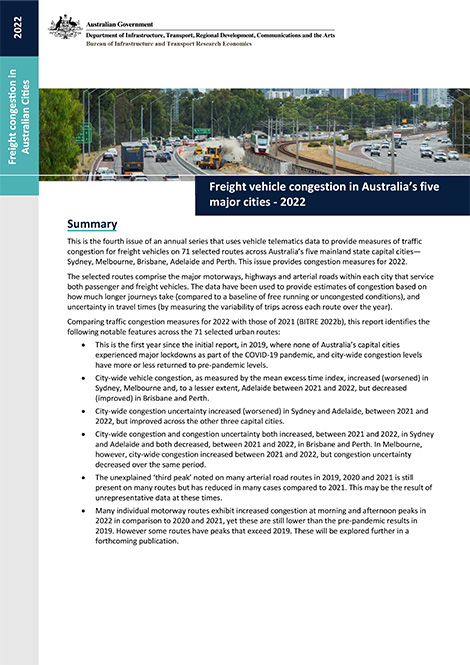
This publication is the fourth in an annual series that uses vehicle telematics data to provide measures of traffic congestion for freight vehicles for selected routes across Australia’s five mainland state capital cities—Sydney, Melbourne, Brisbane, Adelaide and Perth. The selected routes comprise the major motorways, highways and arterial roads within each city that service both passenger and freight vehicles. This release includes measures for 71 routes. The estimates presented in this report cover calendar year 2022, and include comparisons with 2021 traffic congestion levels.
This is the first year since the initial report, in 2019, where none of Australia’s capital cities experienced major lockdowns as part of the COVID-19 pandemic, and city-wide congestion levels have more or less returned to pre-pandemic levels. In particular, city-wide vehicle congestion, as measured by the mean excess time index, increased (worsened) in Sydney, Melbourne and, to a lesser extent, Adelaide between 2021 and 2022, but decreased (improved) in Brisbane and Perth. Many individual motorway routes exhibit increased congestion at morning and afternoon peaks in 2022, compared to 2020 and 2021. On some routes measured congestion is still lower than the pre-pandemic results in 2019. On other routes, congestion peaks exceed 2019 levels. Copies of the data displayed in the report are available here and on data.gov.au.
Australian interstate, intrastate and capital city road freight forecasts – 2022 update
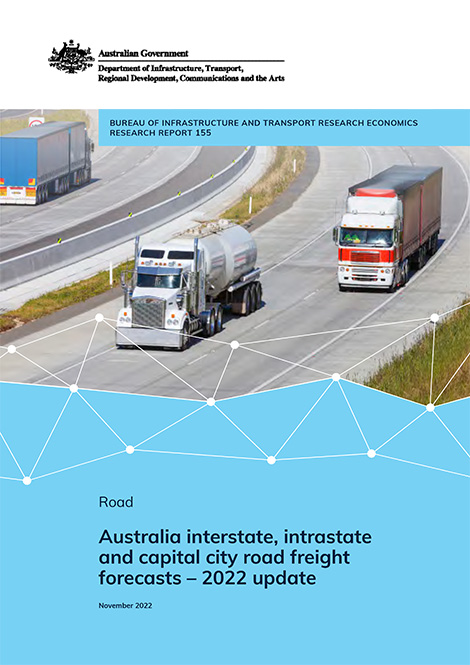
In Australia, road transport is the predominant mode for moving freight between and within states. It is a vital link in various logistics chains, providing access for freight to ports and terminals and urban freight distribution between warehouses and retail outlets. It is also the dominant mode for moving freight over relatively short distances and where other alternatives are not readily available.
This report presents estimates and forecasts of interstate, intrastate and capital cities freight volumes for each state and territory in Australia. Estimates cover the period 1970 to 2020 and forecasts from 2020 to 2040. The forecasts are based on a combination of statistical models relating historical trends in road freight volumes and economic activity, informed by assumptions about likely future long-term economic and demographic trends.
Road Vehicles Australia, January 2022 (re-issue)
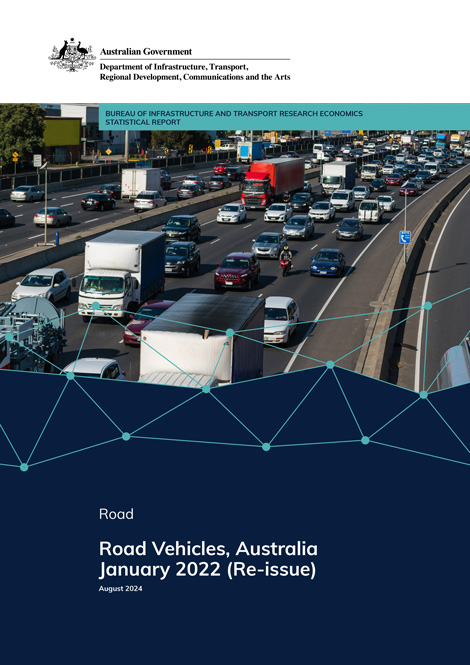
This release provides statistics relating to the number of vehicles registered for road use in Australia on 31st January 2022. The statistics encompass all vehicles that were registered with an Australian state or territory motor vehicle registry for unrestricted use on public roads, and reported by jurisdictions to the National Exchange of Vehicle and Driver Information System (NEVDIS). This is the first annual release of Road Vehicles Australia, which replaces the ABS Motor Vehicle Census, discontinued in 2021. More statistics are available on the BITRE website and data.gov.au.