
Fuel economy of Australian passenger vehicles—a regional perspective
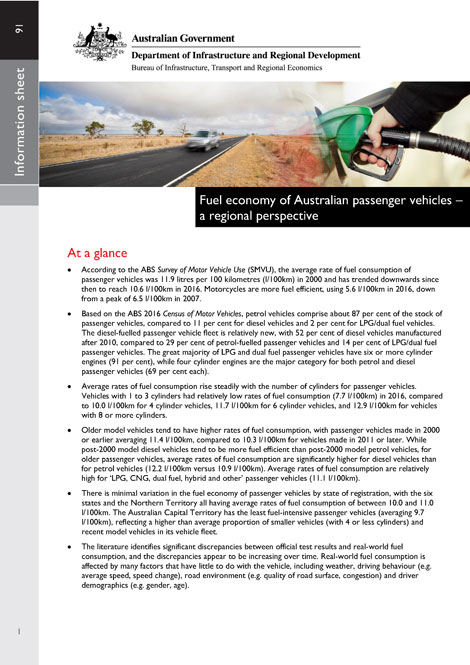
This information sheet presents Australian data on how realised rates of fuel consumption vary over time, and how the rates depend on key vehicle characteristics such as number of cylinders, fuel type and vehicle age. It also investigates state/territory differences in fuel economy and presents new small area estimates of the average rate of fuel consumption for Australia's regions.
These small area estimates are based on the composition of the passenger vehicle and motorcycle fleet in the region, and are derived at both the Statistical Area Level 3 (SA3) and Statistical Area Level 4 (SA4) scale. The key data sources are the Australian Bureau of Statistics (ABS) Survey of Motor Vehicle Use (SMVU) 2016 and the ABS Census of Motor Vehicles 2016.
- Fuel economy of Australian passenger vehicles–a regional perspective
Spending by Australian households on owning and operating vehicles
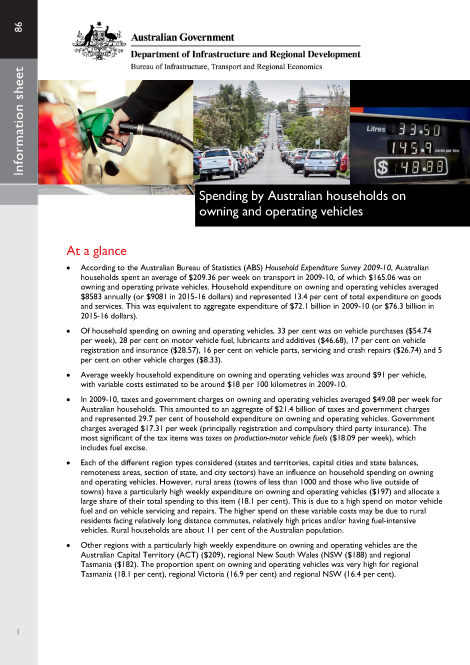
In this research, several elements of spending are examined, including the composition of that expenditure, the contribution of taxes and government charges, how the expenditure varies by broad region type and by key demographic characteristics, as well as the characteristics of those households with the greatest expenditure on owning and operating vehicles.
- Spending by Australian households on owning and operating vehicles
A dozen facts about transport in Australia
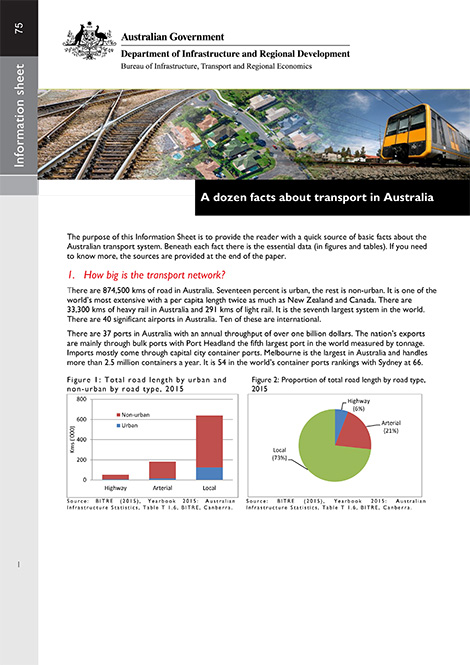
This information sheet covers a wide range of subjects, including commuting, freight, rail, energy and safety. The following 12 facts are included:
- How big is the transport network?
- How far do we travel?
- Is this increasing?
- How do we travel?
- Are we changing how we travel?
- Why do we travel like this?
- What about freight?
- Is freight transport increasing?
- Are we commuting longer?
- How do we pay for transport?
- Is transport becoming more energy efficient and causing less emissions? and
- Is transport safety improving?
- A dozen facts about transport in Australia
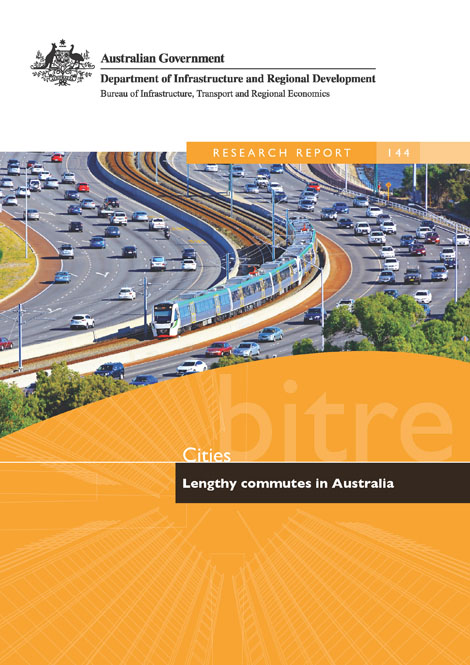
The research provides a solid evidence-base to understand who is undertaking lengthy commutes (those longer than 45 minutes one way), their prevalence and trends. It also explores whether some individuals undertake lengthy commutes for long periods or whether it tends to be temporary.
- Lengthy commutes in Australia
- Data figures from report 144
Australia's commuting distance: cities and regions
The 2011 average commuting distances reflect recent evidence on commuting from home to a place of work at a range of spatial classifications or localities. The main interest is in understanding the patterns and average commuting distances under current land use and availability of transport infrastructure.
- Australia's commuting distance: cities and regions
Changes in Australia's industry structure: cities and regions, 2006–2011
This Information Sheet identifies recent trends (2006 to 2011) in employment by various industries for regional areas, capital cities and non-capital cities. It updates BITRE's previous Information Sheet 32, which focused on employment changes between 2001 and 2006. The information presented in this publication will assist regional communities (including local government and RDAs) to understand how their regions are changing, and help regions map out where their opportunities and challenges might lie.
- Changes in Australia's industry structure: cities and regions, 2006–2011
Major transport employment hubs
This Information Sheet identifies the 33 largest spatial concentrations of transport industry employment within Australia. These major transport employment hubs are all located within the five most populous capital cities and include airports, ports, CBDs and a range of industrial areas. This study presents evidence on the number of jobs located in each of these transport employment hubs, the industry mix of those jobs, and the characteristics of workers in each location. In particular, it focuses on investigating the nature of employment in the industrial area hubs, many of which serve important freight and logistics functions.
- Major transport employment hubs
National profile of Transport, postal and warehousing workers
This study aims to improve understanding of the current characteristics of the Transport, postal and warehousing (TPW) workforce and how the workforce is evolving over time. It provides details of the sub-industries in which TPW workers are employed, their hours worked, gender, age, occupation, educational qualifications, income and commuting behaviour. It also describes some of the key changes that occurred between 2006 and 2011, such as the ageing and upskilling of the TPW workforce.
- National profile of Transport, postal and warehousing workers
Ports: job generation in the context of regional development
This paper presents recent evidence on jobs at Australian ports, based on ABS Census of Population and Housing data. It examines 17 major ports that are of national economic significance, based on the level of activity as measured by ship visits, throughput and the value of trade. It presents the number of jobs located at port precinct, the industry structure, median age, educational qualifications and skill mix of that employment.
- Ports: job generation in the context of regional development
The evolution of Australian towns

This is a historical, economic analysis of change in Australian settlement patterns over a century. Towns have been subject to significant economic, social and technological changes since 1911. This report examines how Australia's town settlement patterns reacted to that change and examines the underlying factors and processes involved. It examines the interacting effects of geography, history, goods and services markets, industry, amenity and investment. The analysis reveals the important roles of competition, existing infrastructure, improved technology, longer life expectancy and increased wealth. It concludes that a stronger focus on amenity and services are likely potential success factors for modern towns.
- The evolution of Australian towns–full report
- Preliminaries
- Executive Summary
- Chapter 1
- Chapter 2
- Chapter 3
- Chapter 4
- Chapter 5
- Chapter 6
- Chapter 7
- Chapter 8
- Chapter 9
- Chapter 10
- Chapter 11
- Chapter 12
- Appendix A
- Appendix B
- Appendix C
- Appendix D
- Appendix E
- Abbreviations and references