
Freight measurement and modelling in Australia
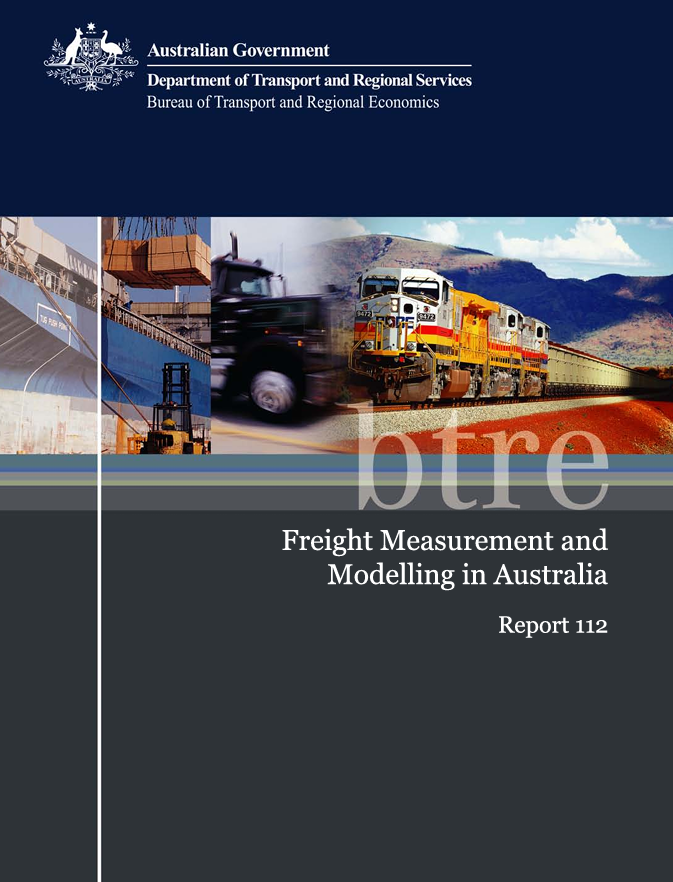
This report summarises the existing knowledge of freight in Australia and presents the time series data, analysis and sources which underpin the BTRE's long-term freight forecasts. Consistently measured time series data are required to model and forecast freight flows. The report describes the methodologies evolved by the BTRE to do this. It includes the results of modelling and forecasting undertaken using the derived series. Non-bulk freight is projected to increase by 82% in tonne-kilometre terms between 2003 and 2020 (average 3.6% per year).
The expected rate of growth in gross domestic product and reductions in freight rates are the key drivers of this growth as well as a continuing trend to national distribution by manufacturers, wholesalers and importers. With Treasury projecting some fall-off in the long-term economic growth, the non-bulk growth rate is slightly lower than in the recent past. Based on past trends, road's share of national non-bulk freight is projected to increase marginally from 74% to 76%, with the rail share declining from 21% to 17% and sea freight making up the balance (with air freight vanishingly small in tonne-kilometre terms, albeit not in value).
These mode share projections do not take account of the potential for rejuvenation of rail on north-south routes, in somewhat the same manner as has already occurred on east-west routes. Capital city freight tonne-kilometres are projected to grow by 3.0% a year between 2003 and 2020 (compared with a 1971–2003 average of 5.0%). While heavy vehicles comprise only 4% of the metropolitan traffic stream, growth of this level implies a slight increase in the heavy vehicle proportion (to 4.2% in 2020).
Rail is expected to remain the largest mode in shipping bulk freight (46% share in 2003, 45% in 2020), followed by sea freight (30% and 29% shares respectively). Rail is well suited for transporting Australia's large export tonnages in coal, other minerals and grains to port. Rail freight has fallen in most other bulk commodities.
Port Level Forecasts of Container and Ship Movements in Australia: 2004–05 to 2024–25
Paper given to the 29th Australian Transport Research Forum conference to be held from 27 to 29 September 2006 in Gold Coast. Authors: Krishna Hamal, Benjamin James, Mark Cregan.
- Port Level Forecasts of Container and Ship Movements in Australia: 2004–05 to 2024–25
Passenger Movements between Australian Cities, 1970–71 to 2030–31
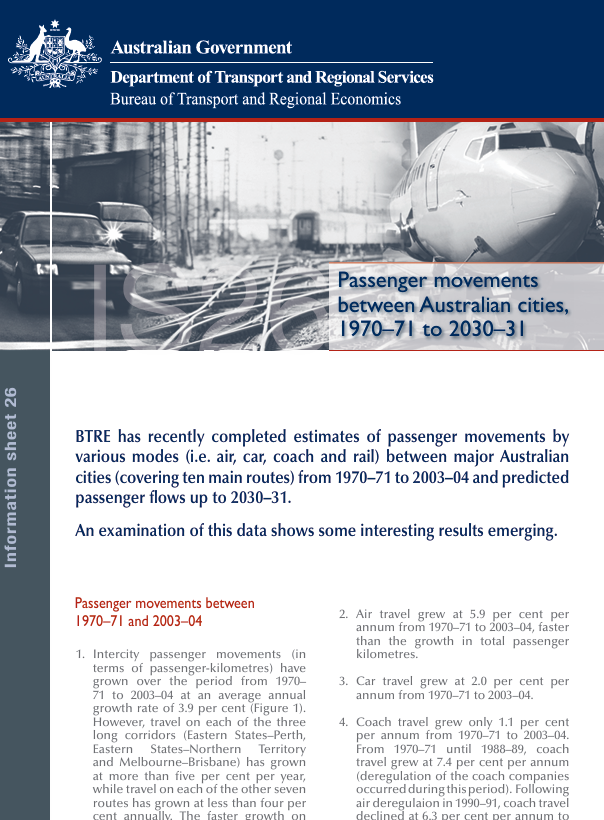
BTRE has recently completed estimates of passenger movements by various modes (i.e. air, car, coach and rail) between major Australian cities (covering ten main routes) from 1970–71 to 2003–04 and predicted passenger flows up to 2030–31.
Container and Ship Movements Through Australian Ports 2004–05 to 2024–25
This report presents the national and port level forecasts of container and ship movements through Australian ports over the next twenty years.
- Container and Ship Movements Through Australian Ports 2004–05 to 2024–25
Air passenger movements through capital city airports to 2025–26
This report presents the forecasts of passenger and aircraft traffic at capital city airports over the next 20 years. The forecasts have been developed on the basis of the estimated econometric models of passenger demand and the most recent economic outlook for Australia and its major trading partners. Australia's eight capital city airports (Adelaide, Brisbane, Canberra, Darwin, Hobart, Melbourne, Perth and Sydney) are included in the development of the forecasts. The report has been updated to 2029–30 in Aircraft movements through capital city airports to 2029–30 in Research report 117.
- Air passenger movements through capital city airports to 2025–26
Modelling the Road Transport Sector
This report was prepared by BITRE and CSIRO, in discussion with Treasury, to provide additional information on the road transport sector modelling carried out jointly by the two agencies in support of Treasury's broader modelling of the introduction of emissions trading in Australia.
- Modelling the Road Transport Sector
National road network intercity traffic projections to 2030

This report provides long-term passenger and freight vehicle traffic projections for intercity corridors of the National Land Transport Network (NLTN) between 2005 and 2030.
- National road network intercity traffic projections to 2030
Urban Congestion Working Group: Critical transport modelling reviews
Reports commissioned in 2009 by the National Transport Modelling Working Group (NTMWG) critically reviewed the current status of the modelling tools available through each of the government agencies in relation to the various models' capability in each capital city. The work identified a number of enhancements for measuring the potential impacts of demand management approaches on road outcomes such as urban congestion. The NTMWG comprises members from each of the government agencies with ownership of the transport models for the respective capital cities; the Department of Infrastructure, Transport, Regional Development and Local Government; and the Bureau of Infrastructure, Transport and Regional Economics.
- Critical Review of Transport Modelling Tools
- Implementation Options Report
Greenhouse Gas Emissions from Australian Transport: Projections to 2020
This working paper models a base case scenario for emissions projections between 2007 and 2020, assuming no further abatement measures are taken. The underlying data has been used in recent reports prepared by the Department of Climate Change and the Treasury.
- Greenhouse Gas Emissions from Australian Transport: Projections to 2020
Aircraft movements through capital city airports to 2029–30
This report presents forecasts of air passenger and aircraft movements through Australia's eight capital city airports (Adelaide, Brisbane, Canberra, Darwin, Hobart, Melbourne, Perth and Sydney) to 2030.
- Aircraft movements through capital city airports to 2029–30