
Impact of COVID-19 on petrol prices in Australia

Australian retail petrol prices are primarily determined by international world oil prices and overseas refined petroleum prices, and variations in exchange rates. As a result of COVID-19 restrictions imposed around the wold, demand for crude oil and refined petroleum products decreased significantly from mid-March 2020 onwards, and led to sharp decreases in crude oil and refined product prices.
The analysis presented in this paper outlines the principal components of Australian retail petrol prices, the impact of COVID-19 on weekly petrol prices and also the typically observed time lag between international refined petroleum product prices and domestic retail petrol prices.
Freight route performance under COVID-19
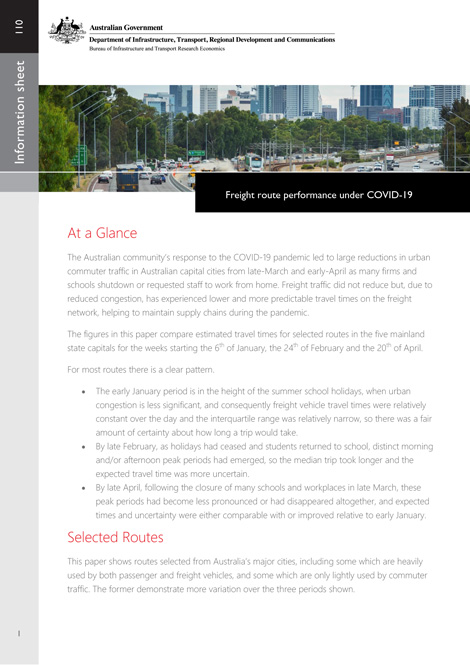
This Information Sheet provides estimates of the impact of the COVID-19 pandemic on freight vehicle travel times for selected routes in Australian major cities in early 2020. The results show that whilst there was no significant change in freight vehicle traffic volumes over that period, freight vehicles experienced shorter and more predictable travel times on many urban freight routes, primarily due to reduced commuting trips. This helped the freight industry to maintain supply chains during the initial stages of the pandemic. The data underlying the estimates is from the BITRE freight telematics program collection, which is sourcing vehicle position data from a small number of road freight operators.
- Freight route performance under COVID-19
Experimental analysis of networked service provision and hierarchies
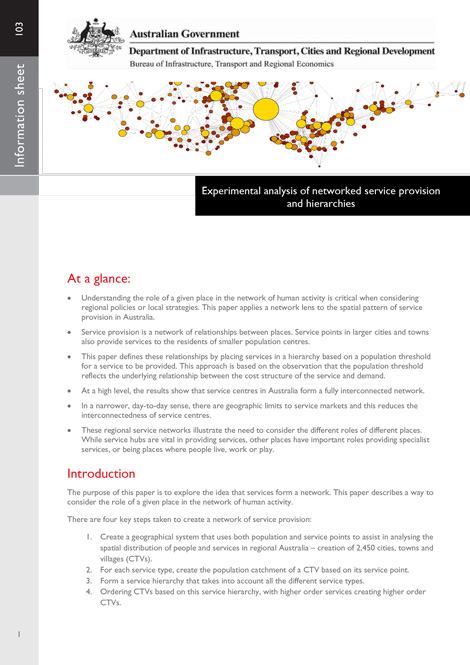
Understanding the role of a given place in the network of human activities is critical when considering regional policies or local strategies. This paper applies a network lens to the spatial pattern of service provision in Australia. It considers the locations of services and their distribution in order to approximate catchment populations, develop population thresholds for each service, and order each service type. From there, the paper establishes a hierarchy of cities, towns and villages and uses this to explore connections between them.
- Experimental analysis of networked service provision and hierarchies
National profile of Transport, postal and warehousing workers in 2016
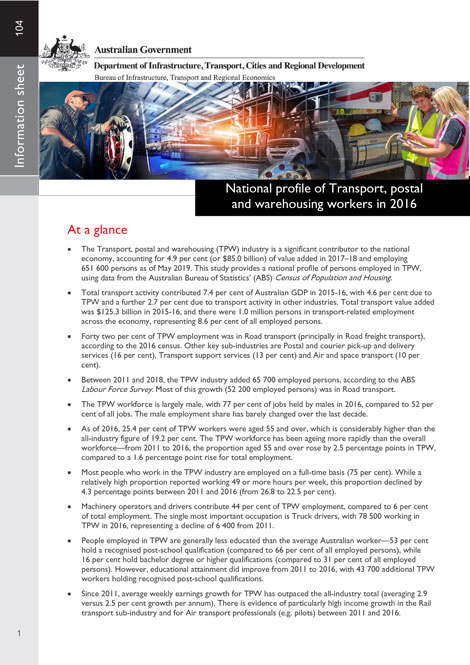
This information sheet is an update of BITRE's previous study on the same subject (BITRE Information Sheet 54) which used ABS 2011 census data. This study used ABS 2016 census data and provides details of the sub-industries in which TPW workers are employed, their employment status, hours worked, gender, age, occupation, educational qualifications, income, work location and commuting behaviour. It also describes some of the key changes that have occurred since 2011, such as the ageing and upskilling of the TPW workforce.
- National profile of Transport, postal and warehousing workers in 2016 [PDF: 863 KB]
National profile of Heavy and civil engineering construction workers in 2016
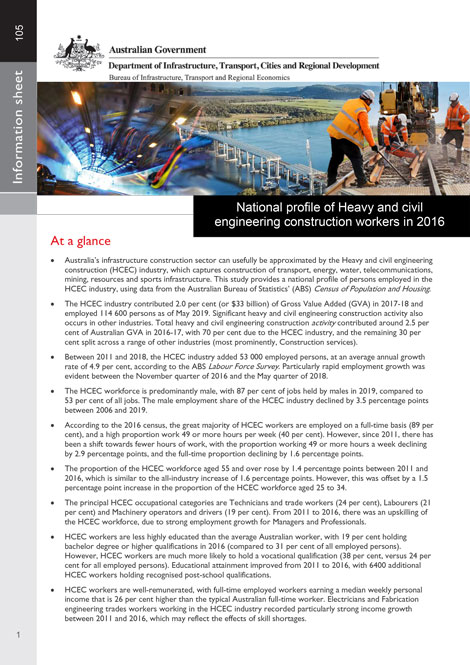
This study explores details of the sub-industries in which HCEC workers are employed, their employment status, hours worked, gender, age, occupation, educational qualifications, income, work location and commuting behaviour. It also describes some of the key changes that have occurred since 2011, including the changing gender mix and the upskilling of the HCEC workforce.
- National profile of Heavy and civil engineering construction workers in 2016
Relationship between transport use and income in Australia
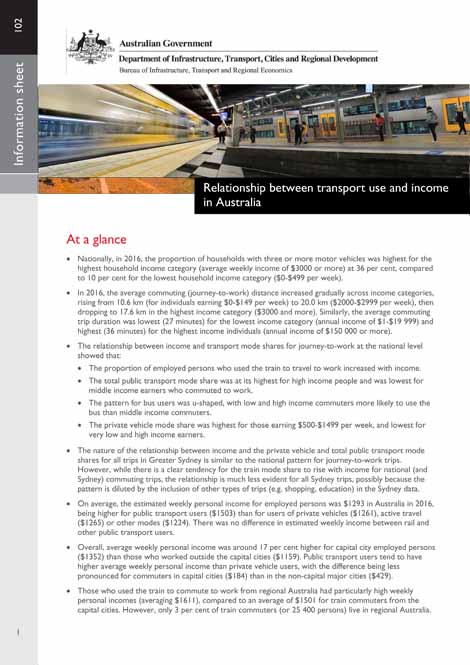
This Information Sheet explores the relationship between income and transport use in Australia by identifying the nature of the relationship between income and different types of transport use, and how public transport use (especially rail) varies with income in different locations. The information presented in this publication will be useful to understand the equity implications of government investment in transport infrastructure, particularly new urban rail infrastructure and implementation of regional development policy for regional cities located within commuting distance of the capital cities.
- Relationship between transport use and income in Australia
Economies of scope and regional services
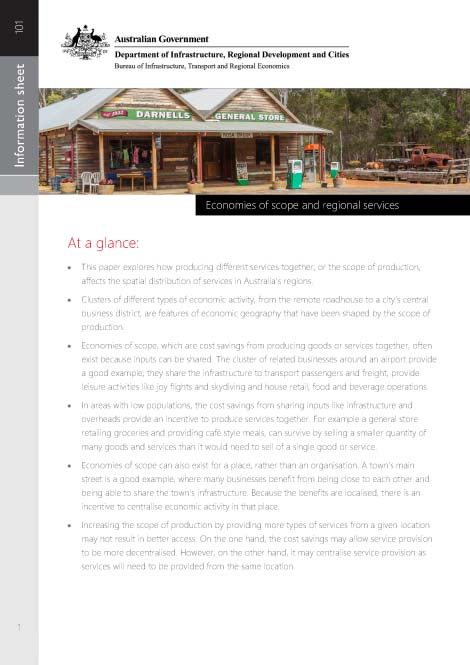
This paper explores how producing different services together, or the scope of production, affects the spatial distribution of services in Australia's regions. Clusters of different types of economic activity, from the remote roadhouse to a city's central business district, are features of economic geography that have been shaped by these economic forces.
- Economies of scope and regional services
Measuring Gross Regional Product
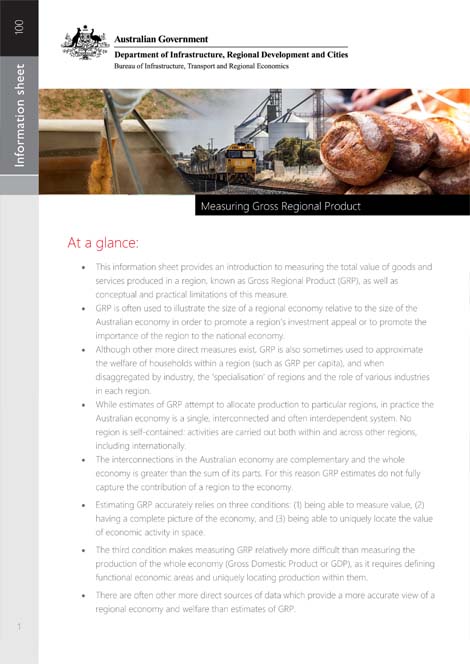
This information sheet provides an introduction to measuring the total value of goods and services produced in a region, known as Gross Regional Product (GRP), as well as conceptual and practical limitations of this measure.
- Measuring Gross Regional Product
Economies of scale and regional services
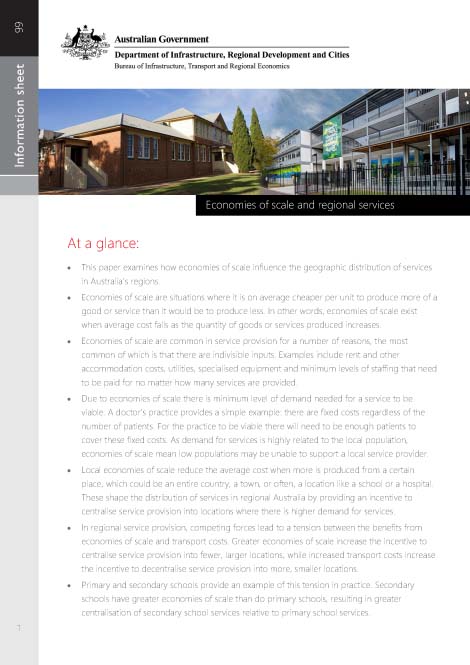
Economies of scale are a common feature of the cost structure of service providers. This paper discussed how economies of scale incentivise the geographic centralisation of services because they make it cheaper to supply services from fewer centralised locations. The paper also articulates the trade-off between centralising to gain the benefits from economies of scale and the costs of centralisation. These costs include extra transport costs for people who access the services and the costs to society from people not using the services due to difficulty accessing them. This creates a tension between the benefits from economies of scale and the benefits from having more geographically dispersed services.
- Economies of scale and regional services
An introduction to where Australians live
This paper provides an introduction to how people are distributed spatially across Australia. The discussion is broken into two sections. The first describes the distribution of where people live across Australia, examines the way in which people are clustered into Cities, Towns and Villages (CTVs) and then analyses the distribution of these clusters. The second outlines how two characteristics, isolation and density, changes across cities, towns and villages, with a particular focus on the link to population size.
- An introduction to where Australians live
- An introduction to where Australians live