
Urban Transport Models: A Review
Transport models have been used for several decades now, both for research, and as an analytical tool to assist planners and decision-makers. As the complexity of traffic and environmental problems in our cities has increased, policy makers have come to depend on models to an even greater extent. The immense increase in available computing power over the last decade has abetted this dependence. Customised software has simplified even the most complex mathematics to such an extent that modelling is no longer the preserve of a select few 'rocket scientists'. If asked, however, many policy analysts and decision-makers would probably admit to a lack of understanding of the models on the results of which they rely. Billions of dollars in resources are expended annually in Australia despite a lack of full understanding of the basis on which decisions are made. To assist both researchers and decision-makers, Dr William (Weiguo) Lu has dissected the major models that have been used to analyse urban transport tasks. This Working Paper therefore represents something of a 'scene-setter' for further work. While a purely non-technical approach is not feasible, he has sought to provide an intuitive exposition of the basic concepts involved, relying on a minimum of mathematical expression.
- Urban Transport Models: A Review
Urban Transport: Looking Ahead
Australian cities have been transformed from fairly tightly knit core-and-spoke configurations, to sprawling suburban low-density configurations. This transformation of urban land use has been accompanied and made possible by a rapid improvement and spread of the road system, and an even more rapid expansion in per person car ownership.
- Urban Transport: Looking Ahead
Drivers of Economic Growth in the Greater Sydney Metropolitan Region

The Greater Sydney Metropolitan Region is one of the fastest growing metropolitan areas of Australia. This project improves our understanding of socio-economic drivers of growth in this region. 54 Statistical Local Areas (SLAs) in the region were analysed, and the study covers the period 1991 to 2001. The paper is accompanied by the Drivers of Economic Growth in the Greater Sydney Metropolitan Region database.
- Drivers of Economic Growth in the Greater Sydney Metropolitan Region
- Statistical Index

COAG commissioned the Review in February 2006 with a focus on national freight corridors but also examining local networks where they interact with, and impact on, these corridors. The Review report was prepared by a working group of representatives from the Department of Transport and Regional Services, State and Territory government transport and planning agencies and the Australian Local Government Association. The Review was overseen by the COAG Competition and Regulation Working Group. The BTRE provided the Secretariat to the Review.
- COAG Urban Congestion Review Report
- Congestion Management Approaches
- Freight Smart
- Traffic Management Systems (Urban Motorways)
- TMS Urban Non Motorway
Estimating urban traffic and congestion cost trends for Australian cities
The study deals with the eight Australian capital cities, and presents base case (or business-as-usual) projections to 2020 of avoidable social costs of congestion for Australian metropolitan traffic. This work updates and revises previous congestion cost projections published by the Bureau (such as Information Sheet 14, BTE 1999), and has been completed to inform the Urban Congestion Review, which was commissioned by the Council of Australian Governments (COAG).
- Estimating urban traffic and congestion cost trends for Australian cities
Air passenger movements through capital city airports to 2025–26
This report presents the forecasts of passenger and aircraft traffic at capital city airports over the next 20 years. The forecasts have been developed on the basis of the estimated econometric models of passenger demand and the most recent economic outlook for Australia and its major trading partners. Australia's eight capital city airports (Adelaide, Brisbane, Canberra, Darwin, Hobart, Melbourne, Perth and Sydney) are included in the development of the forecasts. The report has been updated to 2029–30 in Aircraft movements through capital city airports to 2029–30 in Research report 117.
- Air passenger movements through capital city airports to 2025–26
Moving urban Australia: can congestion charging unclog our roads?
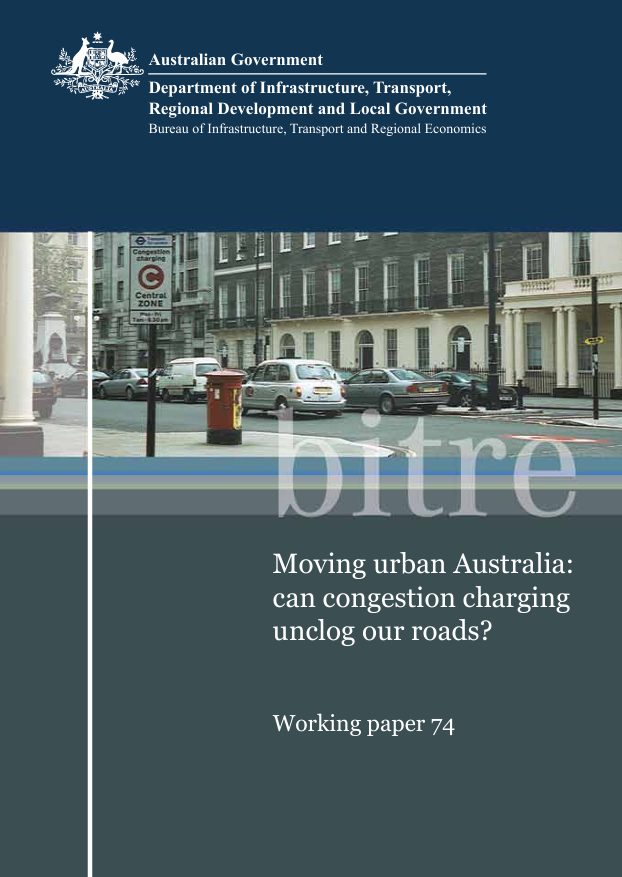
This report reviews the case for congestion charging and provides a policy framework for assessing charging systems. Congestion charging schemes are still in their infancy and evolving in concert with changing policy priorities and system technologies. While individual circumstances determine when and where congestion charging is in the interest of the wider community, some important general lessons can be drawn.
Update August 2009
Responses to the discussion of personalised promotion of alternatives to solo driving (pages 26–7), as one of the existing strategies to manage congestion, have drawn our attention, firstly, to some larger-scale current initiatives of Australian jurisdictions and, secondly, to more recent literature on the effectiveness of the travel behaviour change approach in relation to its various objectives, particularly reducing motorised trips and reducing greenhouse gas emissions.
For information on existing activities in 2 states, see About Travelsmart and Travelsmart General Information. On the effectiveness and impact of the travel behaviour approach, as implemented in Australia and the United Kingdom, see in particular: Australian Greenhouse Office, Evaluation of TravelSmart Projects in the ACT, South Australia, Queensland, Victoria and Western Australia 2001–2005, Department of Environment and Heritage 2006; Brog W. And Ker I., Myths, (Mis)perceptions and reality in measuring voluntary behaviour change, 8th International Conference on Survey Methods in Transport, Annecy, France, May 2008; Department for Transport (United Kingdom), Making Personal Travel Planning Work: Research Report, Integrated Transport Planning Ltd, December 2007; Department for Transport (United Kingdom), Impact assessment of the carbon reduction strategy for transport, July 2009; and Stopher P., Clifford E., Halling B., Evaluating a voluntary travel behaviour change by means of a 3-year GPS panel, Proceedings of the TDM2008 Conference, Vienna, Austria (forthcoming).
Improving urban congestion information for decision making: report to COAG from the Australian Transport Council
In April 2007, COAG considered the Urban Congestion Review it had commissioned in February 2006, and tasked the Australian Transport Council (ATC) with establishing arrangements to improve urban congestion data, modelling and performance information for decision-making. The following document, 'Improving Urban Congestion Information for Decision-Making', is a progress report to COAG of mid-2008. At its 7 November 2008 meeting, ATC noted further progress with implementing agreed approaches, including establishing a National Transport Modelling Working Group, progressing improved consistency between road-based and public transport congestion indicators, a survey of business sector travel, and analyses of specific congestion initiatives.
- Improving urban congestion information for decision making: report to COAG from the Australian Transport Council
Household Wealth
This information paper presents and explores new statistical information relating to household wealth at a small area scale. The paper also explores the relationship between wealth and income for Australia's cities and regions.
- Household Wealth–Information Paper
- Household wealth
- Staff paper–economic wellbeing of Australia's regions

- Mapping wealth in cities
Changes in Australia's Industry Structure: Main Cities 2001–06

BITRE's Industry Structure Database and information sheet 32 present the latest regional industry trends. The study analyses the shifting geography of employment and highlights the dynamics of industry structure in Australia's main cities between 2001 and 2006. This is an update of the first Industry Structure study (and the database) which was published in 2003.
- Changes in Australia's Industry Structure: Main Cities 2001–06
- Industry Structure Database 2009