
Australian Infrastructure Statistics—Yearbook 2018
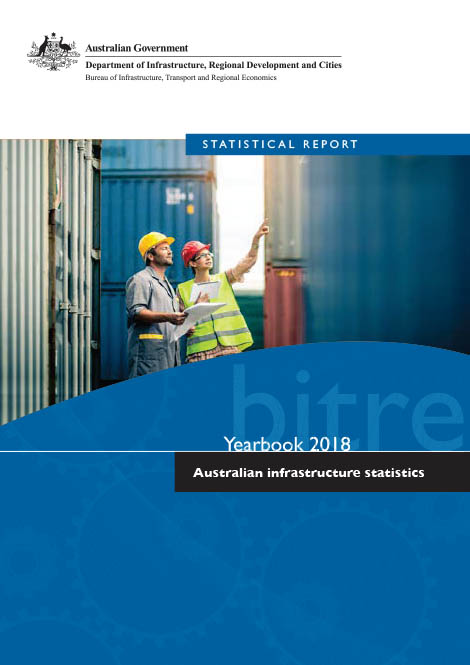
The Australian infrastructure statistics yearbook provides a comprehensive evidence base to examine long-term and emerging trends as well as inform policy development and regulatory reform in the transport, energy, water and communications sectors. It is the only comprehensive source of time series statistics for Australia's major areas of economic infrastructure. The yearbook is accompanied by the Key Australian Infrastructure Statistics Booklet which is a summary of statistics from the yearbook.
To complement the Australian Infrastructure Statistics Yearbook, BITRE has developed an Infrastructure Construction Dashboard. The Infrastructure Construction Dashboard presents quarterly updates on transport, communications, energy and water infrastructure construction, based on the ABS Engineering Construction Activity series.
- Yearbook 2018–Australian Infrastructure Statistics
- Key Australian Infrastructure Statistics 2018
- Australian Infrastructure Statistics Yearbook 2018 Part I–Infrastructure and the Economy

- Australian Infrastructure Statistics Yearbook 2018 Part T–Transport
- Australian Infrastructure Statistics Yearbook 2018 Part E–Energy
- Australian Infrastructure Statistics Yearbook 2018 Part C–Communication
- Australian Infrastructure Statistics Yearbook 2018 Part W–Water
Forecasting Australian Transport: A Review of Past Bureau Forecasts
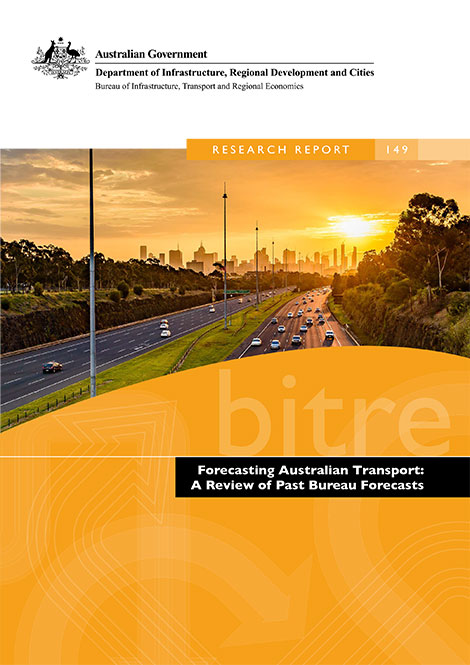
A common rational for the making of transport-related forecasts is the need to anticipate the growth of transport activity and the demand it will place on transport infrastructure. Anticipation of this demand allows for forward planning of needed improvements/additions to key parts of the networks.
As such, it is useful to examine how close past Bureau forecasts were to predicting this growth, and to learn from any obvious errors.
This is the aim of the current report.
- Forecasting Australian Transport: A Review of Past Bureau Forecasts
Australian Infrastructure Statistics—Yearbook 2017
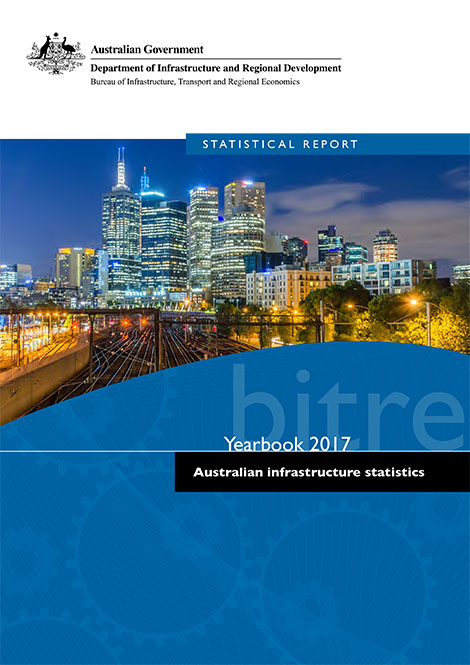
The Australian infrastructure statistics yearbook provides a comprehensive evidence base to examine long-term and emerging trends as well as inform policy development and regulatory reform in the transport, energy, water and communications sectors. It is the only comprehensive source of time series statistics for Australia's major areas of economic infrastructure. The yearbook is accompanied by the Key Australian Infrastructure Statistics Booklet which is a summary of statistics from the yearbook.
- Yearbook 2017–Australian Infrastructure Statistics
- Key Australian Infrastructure Statistics 2017
- Australian Infrastructure Statistics Yearbook 2017 Part I–Infrastructure and the Economy
- Australian Infrastructure Statistics Yearbook 2017 Part T–Transport
- Australian Infrastructure Statistics Yearbook 2017 Part E–Energy
- Australian Infrastructure Statistics Yearbook 2017 Part C–Communication
- Australian Infrastructure Statistics Yearbook 2017 Part W–Water
Fuel economy of Australian passenger vehicles—a regional perspective
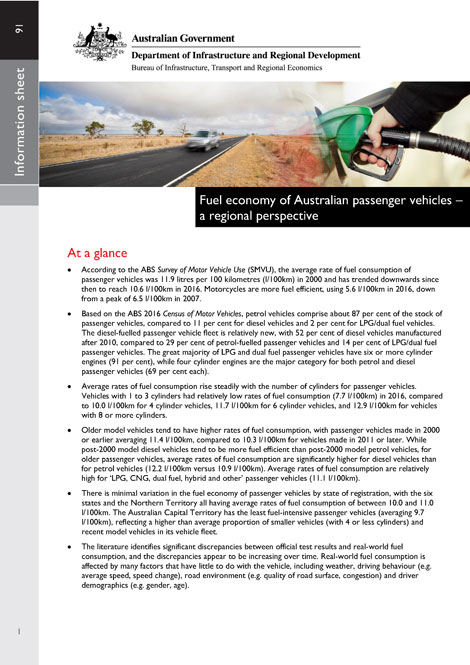
This information sheet presents Australian data on how realised rates of fuel consumption vary over time, and how the rates depend on key vehicle characteristics such as number of cylinders, fuel type and vehicle age. It also investigates state/territory differences in fuel economy and presents new small area estimates of the average rate of fuel consumption for Australia's regions.
These small area estimates are based on the composition of the passenger vehicle and motorcycle fleet in the region, and are derived at both the Statistical Area Level 3 (SA3) and Statistical Area Level 4 (SA4) scale. The key data sources are the Australian Bureau of Statistics (ABS) Survey of Motor Vehicle Use (SMVU) 2016 and the ABS Census of Motor Vehicles 2016.
- Fuel economy of Australian passenger vehicles–a regional perspective
Australian Infrastructure Statistics—Yearbook 2016
The Australian infrastructure statistics yearbook provides a comprehensive evidence base to examine long-term and emerging trends as well as inform policy development and regulatory reform in the transport, energy, water and communications sectors. It is the only comprehensive source of time series statistics for Australia's major areas of economic infrastructure. The yearbook is accompanied by the Key Australian Infrastructure Statistics Booklet which is a summary of statistics from the yearbook.
- Yearbook 2016–Australian Infrastructure Statistics
- Key Australian Infrastructure Statistics 2016
- Australian Infrastructure Statistics
Yearbook 2016
Part I–Infrastructure and the Economy
- Australian Infrastructure Statistics
Yearbook 2016
Part T–Transport
- Australian Infrastructure Statistics
Yearbook 2016
Part E–Energy
- Australian Infrastructure Statistics
Yearbook 2016
Part C–Communication
- Australian Infrastructure Statistics
Yearbook 2016
Part W–Water
A dozen facts about transport in Australia
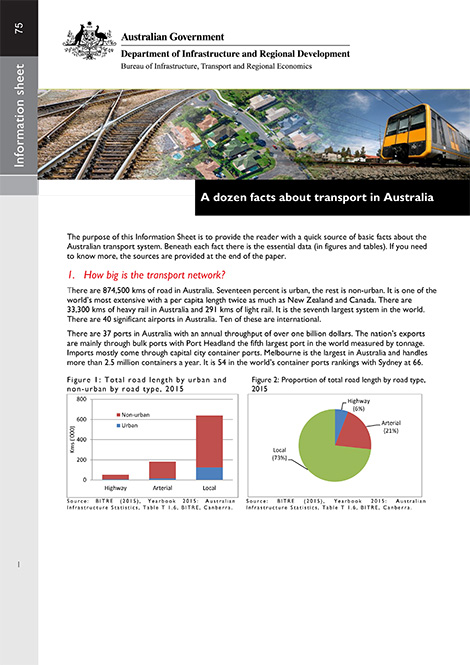
This information sheet covers a wide range of subjects, including commuting, freight, rail, energy and safety. The following 12 facts are included:
- How big is the transport network?
- How far do we travel?
- Is this increasing?
- How do we travel?
- Are we changing how we travel?
- Why do we travel like this?
- What about freight?
- Is freight transport increasing?
- Are we commuting longer?
- How do we pay for transport?
- Is transport becoming more energy efficient and causing less emissions? and
- Is transport safety improving?
- A dozen facts about transport in Australia
Australian infrastructure statistics—Yearbook 2015 and key Australian infrastructure statistics booklet 2015
The Yearbook provides a comprehensive evidence base to examine long-term and emerging trends as well as inform policy development and regulatory reform in the transport, energy, water and communications sectors. It is the only comprehensive source of time series statistics for Australia's major areas of economic infrastructure. The Yearbook is accompanied by the key Australian infrastructure statistics booklet which is a summary of statistics from the Yearbook.
- Yearbook 2015–Australian Infrastructure Statistics
- Key Australian Infrastructure Statistics 2015
- Australian Infrastructure Statistics
Yearbook 2015
Part I–Infrastructure and the Economy
- Australian Infrastructure Statistics
Yearbook 2015
Part T–Transport
- Australian Infrastructure Statistics
Yearbook 2015
Part E–Energy
- Australian Infrastructure Statistics
Yearbook 2015
Part C–Communication
- Australian Infrastructure Statistics
Yearbook 2015
Part W–Water
Australian infrastructure statistics—Yearbook 2014 and key Australian infrastructure statistics booklet
The Yearbook provides a comprehensive evidence base to examine long-term and emerging trends as well as inform policy development and regulatory reform in the transport, energy, water and communications sectors. It is the only comprehensive source of time series statistics for Australia's major areas of economic infrastructure. The Yearbook is accompanied by the Key Australian Infrastructure Statistics booklet which is a summary of statistics from the Yearbook.
- Yearbook 2014–Australian Infrastructure Statistics
- Key Australian Infrastructure Statistics
- Australian Infrastructure Statistics
Yearbook 2014
Part I–Infrastructure and the Economy
- Australian Infrastructure Statistics
Yearbook 2014
Part T–Transport
- Australian Infrastructure Statistics
Yearbook 2014
Part E–Energy
- Australian Infrastructure Statistics
Yearbook 2014
Part C–Communication
- Australian Infrastructure Statistics
Yearbook 2014
Part W–Water
New passenger vehicle fuel consumption trends, 1979 to 2013
The trends evident in BITRE's earlier Information Sheet (BITRE 2009) have continued since 2008. Vehicle sales have increased, with the SUV and LCV categories continuing to increase their shares. With the introduction of compact and more fuel-efficient 4WDs, the growing SUV category has shown a considerable reduction in rated fuel consumption. LCV sales have also been increasing, though not as strongly as SUVs, along with a similarly decreasing level (since about 2006) in rated fuel consumption.
In the past (before 2008), Australian consumers' preference for vehicle characteristics that typically increased fuel consumption (such as higher power, larger size, more accessories or 4WD capability), meant that potential reductions in fuel consumption made possible by technological advances were not fully realised. This has been a worldwide trend in the automobile sector. However, that said, the long-term downward trend in energy intensity has increased in recent years as the latest generation of more fuel efficient light vehicles (including hybrids) entered the market, and with some buyers moving to smaller vehicles as petrol prices rose. The result has been a marked acceleration, over recent years, of the downward trend in the rated fuel consumption (tested L/100km) of new vehicles sold.
- New passenger vehicle fuel consumption trends, 1979 to 2013
Infrastructure Investment Macromonitor
This information sheet provides an overview of activity in five key Australian infrastructure industries: transport, energy, communications, water and resources.
The purpose of the report is to track investment in infrastructure and explore its impact on infrastructure performance, usage and productivity.
- Infrastructure Investment Macromonitor