
Australian Transport Statistics Yearbook 2007
Australian Transport Statistics provides a short summary of a diverse range of transport statistics. Topics include employment, GDP, passenger and freight movements, trade, funding, motor vehicles, fatalities and estimated greenhouse gas emissions attributed to the transport industry. Information is provided for the road, rail, maritime and aviation sectors. Data are gathered from various sources both within BTRE and external organisations.
- Australian Transport Statistics Yearbook 2007
- Australian Transport Statistics Yearbook 2007–Spreadsheets

Australian Transport Statistics 2008—pocket booklet
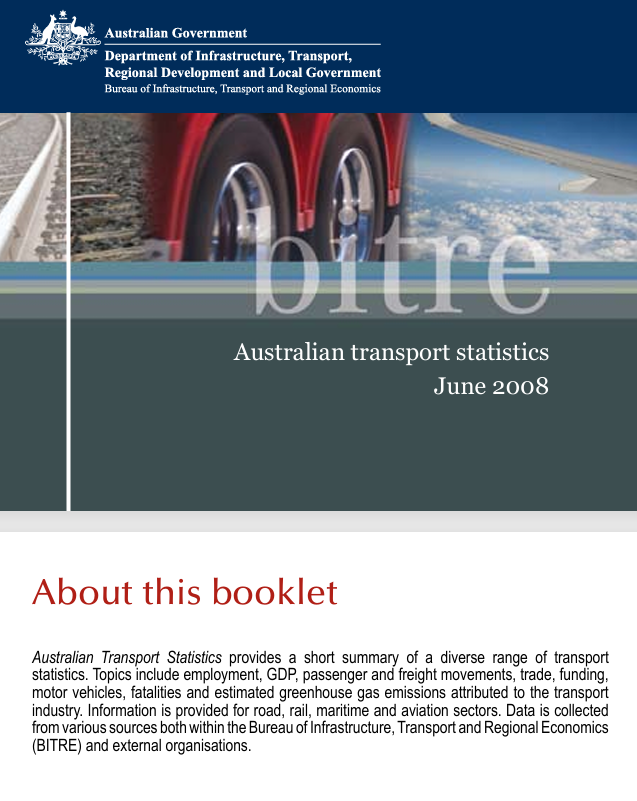
Australian Transport Statistics provides a short summary of a diverse range of transport statistics. Topics include employment, GDP, passenger and freight movements, trade, funding, motor vehicles, fatalities and estimated greenhouse gas emissions attributed to the transport industry.
Australian transport statistics Yearbook 2009
Australian Transport Statistics provides a short summary of a diverse range of transport statistics. Topics include employment, GDP, infrastructure expenditure, passenger and freight movements, trade, motor vehicles, fatalities and estimated greenhouse gas emissions attributed to the transport industry. Information is provided for the road, rail, maritime and aviation sectors. Data are gathered from various sources both within BITRE and external organisations.
- Australian transport statistics Yearbook 2009
- Australian transport statistics Yearbook 2009–Spreadsheets
Road Deaths in Australia 1925–2008
This information sheet contains a historical overview of road death statistics in Australian from 1925, when road deaths were first recorded, to 2008.
- Road Deaths in Australia 1925–2008
Cost of road crashes in Australia 2006
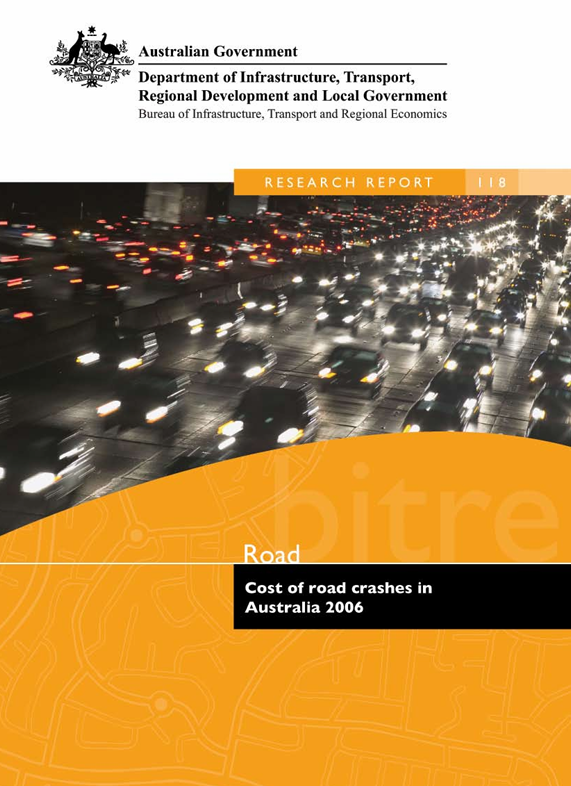
Road crashes impose large human and financial costs on society and substantial investments are made in infrastructure and safety programs to reduce road trauma. The cost of road crashes is important to the safety debate in Australia, and the unit values particularly for a fatality, injury or cost of a fatal crash are key inputs into policy development and cost-benefit analysis for safety programs and infrastructure projects. The social cost of road crashes in 2006 was an estimated $17.85 billion (1.7 per cent of GDP). This was a real decrease of 7.5 per cent compared to 1996 (2006 dollars). Estimated human losses were approximately $2.4 million per fatality, losses for a hospitalised injury were approximately $214 000 per injury (including disability-related costs), and losses for non-hospitalised injury were approximately $2200 per injury. These new estimates of the cost of road crashes update previous estimates for 1996 (Bureau of Transport Economics (BTE) Road crash costs in Australia, Report 102).
Effectiveness of Measures to Reduce Road Fatality Rates
An earlier paper (Gargett et al 2009) showed, by very preliminary analysis of the Victorian road fatality rate, that a combination of increased seat belt wearing, random breath testing (RBT) and speed cameras explained almost all of the reduction in the Victorian road fatality rate since the late 1960s. The current analysis 1) extends the analysis to all states, 2) uses new estimates of vehicle kilometres travelled to derive an "exposure to death" variable and 3) includes actual measurements of state rates of seat belt wearing, as well as RBT and speed camera enforcement back to the inception of the programs in each state. The results of the analysis confirm the findings of the earlier paper seat belt wearing, RBT and speed cameras can explain almost all of the variation in fatality rates in all states since the late 1960s.
- Effectiveness of Measures to Reduce Road Fatality Rates
Australian infrastructure statistics—Yearbook 2011
The Australian Infrastructure Statistics Yearbook 2011 provides a single comprehensive source of Australian infrastructure statistics time series statistics for measures of transport, energy, communications and water infrastructure and the use of this infrastructure in Australia.
- Australian Infrastructure Statistics Yearbook 2011
- Australian Infrastructure Statistics Yearbook 2011 Tables
- Australian Infrastructure Statistics Yearbook 2011
Part I–Infrastructure and the Economy
- Australian Infrastructure Statistics Yearbook 2011
Part T–Transport
- Australian Infrastructure Statistics Yearbook 2011
Part E–Energy
- Australian Infrastructure Statistics Yearbook 2011
Part C–Communication
- Australian Infrastructure Statistics Yearbook 2011
Part W–Water
Fatal Road Crashes in Australia in the 1990s and 2000s: Crash Types and Major Factors
This information sheet aims to provide some statistical snapshots of the characteristics of fatal road crashes in Australia in the last two decades, 1990 to 2009, and complements the road safety statistical summary produced by BITRE each year which presents other key time series. It includes some insights into the types of crashes prevalent during this period, the major factors and the road user groups most frequently involved.
- Fatal Road Crashes in Australia in the 1990s and 2000s: Crash Types and Major Factors