
Drivers of Economic Growth in the Greater Sydney Metropolitan Region

The Greater Sydney Metropolitan Region is one of the fastest growing metropolitan areas of Australia. This project improves our understanding of socio-economic drivers of growth in this region. 54 Statistical Local Areas (SLAs) in the region were analysed, and the study covers the period 1991 to 2001. The paper is accompanied by the Drivers of Economic Growth in the Greater Sydney Metropolitan Region database.
- Drivers of Economic Growth in the Greater Sydney Metropolitan Region
- Statistical Index

Regional economic growth: BITRE's taxable income database
This economic growth update builds on information paper 54, Focus on regions 3–Taxable Income.
The taxable income database contains small-area data from 1980–81 to 2004–05 on a number of indicators. The main indicator is the amount of taxable income each region earns, the change in which can be used as an indicator of economic growth.
The interactive pdfs accompanying the update contain maps of regional growth, graphs of growth by state and remoteness class, and the methodology for the update.
- Notes on method: the BITRE's taxable income database 2007 update
- Taxable income database
Regional economic growth: BITRE's taxable income database (2007 update)
This is the 2007 update of BITRE's economic growth database. For the latest update of the database, please click here Regional economic growth database update 2005–06.
The taxable income database contains small-area data from 1980–81 to 2004–05 on a number of indicators. The main indicator is the amount of taxable income each region earns, the change in which can be used as an indicator of economic growth.
In the interactive pdfs accompanying the update, BITRE has created over a hundred maps and many supporting graphs which allow you to explore inter-regional comparisons and time series of regional growth in Australia. These are often at the local government level.
To access these, you will need to download (SAVE) the files below (~8MB).
NOTE:This program will not run unless SAVED first.
Download (SAVE) the EconomicGrowth_V1.1.zip file, extract it, and double click other_002_EconomicGrowth_V1.1.Msi to install. Mac and Linux users download the Zip file and double click to extract.
The pdfs and database will then be permanently accessible on your computer.
This economic growth update builds on information paper 54, Focus on regions 3–Taxable Income.
- Regional Economic Growth for MS Windows (msi)
- Regional Economic Growth for Mac and Linux
- Notes on method: the BITRE's taxable income database 2007 update
- Taxable income database
Submission to ACCC on impact of location on grocery prices and availability in regional Australia
BITRE's upcoming comprehensive publication will provide a more detailed analysis of the factors that impact on the full range of living costs across Australia. This submission includes some preliminary conclusions from the analysis of data on grocery prices collected for the main study.
The study confirms the view that grocery store prices vary widely across locations. It also finds the presence of a major chain in a town is a practical indicator of the price level of groceries in non-metropolitan centres. The major chain stores are more prevalent in larger population centres.
- Submission to ACCC on impact of location on grocery prices and availability in regional Australia
About Australia's Regions 2008
This booklet provides an accessible introduction to social, economic and environmental statistics for Australia's regions. Information is presented under the following broad themes: population; society; regional economies; housing; transport and communications; education and health; and environmental issues.
- About Australia's Regions 2008
Moving urban Australia: can congestion charging unclog our roads?
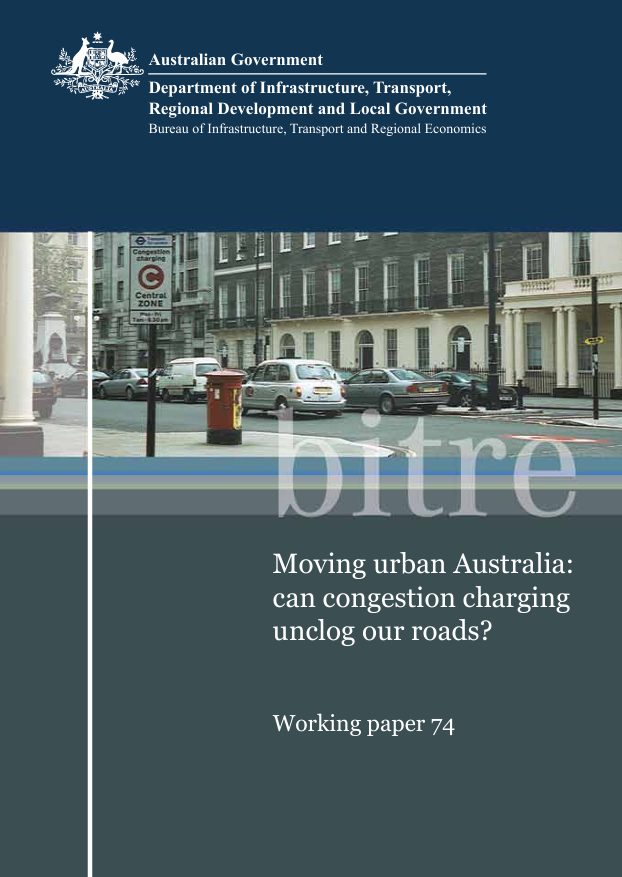
This report reviews the case for congestion charging and provides a policy framework for assessing charging systems. Congestion charging schemes are still in their infancy and evolving in concert with changing policy priorities and system technologies. While individual circumstances determine when and where congestion charging is in the interest of the wider community, some important general lessons can be drawn.
Update August 2009
Responses to the discussion of personalised promotion of alternatives to solo driving (pages 26–7), as one of the existing strategies to manage congestion, have drawn our attention, firstly, to some larger-scale current initiatives of Australian jurisdictions and, secondly, to more recent literature on the effectiveness of the travel behaviour change approach in relation to its various objectives, particularly reducing motorised trips and reducing greenhouse gas emissions.
For information on existing activities in 2 states, see About Travelsmart and Travelsmart General Information. On the effectiveness and impact of the travel behaviour approach, as implemented in Australia and the United Kingdom, see in particular: Australian Greenhouse Office, Evaluation of TravelSmart Projects in the ACT, South Australia, Queensland, Victoria and Western Australia 2001–2005, Department of Environment and Heritage 2006; Brog W. And Ker I., Myths, (Mis)perceptions and reality in measuring voluntary behaviour change, 8th International Conference on Survey Methods in Transport, Annecy, France, May 2008; Department for Transport (United Kingdom), Making Personal Travel Planning Work: Research Report, Integrated Transport Planning Ltd, December 2007; Department for Transport (United Kingdom), Impact assessment of the carbon reduction strategy for transport, July 2009; and Stopher P., Clifford E., Halling B., Evaluating a voluntary travel behaviour change by means of a 3-year GPS panel, Proceedings of the TDM2008 Conference, Vienna, Austria (forthcoming).
A regional economy: a case study of Tasmania
The Department of Infrastructure, Transport, Regional Development and Local Government is committed to the prosperity of Australia's regions. In order to promote economic and social development it is important that we understand the environment in which regional economies operate. This study provides an analytical investigation of the challenges facing regional Australia. BITRE's study takes a multifaceted and holistic approach. The underlying principle is that economies do not work in isolation and a complex mix of interacting drivers affects a region's economic performance. Tasmania's economic performance has experienced changing fortunes over the past two decades. This development provided a unique opportunity to investigate the drivers of this change and to find out if there are lessons for regional policy.
- A regional economy: a case study of Tasmania
The files available from this website may not be suitable for users of assistive technology on all devices.
If you experience difficulties and require assistance, please contact us using the feedback page. Please include which device and assistive technology you are using.
Improving urban congestion information for decision making: report to COAG from the Australian Transport Council
In April 2007, COAG considered the Urban Congestion Review it had commissioned in February 2006, and tasked the Australian Transport Council (ATC) with establishing arrangements to improve urban congestion data, modelling and performance information for decision-making. The following document, 'Improving Urban Congestion Information for Decision-Making', is a progress report to COAG of mid-2008. At its 7 November 2008 meeting, ATC noted further progress with implementing agreed approaches, including establishing a National Transport Modelling Working Group, progressing improved consistency between road-based and public transport congestion indicators, a survey of business sector travel, and analyses of specific congestion initiatives.
- Improving urban congestion information for decision making: report to COAG from the Australian Transport Council
Household Wealth
This information paper presents and explores new statistical information relating to household wealth at a small area scale. The paper also explores the relationship between wealth and income for Australia's cities and regions.
- Household Wealth–Information Paper
- Household wealth
- Staff paper–economic wellbeing of Australia's regions

- Mapping wealth in cities
Urban Passenger Transport: How People Move About in Australian Cities
Information Sheet 31 analyses the trends in passenger transport in Australia's eight capital cities over the period 1977 to 2008. Although car travel continues to dominate travel in our cities, urban public transport has accounted for much of the growth in travel from 2004 to 2008.
- Urban Passenger Transport: How People Move About in Australian Cities