
Logistics in Australia: A Preliminary Analysis
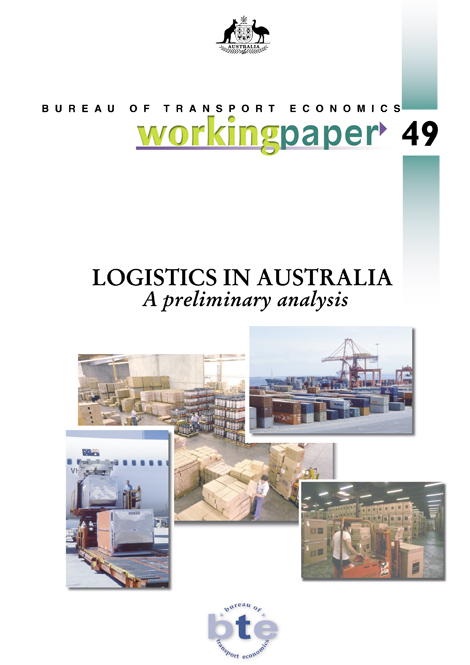
This paper presents the results of preliminary BTE work on logistics in Australia. It draws on the BTE's experience and expertise in the transport sector, and also incorporates information on logistics from sources such as a literature review. The performance of the logistics system has a major impact on cost structures, revenues, service quality, and competitiveness in Australian industry. Logistics activities have been evolving rapidly in response to changes such as globalisation, general industry restructuring, new production processes, and technological advances. Many firms, government agencies and joint industry/government bodies are developing programs to improve logistics performance in Australia. The initiatives include the Freight Transport Logistics Industry Action Agenda. This paper develops a broad framework for analysing logistics activities. It also examines three priority issues identified by the Secretariat for the development of the Action Agenda the economic significance of logistics in Australia, the extent of integration, and the dimensions of a full economic study.
- Logistics in Australia: A Preliminary Analysis
Australia's Seaborne Containerised Freight: Forecasts to 2010–11
This study analyses and forecasts trends in the usage of containers for the carriage of Australia's seaborne freight over the period 2001–02 to 2010–11. The study also estimates the proportion of 40-foot containers used in Australia's inbound and outbound seaborne trade and assesses the implications of their increasing use over time.
- Australia's Seaborne Containerised Freight: Forecasts to 2010–11
Freight Rates in Australia

This paper provides estimates of interstate non-bulk freight rates. The estimates show that, in real terms, it has never been cheaper to ship goods in Australia.
- Freight Rates in Australia
Freight Between Australian Cities 1972 to 2001
This paper provides estimates of non-bulk freight flows over seven intercity corridors for three decades from 1972 to 2001. Earlier estimates to 1995 were published in Information Sheet 17.
- Freight Between Australian Cities 1972 to 2001
An Overview of the Australian Road Freight Transport Industry

This paper presents the results of a desk study of the road freight industry. The aim of the study is to update our knowledge of the Australian freight industry by bringing together and analysing information that is currently available. The study is intended as a 'building block' for a future larger survey-based study of the road freight and logistics industries. It is now 20 years since comprehensive studies of the road freight industry were undertaken, by the Bureau of Transport Economics and the Australian Bureau of Statistics.
- An Overview of the Australian Road Freight Transport Industry
Modelling Responses of Urban Freight Patterns to Greenhouse Gas Abatement Scenarios

This paper presents the results of applying a policy model to simulate the effects on greenhouse gas emissions from trucking in Sydney of various abatement scenarios. These include vehicle efficiency scenarios, traffic efficiency scenarios and alternative infrastructure and land use scenarios. The model developed is quite comprehensive. It includes the effects of the interaction of trucks with car traffic in the city. And it extends the results, not only to the recognised greenhouse gases, but also to the effect of the scenarios on pollutant emissions from road transport and thus on pollution in the Sydney airshed. The research reported on here shows that, using the model developed, answers can be given as to detailed effects of transport policy measures on emissions in Sydney. Just as importantly, it points to methods that can be used to build such a model in other cities. The series of five technical papers describing the construction and make-up of the model and its capabilities is available on the CSIRO website (www.energytransformed.csiro.au). CSIRO was the co-ordinator of the research, with Parsons Brinckerhoff and the Transport Systems Centre of the University of South Australia contributing components. CSIRO prepared this report. The Transport and Population Data Centre of the NSW Department of Infrastructure, Planning and Natural Resources provided the datasets of traffic and now owns the model framework. All of the research was made possible by a grant from the Australian Greenhouse Office.
- Modelling Responses of Urban Freight Patterns to Greenhouse Gas Abatement Scenarios
Freight rates and competitiveness
Paper given to the Grains West Expo 2005 at Scarborough Beach WA, 19–20 July by David Gargett, Bureau of Transport and Regional Economics.
- Freight rates and competitiveness
Freight measurement and modelling in Australia
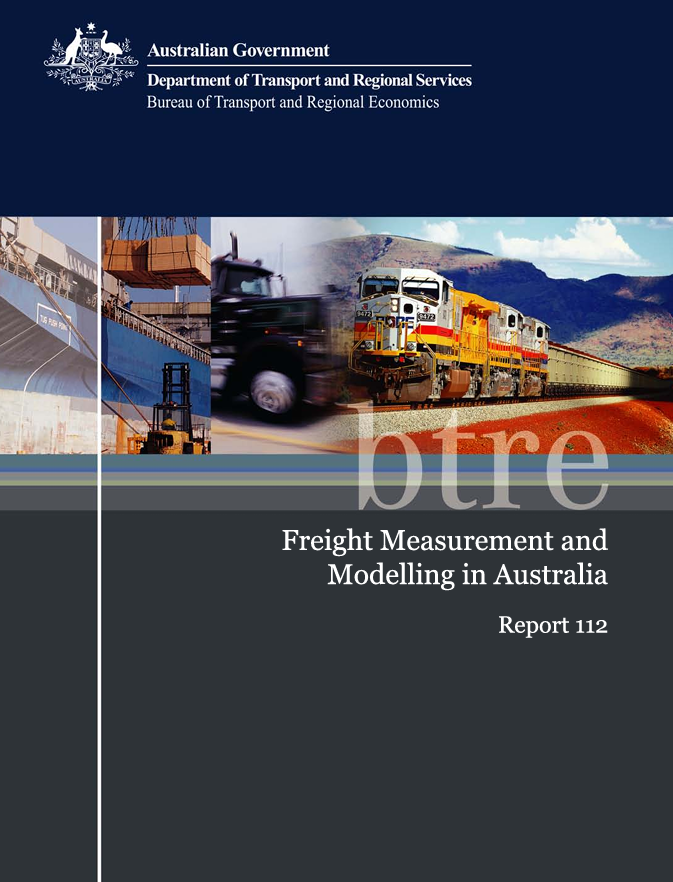
This report summarises the existing knowledge of freight in Australia and presents the time series data, analysis and sources which underpin the BTRE's long-term freight forecasts. Consistently measured time series data are required to model and forecast freight flows. The report describes the methodologies evolved by the BTRE to do this. It includes the results of modelling and forecasting undertaken using the derived series. Non-bulk freight is projected to increase by 82% in tonne-kilometre terms between 2003 and 2020 (average 3.6% per year).
The expected rate of growth in gross domestic product and reductions in freight rates are the key drivers of this growth as well as a continuing trend to national distribution by manufacturers, wholesalers and importers. With Treasury projecting some fall-off in the long-term economic growth, the non-bulk growth rate is slightly lower than in the recent past. Based on past trends, road's share of national non-bulk freight is projected to increase marginally from 74% to 76%, with the rail share declining from 21% to 17% and sea freight making up the balance (with air freight vanishingly small in tonne-kilometre terms, albeit not in value).
These mode share projections do not take account of the potential for rejuvenation of rail on north-south routes, in somewhat the same manner as has already occurred on east-west routes. Capital city freight tonne-kilometres are projected to grow by 3.0% a year between 2003 and 2020 (compared with a 1971–2003 average of 5.0%). While heavy vehicles comprise only 4% of the metropolitan traffic stream, growth of this level implies a slight increase in the heavy vehicle proportion (to 4.2% in 2020).
Rail is expected to remain the largest mode in shipping bulk freight (46% share in 2003, 45% in 2020), followed by sea freight (30% and 29% shares respectively). Rail is well suited for transporting Australia's large export tonnages in coal, other minerals and grains to port. Rail freight has fallen in most other bulk commodities.
Interstate Freight on States Roads
Paper given to the 29th Australasian Transport Research Forum, 27–29 September 2006, Crowne Plaza Surfers Paradise, Gold Coast. Authors: David Gargett, Afzal Hossain and David Cosgrove.
- Interstate Freight on States Roads
COAG commissioned the Review in February 2006 with a focus on national freight corridors but also examining local networks where they interact with, and impact on, these corridors. The Review report was prepared by a working group of representatives from the Department of Transport and Regional Services, State and Territory government transport and planning agencies and the Australian Local Government Association. The Review was overseen by the COAG Competition and Regulation Working Group. The BTRE provided the Secretariat to the Review.
- COAG Urban Congestion Review Report
- Congestion Management Approaches
- Freight Smart
- Traffic Management Systems (Urban Motorways)
- TMS Urban Non Motorway