
Measuring Gross Regional Product
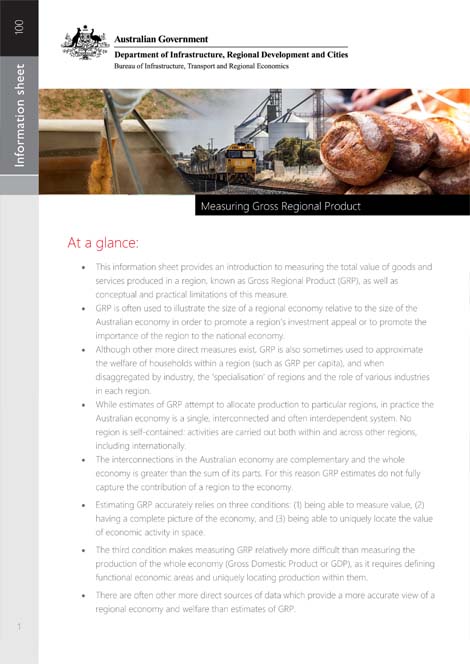
This information sheet provides an introduction to measuring the total value of goods and services produced in a region, known as Gross Regional Product (GRP), as well as conceptual and practical limitations of this measure.
- Measuring Gross Regional Product
Economies of scale and regional services
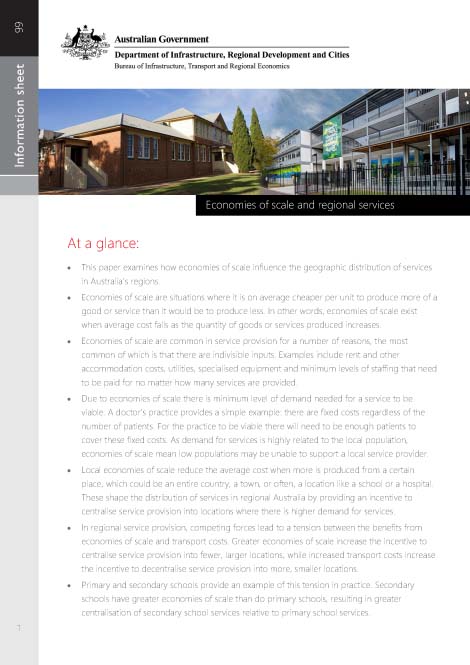
Economies of scale are a common feature of the cost structure of service providers. This paper discussed how economies of scale incentivise the geographic centralisation of services because they make it cheaper to supply services from fewer centralised locations. The paper also articulates the trade-off between centralising to gain the benefits from economies of scale and the costs of centralisation. These costs include extra transport costs for people who access the services and the costs to society from people not using the services due to difficulty accessing them. This creates a tension between the benefits from economies of scale and the benefits from having more geographically dispersed services.
- Economies of scale and regional services
An introduction to where Australians live
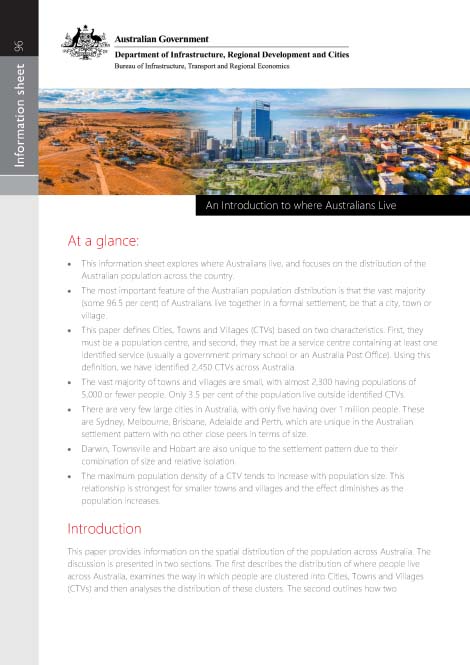
This paper provides an introduction to how people are distributed spatially across Australia. The discussion is broken into two sections. The first describes the distribution of where people live across Australia, examines the way in which people are clustered into Cities, Towns and Villages (CTVs) and then analyses the distribution of these clusters. The second outlines how two characteristics, isolation and density, changes across cities, towns and villages, with a particular focus on the link to population size.
- An introduction to where Australians live
- An introduction to where Australians live
Location and other risk factors in crashes
This information sheet reports results of a study into the risk factors of vehicle crashes given a crash has occurred in terms of whether it results in the death of a person involved. Factors include vehicle type and age, whether a restraint or helmet was worn, nature of crash, time of day and location-specific factors such as the built-up or rural character of an area, the distance to high-care emergency medical facility and environmental conditions i.e. sunrise, sunset or night-time.
- Location and other risk factors in crashes
Modelling Road Safety in Australian States and Territories
This Information Sheet describes modelling of road fatality rates for the eight Australian States and Territories, and fatality and injury rates for Australia as a whole. The models are constructed 1) to allow an understanding of the past forces underlying the fatality rates in each jurisdiction covered, and 2) to allow forecasts of future trends in road safety–or rather its obverse, death and injury.
- Modelling Road Safety in Australian States and Territories
- Modelling Road Safety in Australian States and Territories
Spending by Australian households on owning and operating vehicles in 2015–16
This Information Sheet presents data on Australian households' expenditure patterns, based on the ABS Household Expenditure Survey (HES) for 2015–16. It updates BITRE Information Sheet 86 Spending by Australian households on owning and operating vehicles (BITRE 2017a), which relied on 2009–10 HES data. It details the composition of household expenditure on owning and operating vehicles and explores variation in the incidence of these costs across different types of households, such as capital city and regional households, and high income and low income households. This updated analysis also investigates changes in vehicle-related spending since 2009–10, with the aim of identifying any significant changes that have occurred for particular types of regions or particular demographic groups.
- Spending by Australian households on owning and operating vehicles in 2015–16
Fuel economy of Australian passenger vehicles—a regional perspective
This information sheet presents Australian data on how realised rates of fuel consumption vary over time, and how the rates depend on key vehicle characteristics such as number of cylinders, fuel type and vehicle age. It also investigates state/territory differences in fuel economy and presents new small area estimates of the average rate of fuel consumption for Australia's regions.
These small area estimates are based on the composition of the passenger vehicle and motorcycle fleet in the region, and are derived at both the Statistical Area Level 3 (SA3) and Statistical Area Level 4 (SA4) scale. The key data sources are the Australian Bureau of Statistics (ABS) Survey of Motor Vehicle Use (SMVU) 2016 and the ABS Census of Motor Vehicles 2016.
- Fuel economy of Australian passenger vehicles–a regional perspective
Growth in the Australian Road System
This information sheet presents estimates of Kilometres and lane-kilometres of road length for Australian States and Territories back to 1910. It provides the same data for Metropolitan Australia back to 1910, and for individual cities back to 1970.
It also introduces the concept of value equivalent lane-kilometres, where lane-kilometres for different road types are weighted by current value estimates.
The latter concept allows a clearer picture of the growth in the value of Australian road infrastructure over time–which is substantial.
- Growth in the Australian Road System
Infrastructure and Transport PPPs and Privatisation in Australia
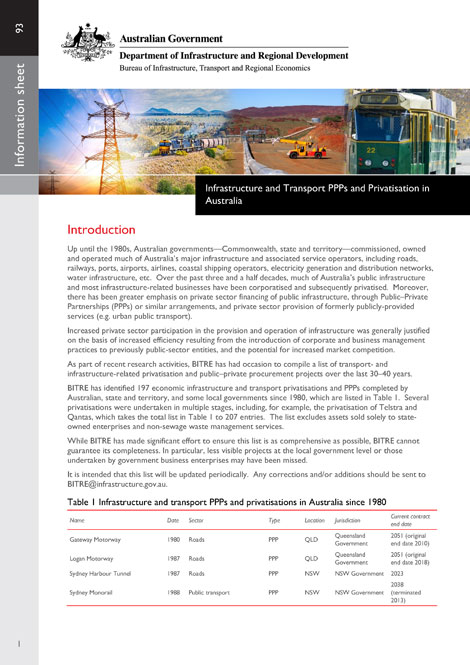
This information sheet provides a list of infrastructure and transport-related Public Private Partnerships and privatisations in Australia since 1980. To the Bureau of Infrastructure Transport and Regional Economics' (BITRE) knowledge, this is the most comprehensive list on the subject to date.
One hundred and ninety seven economic infrastructure assets have been privatised or procured through PPPs since 1980. Several privatisations were undertaken in multiple stages, including, for example, the privatisations of Telstra and Qantas. Including all these stages takes the total list to 207 entries. The list excludes assets sold solely to state-owned enterprises, and non-sewage waste management services.
- Infrastructure and Transport PPPs and Privatisation in Australia
Freight Rates in Australia
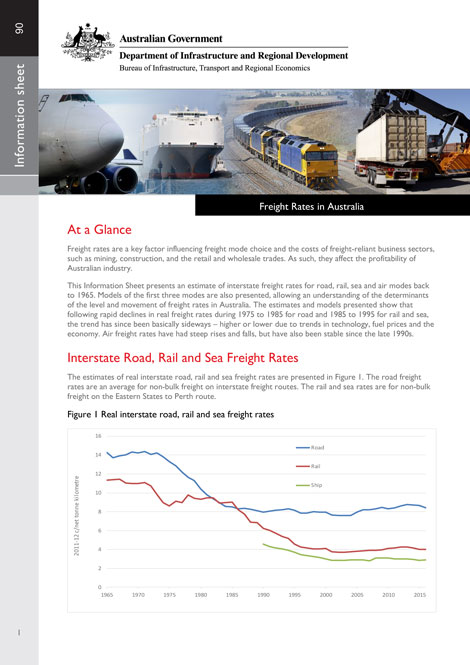
This Information Sheet presents an estimate of interstate freight rates for road, rail, sea and air modes back to 1965. Models of the first three modes are also presented, allowing an understanding of the determinants of the level and movement of freight rates in Australia.
The estimates and models presented show that following rapid declines in real freight rates during 1975 to 1985 for road and 1985 to 1995 for rail and sea, the trend has since been basically sideways–higher or lower due to trends in technology, fuel prices and the economy.
- Freight Rates in Australia