
Regional Impact of the Port of Mackay
This paper presents the results of a Bureau of Transport Economics study of the regional impact of the Port of Mackay located on the central coast of Queensland. The port is an important component of the transport chain for sugar and agriculture. By measuring both direct and flow-on effects, the study estimated that the port was responsible for 1.0% of all employment in the region, with a value added contribution of 0.9%.
- Regional Impact of the Port of Mackay
Regional Impact of the Port of Gladstone
This report presents the economic impact of the Port of Gladstone on the Fitzroy region in Queensland. At the time of writing, Gladstone Port was the fourth largest in Australia. By measuring both direct and flow-on effects, the study estimated that the port was responsible for 2.3% of all employment in the region, with a value added contribution of 3.0%.
- Regional Impact of the Port of Gladstone
Atherton Tablelands Regional Analysis
The agriculture-based Atherton Tablelands region of Far North Queensland experienced major change after the deregulation of the tobacco industry, and more recently, the dairy industry. The area was previously stable and relatively prosperous, but coping with continual change, unfamiliar market systems and the move to operating professional farm businesses, had caused some levels of distress. This working paper provides a social and economic overview of the region, an assessment of factors affecting the region and a brief discussion of economic development possibilities which might increase the economic resilience of the region.
- Atherton Tablelands Regional Analysis
Flood Damage in Tamworth: Costs of the November 2000 Flood
Tamworth NSW experiences frequent flooding, especially in the industrial area of Taminda. The flood in November 2000 provided an opportunity to estimate the cost savings that would have occurred in Taminda if there had been a levee to protect the area. As part of a wider study by the Bureau of Transport Economics to investigate the benefits of flood mitigation, the effectiveness of the central business district (CBD) levee in preventing flood damage was also part of this study.
- Flood Damage in Tamworth: Costs of the November 2000 Flood
Logistics in Australia: A Preliminary Analysis
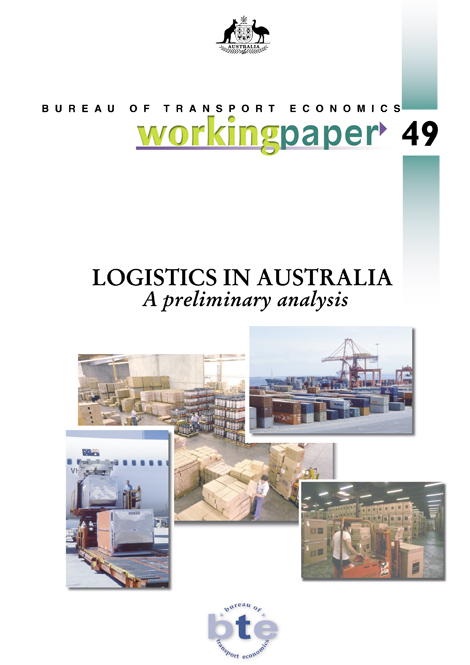
This paper presents the results of preliminary BTE work on logistics in Australia. It draws on the BTE's experience and expertise in the transport sector, and also incorporates information on logistics from sources such as a literature review. The performance of the logistics system has a major impact on cost structures, revenues, service quality, and competitiveness in Australian industry. Logistics activities have been evolving rapidly in response to changes such as globalisation, general industry restructuring, new production processes, and technological advances. Many firms, government agencies and joint industry/government bodies are developing programs to improve logistics performance in Australia. The initiatives include the Freight Transport Logistics Industry Action Agenda. This paper develops a broad framework for analysing logistics activities. It also examines three priority issues identified by the Secretariat for the development of the Action Agenda the economic significance of logistics in Australia, the extent of integration, and the dimensions of a full economic study.
- Logistics in Australia: A Preliminary Analysis
Australia's Seaborne Containerised Freight: Forecasts to 2010–11
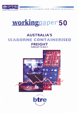
This study analyses and forecasts trends in the usage of containers for the carriage of Australia's seaborne freight over the period 2001–02 to 2010–11. The study also estimates the proportion of 40-foot containers used in Australia's inbound and outbound seaborne trade and assesses the implications of their increasing use over time.
- Australia's Seaborne Containerised Freight: Forecasts to 2010–11
Improving Transport on the Warringah Peninsula: Issues And Options
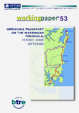
The Warren Centre's Community Values Study identified traffic congestion as the main traffic and transport concern for Warringah region residents (51 per cent of those surveyed, compared with 42 per cent for Sydney). The closer to the city, the greater the congestion, although Forest Way, in the northern part of the peninsula, is also significantly congested. The slowest car speeds are on Spit and Military roads (average of 21 kilometres per hour, five to eight kilometres per hour slower than inner routes through Chatswood and Willoughby). At weekends particularly, the Spit Bridge, which opens regularly for boat traffic, is a major congestion point. Secondly, public transport was the focus of 29 per cent of the Warren Centre's survey respondents in the Warringah region, 17 per cent identifying lack of adequate public transport (compared with 12 per cent for Sydney) and 12 per cent indicating the reliability of public transport as their main concern (compared with 11 per cent for Sydney). With no rail service in the region, Warringah region residents have fewer public transport options available to them than many other parts of Sydney. 'East-west' bus services are more limited than 'north-south' services. Bus services also are not independent of congestion on the road system, although bus priority arrangements secure a travel time advantage for bus passengers relative to car passengers over the same route. Thirdly, the Spit Bridge and Roseville Bridge routes each pass through dense residential inner areas. Conflicts between through and local traffic, which include 'rat-running' through residential streets during peak periods, have adverse consequences for the local transport environment and residential amenity. On the Spit route, where traffic is heaviest, with six traffic lanes to accommodate and less than optimal lane widths, safety is an issue with insufficient space for a Jersey (crash) barrier on the winding Spit Hill. There are also kerbside markings at Spit Junction in the northbound direction, advising pedestrians that large vehicles may 'jump the kerb'.
- Improving Transport on the Warringah Peninsula: Issues And Options
Greenhouse Gas Emissions from Australian Transport: A Macro Modelling Approach
This paper presents the results of a Bureau of Transport and Regional Economics (BTRE) study involving a general equilibrium modelling (or 'top-down') approach to deriving projections of greenhouse emissions from the Australian transport sector.
- Greenhouse Gas Emissions from Australian Transport: A Macro Modelling Approach
Regional Public Transport In Australia: Long-Distance Services, Trends And Projections
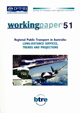
Regional public transport plays an important role in meeting the needs of Australians living in regional and remote areas for access to essential services and for mobility. This paper provides information on long-distance regional public transport services in Australia, and includes a snapshot of all such services across Australia in 2000–01 and the level of demand and characteristics of regional passenger travel in 1999–2000. The report also provides projections of likely future long-term trends in regional passenger travel. A companion paper, Regional public transport in Australia: Economic regulation and assistance measures (Working Paper 54), provides information on the regulatory arrangements and assistance measures relating to regional public transport.
- Regional Public Transport In Australia: Long-Distance Services, Trends And Projections
Regional Public Transport in Australia: Economic Regulation and Assistance Measures
Regional public transport plays an important role in meeting the needs of Australians living in regional and remote areas for access to essential services and for mobility. This paper provides information on Commonwealth, State and Territory government regulatory arrangements and assistance measures relating to regional public transport in 2001–02.
A companion paper, Regional public transport in Australia: Long-distance services, trends and projections (Working Paper 51), provides information on long-distance regional public transport services in Australia, and includes a snapshot of all such services across Australia in 2000–01 and the level of demand and characteristics of regional passenger travel.
- Regional Public Transport in Australia: Economic Regulation and Assistance Measures