
Analysis of the Rail Deficit
The aim of this study is to find out if railways are improving their financial performance following the industry reform programs initiated by the State and Commonwealth Governments in the 1980s.
- Analysis of the Rail Deficit
Costs of Rail Accidents in Australia—1993
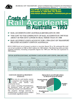
BTCE (1992) Social cost of transport accidents in Australia, Report 79, p. 52, estimated the total cost of rail accidents in 1988 as $94.5 million (in 1988 dollars). The Information Sheet table provides updated estimates, including comparable figures for 1988 and 1993 that are expressed in 1993 dollars.
- Costs of rail accidents in Australia–1993
Quality of Rail Freight Service: The Customer's Perspective
Indicators currently published by Australian railways do not measure service standards from the viewpoint of customers, but rather are based on statistics compiled by management for other purposes.
- Quality of Rail Freight Service: The Customer's Perspective
Brisbane to Melbourne Rail Link: Economic Analysis
Historically, railways have provided the means to open up new areas for economic development. When built to link existing centres of economic activity, they have given rise to greatly increased opportunities for trade and travel.
- Brisbane to Melbourne Rail Link: Economic Analysis
This report is the third in a series covering the socio-economic costs of transport accidents in Australia. Transport accidents impose a significant burden on the Australian community. Not all of their consequences can be expressed in financial terms. However, to weigh up options for minimising and dealing with this burden, it is important to know the costs of transport accidents.
- Rail Accident Costs in Australia
Optimising Harmonisation in the Australian Railway Industry
In the last decade, Australia's railways have undergone an ownership, operational and technological revolution. The establishment of national public and private train operators has finally brought seamless rail freight services across the country. There has been a complementary development in track management, with one manager (Australian Rail Track Corporation) rather than five, now controlling most of the interstate track.
The standardisation of the Melbourne-Adelaide railway in 1995 removed the break-of-gauge on the East-West Corridor. This has facilitated the subsequent more than doubling of rail freight task between those cities.
Infrastructure investments and complementary funding of new generation locomotives have enabled train operators to harness train economics of heavier, longer trains, for instance, with Melbourne-Adelaide trains now 50 per cent longer than a decade ago.
These changes are transforming the industry. However, the perception is that the legacy of the separate State-based networks may still draw a long shadow over the performance of the network. This report investigates the extent to which physical, operational and regulatory breaks-of-gauge impede the industry. The report provides guidance to policy makers and industry on those issues.
- Optimising Harmonisation in the Australian Railway Industry
Filling a gap in rail data: an investigation of the Gheringhap Loop train sightings
This paper analyses train sightings data collected at Gheringhap, Victoria, located on the Melbourne to Adelaide main line. These sightings provide an independent source of information on train movements, train lengths, and reliability, and, given knowledge of freight volumes, can be used to estimate average wagon loads. In cases where trains are not scheduled, sightings such as these are presently the only publicly available source of data for freight volumes on specific routes.
Following the growth in private train operations since the mid-1990s and the privatisation of National Rail in 2002, rail freight activity data became increasingly scarce. The lack of data can be a challenge for the BTRE in providing the government with timely and accurate information about trends in Australian freight transport. The rail industry has recognised this deficiency: the Australasian Railway Association and its members are working with the BTRE to produce the first public report on the performance of the Defined Interstate Rail Network and to supply data for AusLink planning.
In the meantime, the BTRE has investigated other potential data sources, including information from railway enthusiasts. This paper presents an analysis of one such source of rail data that is reported online, from video-taped observations made and collated by Graham Elliott at Gheringhap Loop, Victoria, on the mainline between Adelaide and Melbourne. The paper provides a short review of the reliability of the data, makes observations about trends in freight activity from the data set, and draws some conclusions about the value of the data collection method.
- Filling a gap in rail data: an investigation of the Gheringhap Loop train sightings
The pitfalls in competitive tendering: addressing the risks revealed by experience in Australia and Britain
Paper presented to European Conference of Ministers of Transport "Workshop on Competitive Tendering for Rail Services" held in Paris on 12 January 2006. Paper to be published in forthcoming ECMT Workshop Proceedings. Author: Peter Kain.
- The pitfalls in competitive tendering: addressing the risks revealed by experience in Australia and Britain
Rail Freight Performance Indicators 2007–08—Statistical Report
This statistical report is the third in this series and is a result of collaboration between the Australasian Railway Association (ARA) and the Bureau of Infrastructure, Transport and Regional Economics (BITRE).
- Rail Freight Performance Indicators 2007–08–Statistical Report
Brief—A profile of high-speed railways
This paper discusses high-speed train services. The paper sets out what is meant by 'high-speed', explains the objective of introducing services and sets out where they have been introduced. The paper also considers funding experiences and Australian high-speed train proposals.
- Brief–A profile of high-speed railways