
Why short-haul intermodal rail services succeed
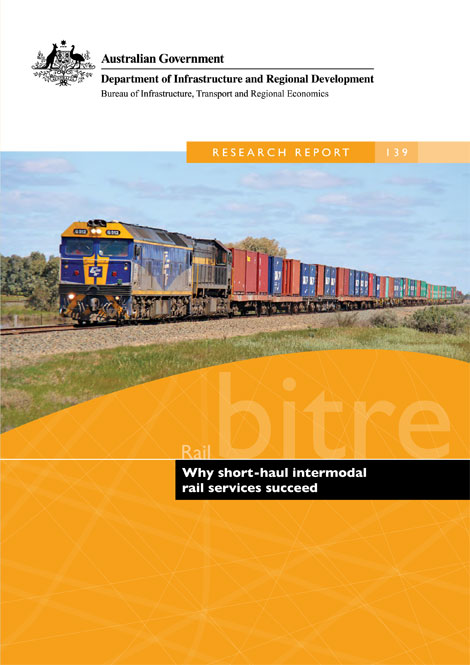
The shipping container has revolutionised freight transport over the last half-century but its success is bringing challenges, not least in landside container movements. Port-induced road traffic congestion impacts on port arteries and communities and undermines port efficiency. Policymakers and planners seek to shift activities from roads to rail. This is a challenge, however, because most of the containers move over short distances, where trains are relatively uncompetitive. Despite that, there are instances where port–hinterland rail services exist. This report analyses the underlying necessary conditions that need to prevail for those rail services to be sustainable.
- Why short-haul intermodal rail services succeed
Freightline 3—Australia sugar freight transport
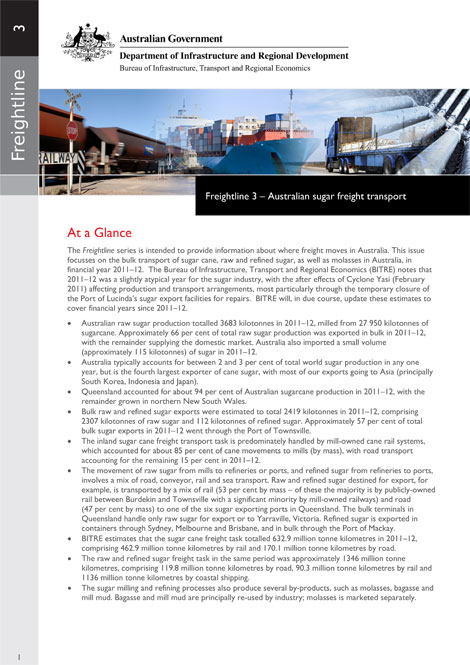
The Freightline series is intended to provide information on interregional freight movements across Australia, filling a major gap in Australian transport-related data and information, to help better inform and support policy development and infrastructure planning. The Freightline series begins with a broad overview of the freight task, followed by separate commodity-specific issues that provide more detailed information about the size and location of major freight movements, supply chain composition and key infrastructure components. Freightline 3 (this issue) focusses on Australian sugar-related transport supply chains and freight movements in 2011–12.
- Freightline 3–Australia sugar freight transport
Australian road freight estimates: 2014 update
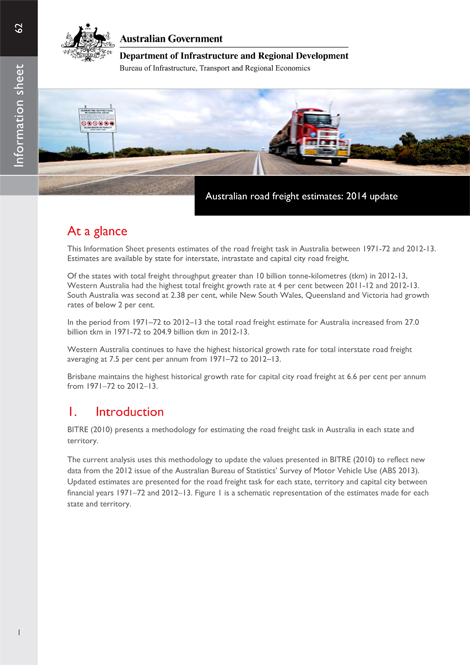
This information sheet provides updated road freight estimates previously reported in Chapter 2 of BITRE Research Report 121. It gives estimates for interstate, intrastate, capital city and total road freight for each state/territory for the period between 1971–72 and 2012–13.
- Australian road freight estimates: 2014 update
Freightline 1—Australia freight transport overview
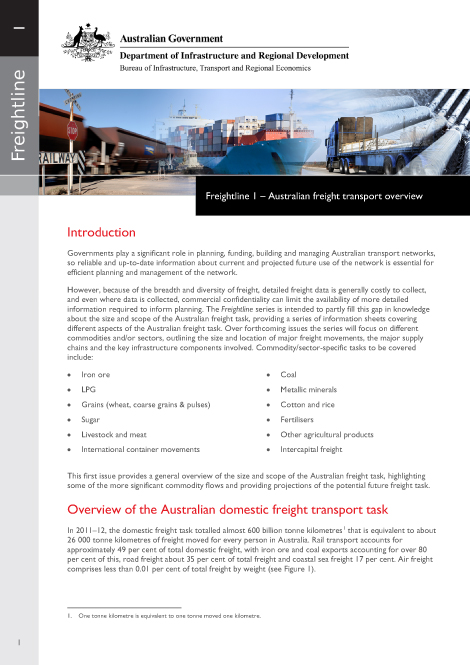
The Freightline series is intended to provide information on interregional freight movements across Australia, filling a major gap in Australian transport-related data and information, to help better inform and support policy development and infrastructure planning. The Freightline series begins with a broad overview of the freight task, followed by separate commodity-specific issues that provide more detailed information about the size and location of major freight movements, supply chain composition and key infrastructure components. Freightline 1 (this issue) provides a broad overview of freight movements in Australia, highlighting some of the major commodity flows.
- Freightline 1–Australia freight transport overview
Freightline 2—Australia iron ore freight transport
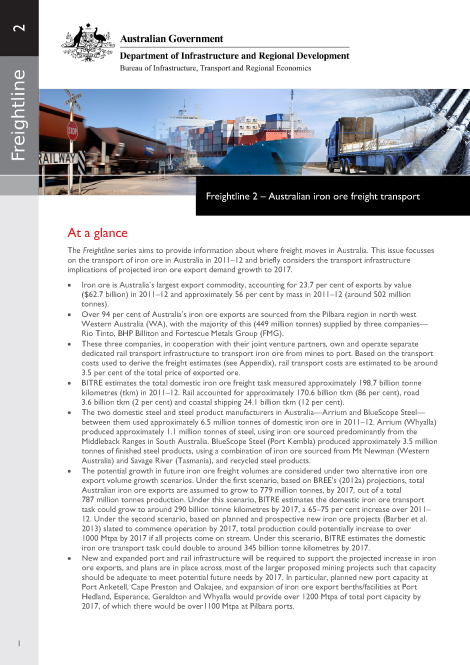
The Freightline series is intended to provide information on interregional freight movements across Australia, filling a major gap in Australian transport-related data and information, to help better inform and support policy development and infrastructure planning. The Freightline series begins with a broad overview of the freight task, followed by separate commodity-specific issues that provide more detailed information about the size and location of major freight movements, supply chain composition and key infrastructure components. Freightline 2 (this issue) focusses on Australian iron ore transport supply chains and freight movements in 2011–12.
- Freightline 2–Australia iron ore freight transport
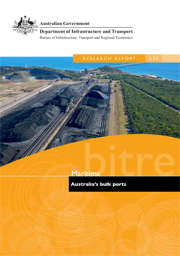
The report provides a profile of Australia's principal bulk ports and the logistics chain that delivers commodities through those ports. Efficient logistics are essential for these volumes, requiring substantial investment as well as good co-ordination of the different links in the logistics chain. These factors have been especially important in the last decade, with tonnage rising by over 75%. The report illustrates the tasks performed at each port using the broad range of data and indicators that are published by port authorities and bulk terminal operators.
Tasmanian Passenger and Freight movements
This information sheet provides a summary of Tasmanian passenger and freight movements in 2011–12. It brings together key data about Tasmanian transport from other Bureau publications and unpublished data sources.
- Tasmanian Passenger and Freight movements
Relative Efficiencies in the Transportation of Commodities
This Report assesses the relative efficiencies of road and rail in the transportation of several bulk commodities. The work explores potential constraints to the efficient transportation of bulk commodities, including the pricing systems applied by road and rail operators.
- Relative Efficiencies in the Transportation of Commodities
Road Freight Estimates by State/Territory
Paper given to the 31st Australasian Transport Research Forum, 2 October–3 October 2008, Gold Coast. Authors: David Gargett, Afzal Hossain
- Road Freight Estimates by State/Territory
External Costs of Inter-Capital Freight in Australia
Paper given to the 33rd Australasian Transport Research Forum, 29 September–1 October 2010, Canberra. Author: Jack McAuley.
- External Costs of Inter-Capital Freight in Australia