
Tasmanian Freight Equalisation Scheme Monitoring Reports
The Tasmanian Freight Equalisation Scheme (TFES) provides financial assistance for cost incurred by shippers of eligible non-bulk goods moved by sea across the Bass Strait. More information about the operation of the Scheme can be found at Tasmanian Freight Equalisation Scheme | Department of Infrastructure, Transport, Regional Development, Communications and the Arts.
Under the TFES Ministerial Directions, BITRE provides a statistical report on all components of the Scheme every four years. The Monitoring Reports and other reports related to the scheme are linked below.
Monitoring Reports
- Tasmanian Freight Equalisation Scheme Monitoring Report 2024
- Consultation Draft Tasmanian Freight Equalisation Scheme Monitoring Report 2024
- Monitoring report 2020 Tasmanian Freight Equalisation Scheme
Other Reports
- Tasmanian Freight Equalisation Scheme - Review of the expanded component: Final Report (2018)
- Tasmanian Freight Equalisation Scheme: A 'Landbridge' Approach to the Estimation of Subsidy Rates (1981)
- Tasmanian Freight Equalisation Scheme: Recommended Rates of Assistance for Southbound Cargoes, Livestock and Timber at 31 January 1979
- Tasmanian Freight Equalisation Scheme: Recommended Northbound Assistance Rates at 1 January 1978
- Tasmanian Freight Equalisation Scheme: Discussion Paper September 1996
Tasmanian Freight Schemes Parameter Reviews
Regional port catchments for road freight
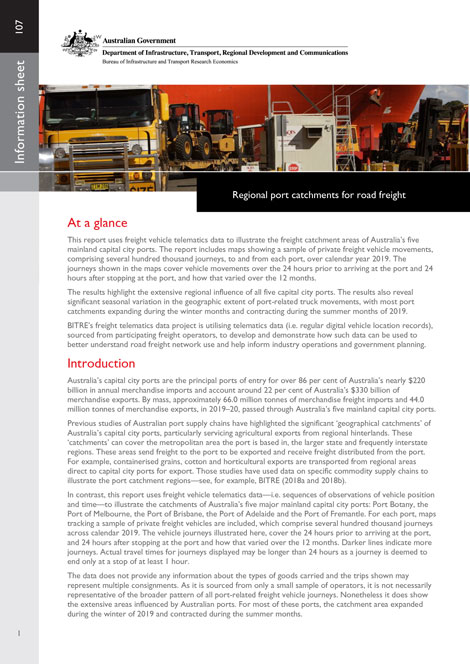
This Information Sheet uses freight vehicle telematics data to illustrate the freight catchment areas of Australia’s five mainland capital city ports. The report includes maps showing a sample of private freight vehicle movements, comprising several hundred thousand journeys, to and from each port, over calendar year 2019. The maps cover the 24 hours prior to arriving at the port and 24 hours after stopping at the port. The results highlight the extensive regional influence of all five capital city ports and also reveal significant seasonal variation in the geographic extent of port-related truck movements.
Freight Data Exchange pilot projects—Summary Report 2020
Information technology and data are increasingly essential to modern business operations. The increasing digitalisation of supply chain processes and freight consignment information offers further opportunities to increase the efficiency and productivity of Australian freight supply chains.
For industry, increasing digitalisation can improve visibility of freight consignments and interoperability between supply chain partners, and aid industry in responding to supply chain delays, bottlenecks or errors – and thereby improve overall freight industry efficiency and productivity. For governments and transport planning agencies, the increasing digitalisation of freight supply chain information can potentially provide more timely strategic-level information to help inform planning and investment, and at less cost.
In 2019-20, the Australian Government, in cooperation with iMOVE and selected industry partners, undertook an initial round of Freight Data Exchange pilot projects to investigate, develop and demonstrate the capability for supply chain partners to share freight consignment information in real time and also assess the feasibility of aggregating freight consignment event/message data to produce aggregate outputs that help inform infrastructure planning and policy priorities.
This report briefly outlines some of the key outcomes of the three projects and suggests directions for further work.
The report was produced in collaboration between BITRE and iMOVE Australia, and with the support and assistance of participating industry partners.
Freight route performance under COVID-19
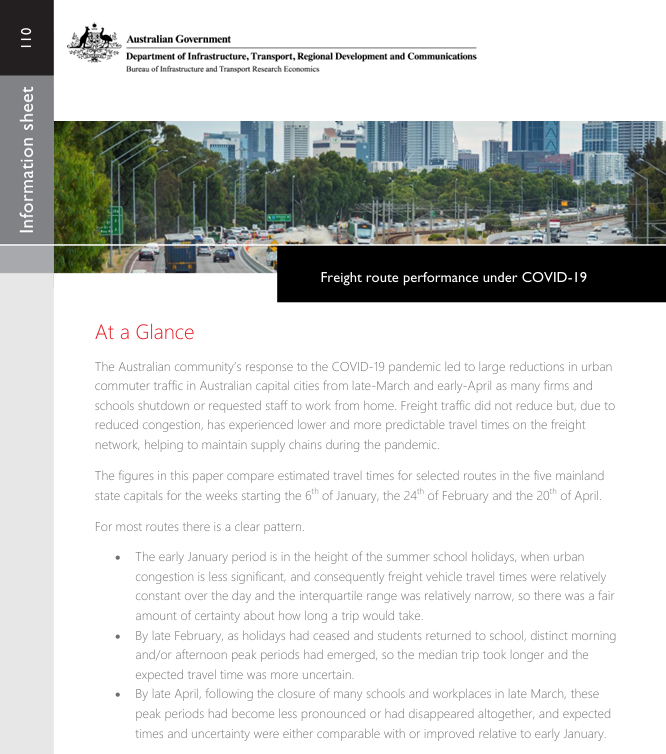
This Information Sheet provides estimates of the impact of the COVID-19 pandemic on freight vehicle travel times for selected routes in Australian major cities in early 2020. The results show that whilst there was no significant change in freight vehicle traffic volumes over that period, freight vehicles experienced shorter and more predictable travel times on many urban freight routes, primarily due to reduced commuting trips. This helped the freight industry to maintain supply chains during the initial stages of the pandemic. The data underlying the estimates is from the BITRE freight telematics program collection, which is sourcing vehicle position data from a small number of road freight operators.
Freightline 7—Australian aluminium industry freight transport
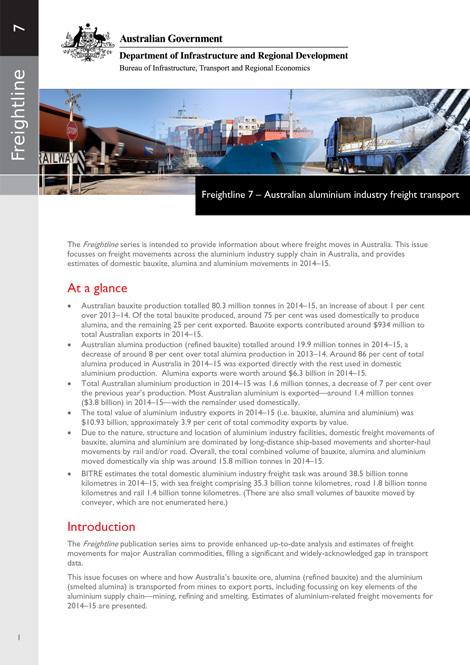
The Freightline series is intended to provide information on interregional freight movements across Australia, filling a major gap in Australian transport-related data and information, to help better inform and support policy development and infrastructure planning. Freightline 1 provides a broad overview of the freight task. Subsequent issues consider specific commodity freight tasks, and include more detailed information about the size and location of major freight movements, supply chain composition and key infrastructure components.
This issue (Freightline 7) focusses on Australian aluminium industry transport supply chains and freight movements in 2014–15.
- Freightline 7–Australian aluminium industry freight transport
Freightline 6—Australian rice freight transport
The Freightline series is intended to provide information on interregional freight movements across Australia, filling a major gap in Australian transport-related data and information, to help better inform and support policy development and infrastructure planning. Freightline 1 provides a broad overview of the freight task. Subsequent issues consider specific commodity freight tasks, and include more detailed information about the size and location of major freight movements, supply chain composition and key infrastructure components. This issue (Freightline 6) focusses on Australian rice transport supply chains and freight movements in 2015–16.
- Freightline 6–Australian rice freight transport
Freightline 5—Australian cotton freight transport
The Freightline series is intended to provide information on interregional freight movements across Australia, filling a major gap in Australian transport-related data and information, to help better inform and support policy development and infrastructure planning. Freightline 1 provides a broad overview of the freight task. Subsequent issues consider specific commodity freight tasks, and include more detailed information about the size and location of major freight movements, supply chain composition and key infrastructure components. This issue (Freightline 5) focusses on Australian cotton transport supply chains and freight movements in 2015–16.
- Freightline 5–Australian cotton freight transport
Freight Rates in Australia
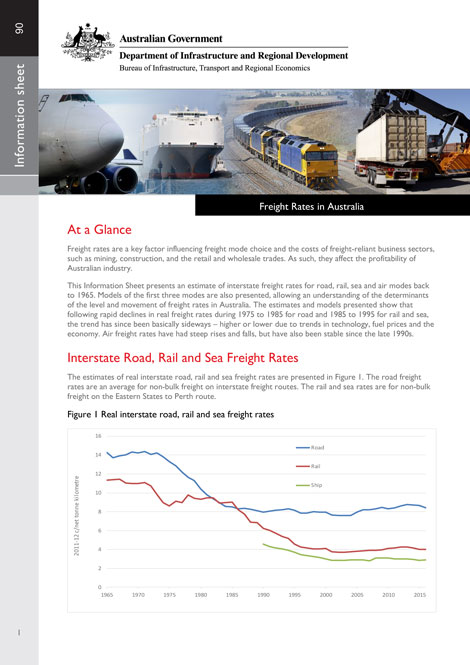
This Information Sheet presents an estimate of interstate freight rates for road, rail, sea and air modes back to 1965. Models of the first three modes are also presented, allowing an understanding of the determinants of the level and movement of freight rates in Australia.
The estimates and models presented show that following rapid declines in real freight rates during 1975 to 1985 for road and 1985 to 1995 for rail and sea, the trend has since been basically sideways–higher or lower due to trends in technology, fuel prices and the economy.
- Freight Rates in Australia
Freightline 4—Australian coal freight transport
The Freightline series is intended to provide information on interregional freight movements across Australia, filling a major gap in Australian transport-related data and information, to help better inform and support policy development and infrastructure planning. The Freightline series begins with a broad overview of the freight task, followed by separate commodity-specific issues that provide more detailed information about the size and location of major freight movements, supply chain composition and key infrastructure components. Freightline 4 (this issue) focusses on Australian coal transport supply chains and freight movements in 2014–15.
- Freightline 4–Australian coal freight transport
Australian road freight estimates: 2016 update
The Information Sheet provides revised estimates of road freight by State, capital city and rest-of-state. The long-term trend in growth has been substantial, interrupted only by the 1990 recession and the Global Financial Crisis.
- Australian road freight estimates: 2016 update