
Emerging cities in regional Australia
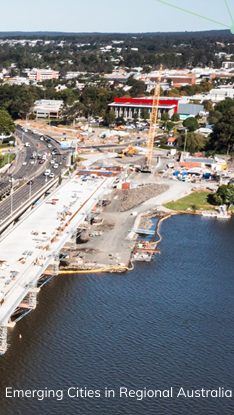
This analysis investigates emerging cities in regional Australia focusing on Significant Urban Areas ranging in size from 25,000 to 90,000 residents. Understanding future growth patterns in urban areas outside major capital and regional cities has important implications for planning and development, particularly in relation to infrastructure, housing and access to services.
Snapshot of cities and regions
This placemat provides a snapshot of cities and regions in regard to population, employment, housing and liveability.
Estimated resident population
Estimated Resident Population is the official measure of Australia’s population produced by the Australian Bureau of Statistics. These preliminary population estimates were released on 29 March 2022.
Population trends BCARR migration geography
This fact sheet provides an overview of population trends in Australia over 5 years, from 2016 to 2021. The analysis is based on Estimated Resident Population (ERP) data released by the Australian Bureau of Statistics (ABS) in July 2022. A custom geography – Bureau of Communications, Arts and Regional Research (BCARR) migration geography – is used to analyse Australia's population trends.
The BCARR migration geography classifies Australia into 6 region categories (without overlap) according to natural endowments, administration boundaries and proximity to amenities. These categories are:
- Capital cities
- Coastal cities
- Coastal country areas
- Inland cities
- Inland country areas; and
- Remote areas.
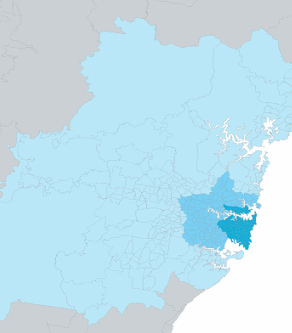
The fact sheet below provides a guide to the purpose and use of this statistical geography. The rings geography breaks Australia’s five largest capital cities into three concentric zones and can be used to analyse patterns in population, jobs, connectivity and access to services. This fact sheet provides a guide to understanding and using the classification.
South East Queensland research project
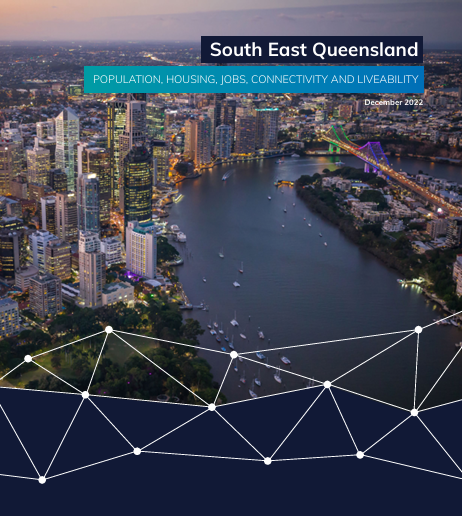
BCARR has undertaken a South East Queensland (SEQ) research project to provide an evidence base on the spatial distribution of population growth, jobs, connectivity and liveability of SEQ. This evidence can be used to monitor how population, jobs, connectivity and liveability change over time and respond to investment. The report aims to support the department's policy and project delivery. The final report is available below.
The role of socio-demographic and spatial characteristics in work from home in Australia

We conducted a Work from Home (WfH) research project to provide evidence of how social, demographic and spatial characteristics influence WfH capability and uptake in Australian cities. The study also explores the link between WfH and relocation and investigates post-pandemic prospects for WfH in Australia. This new evidence can help improve understanding of the key drivers of WfH and the ongoing role that WfH will likely play in influencing urban and regional development outcomes in Australia.
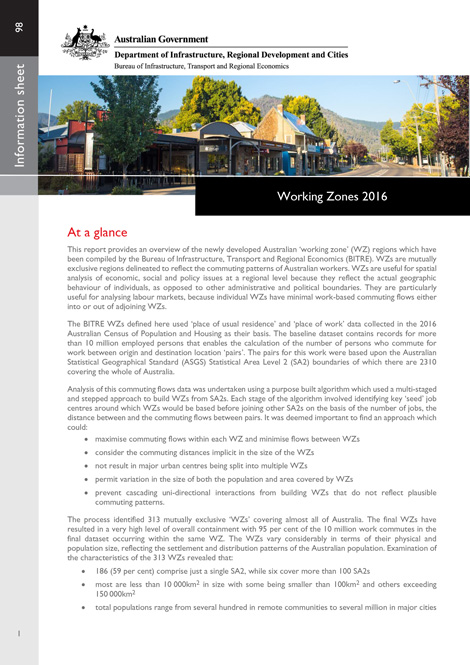
This is not the latest release. View the latest Working zones update
This report provides an overview of the newly developed Australian 'working zone' (WZ) regions which have been compiled by the Bureau of Infrastructure, Transport and Regional Economics (BITRE). WZs are mutually exclusive regions delineated to reflect the commuting patterns of Australian workers. WZs are useful for spatial analysis of economic, social and policy issues at a regional level because they reflect the actual geographic behaviour of individuals, as opposed to other administrative and political boundaries. They are particularly useful for analysing labour markets, because individual WZs have minimal work-based commuting flows either into or out of adjoining WZs.
- Working Zones 2016
- Working Zones 2016 Data
- Working Zones 2016 to SA2 Concordance
- Working Zones 2016 Shape File

Review of the National Cities Performance Framework – Final paper
The National Cities Performance Framework (NCPF) was launched in 2017 with the commitment to conduct reviews every 3 years. This report covers the feedback received and the approach for the future of the NCPF. The conclusion of the NCPF review is that alternate departmental data and research products better meet the needs of stakeholders and that the Framework should be phased out. Targeted research will focus on issues of the highest priority to the government and cities’ stakeholders.
Australia’s light vehicle fleet - some insights
This Information Sheet investigates how the characteristics of Australia’s light vehicle fleet vary across different types of regions, including States/Territories, major cities, city sectors, region types, and small areas. Vehicle characteristics considered include fuel type, average age, cylinders and tare weight. Specific types of vehicles, such as electric vehicles, sports utility vehicles and utilities are also examined. The study also identifies recent changes in the composition of Australia’s light vehicle fleet.