
Logistics in Australia: A Preliminary Analysis
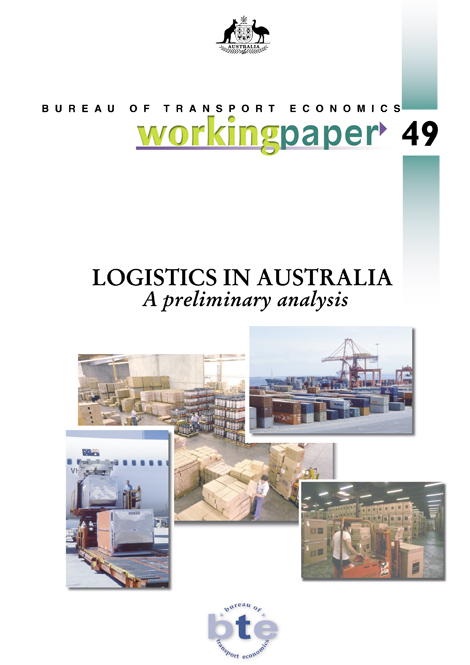
This paper presents the results of preliminary BTE work on logistics in Australia. It draws on the BTE's experience and expertise in the transport sector, and also incorporates information on logistics from sources such as a literature review. The performance of the logistics system has a major impact on cost structures, revenues, service quality, and competitiveness in Australian industry. Logistics activities have been evolving rapidly in response to changes such as globalisation, general industry restructuring, new production processes, and technological advances. Many firms, government agencies and joint industry/government bodies are developing programs to improve logistics performance in Australia. The initiatives include the Freight Transport Logistics Industry Action Agenda. This paper develops a broad framework for analysing logistics activities. It also examines three priority issues identified by the Secretariat for the development of the Action Agenda the economic significance of logistics in Australia, the extent of integration, and the dimensions of a full economic study.
- Logistics in Australia: A Preliminary Analysis
Waterline 29—December 2001
The five-port average crane rate declined to 25.8 containers per hour for the September quarter 2001.
Australian sea freight, 1999–2000
The Australian Sea Freight series presents statistics on the movement of Australian freight by sea, as well as information on port activity, fleet structure, and use of coastal permits. This edition focuses on sea freight activity around Australia during 1999–2000.
Waterline 30—March 2002
The five-port total container traffic increased to 1.740 million TEUs during July–December 2001. Berth availability was 95% in the December quarter.
Waterline 31—June 2002
The five-port total container traffic increased to 1.740 million TEUs during July–December 2001. Berth availability was 95% in the December quarter.
Australia's Seaborne Containerised Freight: Forecasts to 2010–11
This study analyses and forecasts trends in the usage of containers for the carriage of Australia's seaborne freight over the period 2001–02 to 2010–11. The study also estimates the proportion of 40-foot containers used in Australia's inbound and outbound seaborne trade and assesses the implications of their increasing use over time.
- Australia's Seaborne Containerised Freight: Forecasts to 2010–11
Freight Rates in Australia
This paper provides estimates of interstate non-bulk freight rates. The estimates show that, in real terms, it has never been cheaper to ship goods in Australia.
- Freight Rates in Australia
Waterline 32—September 2002
The five-port average crane rate improved from 26.6 in the March quarter to 26.9 containers per hour for the June quarter 2002. This is the highest five-port average crane rate ever recorded in Waterline.
Australia's Seaborne Containerised Freight
This publication forecasts container movements into and out of Australia. Combined Australian containerised imports and exports are expected to increase at an average annual rate of 5 per cent over the period 2001–02 to 2010–11.
- Australia's Seaborne Containerised Freight
Waterline 33—December 2002
Waterline's format has remained largely unchanged since the first issue was produced in 1994. However, there have been many changes in the maritime industry in that time. The Bureau believes that Waterline needs to change too if it is to remain useful.