
International road safety comparisons—annual
This report presents road deaths and road death rates for Organisation for Economic Co-operation and Development (OECD) nations and Australia. The rates allow for a comparison of Australia’s road safety performance with that of other OECD nations by accounting for the differing levels of population, motorisation and distances travelled. The latest available international data is for 2023.
Fatalities per 100,000 population is the measure specified in the UN Sustainable Development Goals (Indicator 3.61) to monitor road crash trauma.
Road trauma Australia—annual summaries
This report is the latest in the BITRE series of annual road crash statistical reports. It presents annual counts of road deaths, injuries and standardised rates.
Road Deaths In Crashes Involving Heavy Vehicles—Quarterly Bulletins
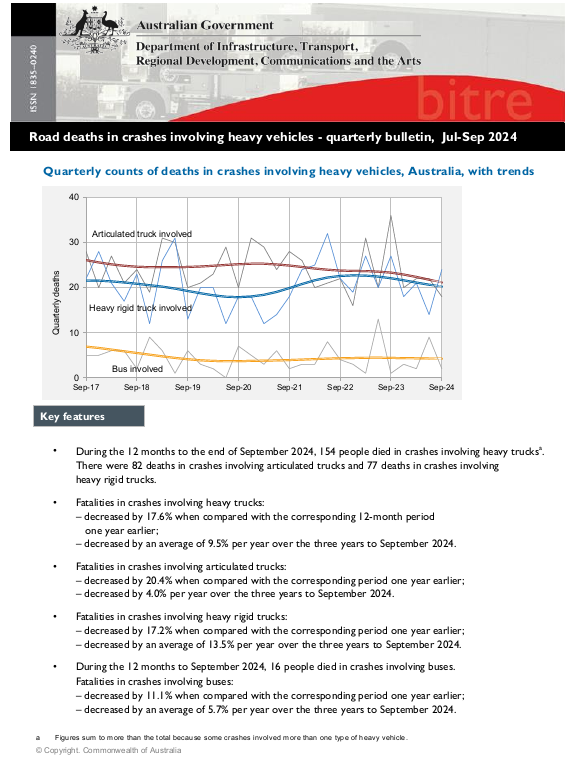
This publication is now being published on the DITRDCSA Data Catalogue and the National Road Safety Data Hub.
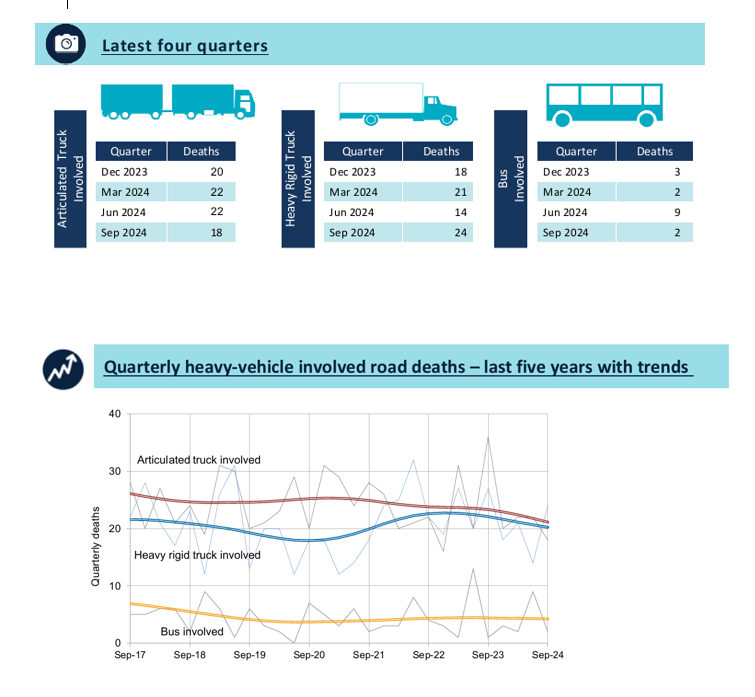
A quarterly publication tracking counts of fatalities in crashes that involve heavy vehicles.
Latest Quarter: Jul-Sep 2024
Archives
Road Deaths Australia—Monthly Bulletins
Latest summaries of road crash deaths and fatal road crashes are presented here. Updates are monthly and published on BITRE's website on or around the 14th of each month.
Data are sourced from the road traffic or police authorities in each jurisdiction. Data are preliminary and subject to revision.
Latest Month
- Link to Monthly Bulletin: Monthly road deaths | National Road Safety Data Hub
- Road Deaths Australia—Dashboard
Archives
Probability Based Estimation of Human Productivity Losses from Road Fatalities
Paper given to the 31st Australasian Transport Research Forum, 2 October–3 October 2008, Gold Coast. Authors: Hema de Silva, Tim Risbey, Justin McEvoy, Joel Mallett
- Probability Based Estimation of Human Productivity Losses from Road Fatalities
Paper given to the 32nd Australasian Transport Research Forum, 29 September–1 October 2009, Auckland. Authors: David Gargett, Tony Nguyen, David Cosgrove.
- Fatality Rates
Social Cost of Road Crashes
Paper given to the 33rd Australasian Transport Research Forum, 29 September–1 October 2010, Canberra. Authors: Tim Risbey, Mark Cregan, Hema de Silva.
Evaluation of the National Black Spot Program—Volume 1, 2 and 3
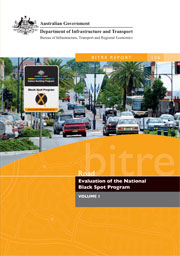
This evaluation covered 1599 black spot projects, 62% of the 2578 Australian Government funded black spot projects approved during the seven-year period 1996–97 to 2002–03 and completed.
The national Black Spot Program is estimated to be reducing fatal and casualty crashes in total at treated sites by 30% and property damage only (PDO) crashes by 26%.
- Evaluation of the National Black Spot Program–Volume 1
- Evaluation of the National Black Spot Program–Volume 2
- Evaluation of the National Black Spot Program–Volume 3
Marine Oil Spill Risk in Australia
Oil spills are basically chance events, their occurrences and characteristics being governed by probability distributions. Many properties of these distributions can be applied, with reasonable confidence, to the prediction of the location, number and size of oil spills around the Australian coast.
The analyses described in this Report are aimed at identifying the most appropriate statistical distributions underlying oil spill occurrences in Australia, and at interpreting the results to assist the planning process. In particular, the results are used to estimate future levels and locations of chemical dispersant stockpiles.
- Marine Oil Spill Risk in Australia