
Waterline 38—March 2005
This issue contains an article on Australian International Shipping. It summarises Australia's maritime trade 2002–2003, including cargo movements, main trading partners as well as major port activity with the main focus on international trade.
Waterline 39—September 2005
This issue contains an article on trends in Australian international sea trade. It examines Australia's maritime trade 1994–1995 to 2004–2005, including commodity exports and imports, trade regions and port activity.
Bass Strait Passenger Vehicle Equalisation Scheme BTRE Monitoring Report No. 8 2003–04
This report presents the results of BTRE's eighth annual review of the Bass Strait Passenger Vehicle Equalisation Scheme. It covers the operation and impact of the Scheme up to (and including) 2003–04.
- BSPVES Monitoring Report 8
Bass Strait Passenger Vehicle Equalisation Scheme BTRE Monitoring Report No. 9 2004–05
This report presents the results of BTRE's ninth annual review of the Bass Strait Passenger Vehicle Equalisation Scheme. It covers the operation and impact of the Scheme up to (and including) 2004–05.
- BSPVES Monitoring Report 9
Freight measurement and modelling in Australia
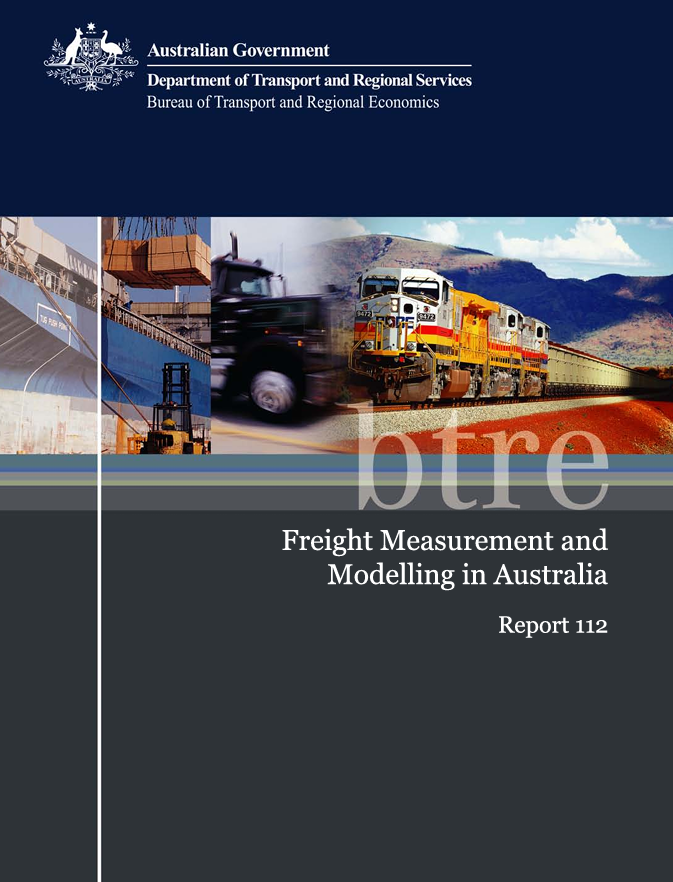
This report summarises the existing knowledge of freight in Australia and presents the time series data, analysis and sources which underpin the BTRE's long-term freight forecasts. Consistently measured time series data are required to model and forecast freight flows. The report describes the methodologies evolved by the BTRE to do this. It includes the results of modelling and forecasting undertaken using the derived series. Non-bulk freight is projected to increase by 82% in tonne-kilometre terms between 2003 and 2020 (average 3.6% per year).
The expected rate of growth in gross domestic product and reductions in freight rates are the key drivers of this growth as well as a continuing trend to national distribution by manufacturers, wholesalers and importers. With Treasury projecting some fall-off in the long-term economic growth, the non-bulk growth rate is slightly lower than in the recent past. Based on past trends, road's share of national non-bulk freight is projected to increase marginally from 74% to 76%, with the rail share declining from 21% to 17% and sea freight making up the balance (with air freight vanishingly small in tonne-kilometre terms, albeit not in value).
These mode share projections do not take account of the potential for rejuvenation of rail on north-south routes, in somewhat the same manner as has already occurred on east-west routes. Capital city freight tonne-kilometres are projected to grow by 3.0% a year between 2003 and 2020 (compared with a 1971–2003 average of 5.0%). While heavy vehicles comprise only 4% of the metropolitan traffic stream, growth of this level implies a slight increase in the heavy vehicle proportion (to 4.2% in 2020).
Rail is expected to remain the largest mode in shipping bulk freight (46% share in 2003, 45% in 2020), followed by sea freight (30% and 29% shares respectively). Rail is well suited for transporting Australia's large export tonnages in coal, other minerals and grains to port. Rail freight has fallen in most other bulk commodities.
Australian sea freight 2003–04
Statistics on the movement of Australian freight by sea, information on port activity, fleet structure and use of coastal permits. This edition focuses on sea freight activity around Australia during 2003–04.
Waterline No 40—May 2006
This issue contains articles on the role of the new Maritime Security Identification Card system and on Australian International Shipping.
Port Level Forecasts of Container and Ship Movements in Australia: 2004–05 to 2024–25
Paper given to the 29th Australian Transport Research Forum conference to be held from 27 to 29 September 2006 in Gold Coast. Authors: Krishna Hamal, Benjamin James, Mark Cregan.
- Port Level Forecasts of Container and Ship Movements in Australia: 2004–05 to 2024–25
Waterline No 41—December 2006
In addition to the usual content on wharfside indicators of productivity, Waterline 41 contains a feature article on a set of new indicators of productivity improvements focusing on the interface between port terminals and the trucks and trains that deliver containers to and pick up containers from the terminals.
Indicators include number of trucks processed, container turnaround time, rail transported containers as percent of containers processed on the landside of terminal, and indicators on the availability and use of vehicle booking system time slots at port terminals.
The article includes preliminary estimates of the indicators. However these estimates are based on incomplete data and some, for example rail mode share, are unreliable. They are published at this stage to indicate the intended scope of the new indicators and for comment before formal reporting of the indicators starts in 2007.
Container and Ship Movements Through Australian Ports 2004–05 to 2024–25
This report presents the national and port level forecasts of container and ship movements through Australian ports over the next twenty years.
- Container and Ship Movements Through Australian Ports 2004–05 to 2024–25