
Impacts of closing the Digital Divide for First Nations Australians

Digital inclusion refers to equitable access to digital opportunities and reflects the extent to which people can engage with these opportunities. This report outlines analysis of the potential impacts of improving digital inclusion, with a focus on First Nations Australians.
The analysis finds that improving digital inclusion through closing the digital divide could support better access to jobs, education, health services and information. It could also help people save time and improve economic, social and wellbeing outcomes. These benefits depend on people having safe and reliable connections, as well as the skills and confidence to use digital technologies.
The analysis also identifies risks that need to be managed, including cyber security threats, scams, misinformation and online harms such as cyber-racism. If not addressed, these risks can affect social and emotional wellbeing.
This analysis was developed in consultation with the First Nations Digital Inclusion Advisory Group.
Telecommunications affordability and access for First Nations households
Digital technologies are transforming how we interact as a community and how businesses and governments operate. Communications services are essential for everyday living and a primary means of accessing information, employment, markets and key services. Affordable communications services are critical for digital inclusion but assessing what is 'affordable' is complex due to diversity of Australian experiences and wants.
This is the fourth report in a series of papers creating measure that monitor and report on the affordability of communications services. This report is an extension of the third working paper and analyses trends in telecommunications affordability and access for First Nations households.
Looking to the future, strong consumer demand for telecommunications services is anticipated to continue. The outlook for affordability will depend on a number of factors including regulatory settings, technology developments, competitive pressures and broader income growth.
Australian households and the affordability of telecommunications

Digital technologies are transforming how we interact as communities and how businesses and governments operate. Communications services are essential for everyday living and are a primary means of accessing information, employment, markets and key services. Affordable communications services are critical for digital inclusion but assessing affordability is complex due to the diversity of Australian experiences, needs and wants.
This is the third of 4 reports in a series of papers creating measures to monitor and report on the affordability of communications services. This report uses econometric modelling to identify the demographic and socioeconomic factors impacting household spending on telecommunications services and their risk of potential digital exclusion.
Strong consumer demand for telecommunications services is anticipated to continue. The outlook for affordability will depend on a number of factors including regulatory settings, technology developments, competitive pressures and broader income growth.
Affordability of communications services for low-income households

Digital technologies are transforming how we interact as communities and how businesses and governments operate. Communications services are essential for everyday living and are a primary means of accessing information, employment, markets and key services. Affordable communications services are critical for digital inclusion but assessing 'affordability is complex due to the diversity of Australian experiences, needs and wants.
This is the second of 4 reports in a series of papers creating measures to monitor and report on the affordability of communications services. This report uses updated market trends from the initial paper and data use case studies to estimate basic data needs.
Strong consumer demand for telecommunications services is anticipated to continue. The outlook for affordability will depend on factors including regulatory settings, technology developments, competitive pressures and broader income growth.

Access to quality and reliable telecommunications services has become a central part of modern life. Digital technologies are essential for everyday living and a primary means of accessing information, employment, markets and key services. For children, it is particularly important as these technologies can support their education, social connectedness and their ability to participate in an increasingly digital economy.
For some Australians, however, their lower level of digital inclusion means that they are less able to enjoy the benefits of being online. This includes First Nations people and communities, older Australians, and low-income households.
The report below is the third in the series on access to telecommunication services and uses HILDA data to gain insights into the socioeconomic characteristics of Australians without access to the internet.
With the continued transition of services and opportunities online, supporting digital inclusion will continue to be a critical part of ensuring all Australians can access those benefits, particularly people living in regional and remote areas.
Revision note (June 2026)
This report has been revised following publication to improve the specification of the econometric models and the clarity of interpretation.
The key changes are:
- Household income is now expressed in logarithmic form in both models to improve consistency and interpretability.
- Interaction terms have been removed from the logistic regression model to simplify the specification.
- The interpretation of marginal effects has been clarified to more accurately reflect model outputs.
- Explanations of hazard rates, odds ratios and Kaplan-Meier survival curves have been revised for greater precision.
These revisions improve the robustness and interpretability of the analysis. The overall findings and policy insights remain materially unchanged.

Access to quality and reliable telecommunications services has become a central part of modern life. Digital technologies are essential for everyday living and a primary means of accessing information, employment, markets and key services. For children, it is particularly important as these technologies can support their education, social connectedness and their ability to participate in an increasingly digital economy.
For some Australians, however, lower levels of digital inclusion means that they are less able to enjoy the benefits of being online. This includes First Nations people and communities, older Australians and low-income households.
The second report of the series on access to telecommunication services uses survey data of Australian youth to understand how young peoples’ socioeconomic and demographic backgrounds impact their access to digital technology. It also explores young people’s experiences online.
Subscription video on demand dashboard

The ongoing rise of SVOD services is transforming Australia's video content landscape. The widespread and rapid growth of SVOD services has created competition for existing producers and distributors of video content, traditional broadcasters (including free-to-air and pay television broadcasters) and production studios.
SVOD services emerged in Australia with the arrival of Netflix in 2015. Since that time, household uptake of services has grown and new streaming players have continued to enter the market.
To monitor trends and developments in the Australian video content market and the impact of SVOD services on the market, we published statistical snapshots in February 2021 and March 2022.
The dashboards show trends in Australia's video market as SVOD providers refine their business models and strategies, while traditional producers and distributors adapt their own structures and strategies. This series is intended to provide insights for stakeholders and help inform effective policy development.
Digital connectivity indicators
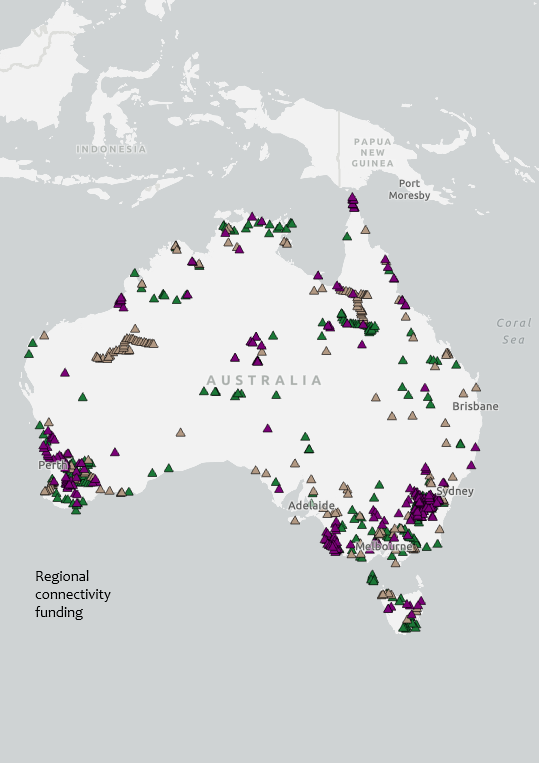
Have your say on our new interactive mapping tool which lets you search for digital connectivity across all different technologies in your area.
Digital connectivity is part of everyday life—it’s how we access information, jobs, and essential services. But until now, it’s been hard to find clear, local data on connectivity.
That’s why we have created easy-to-use interactive maps showing digital connectivity indicators across Australia. These maps let you explore broadband and mobile service availability in your area—so you can see what’s working, what’s not, and where improvements might be needed.
The maps show connectivity levels (from 0% to 100%) for different technologies, including mobile coverage (4G and 5G) and NBN services (fixed line, fixed wireless, and satellite). There’s also data on services provided by non-NBN Statutory Infrastructure Providers (SIPs).
Our maps complement DITRDCSA's communications programs mapping tool which lets you search for funded communications projects in your area.
We’re releasing these maps as a BETA version to share this information widely and get your feedback before the final release. Your input will help us make the maps even better.
Check out the maps and tell us what you think.
Demand for broadband

BCARR research informs forecasts of peak bandwidth demand.
The latest research looked at the decade to 2028 and estimates that in 2018, 95% of Australian households had peak bandwidth demand of 24 megabits per second (Mbps) or less, but that this will increase to 56 Mbps by 2028.
For small businesses (with 1 to 19 employees), we estimate that 95% had bandwidth demand of 24 Mbps or less in 2018, which is forecast to rise to 37 Mbps in 2028.
Growth in household bandwidth demand is expected to be driven by video streaming and uptake of higher resolution formats such as 4K and 8K television. Increased adoption of streamed gaming and virtual reality will add to this demand.
Small business bandwidth demand will also be driven by video streaming and other applications such as file transfers and web browsing. Industries that provide guest WiFi, such as education and accommodation, are forecast to have the greatest bandwidth demand among small businesses.
The research also examined household data downloads and found that household data downloads are estimated to increase from 199 gigabytes (GB) per month in 2018, to 767 GB in 2028. This represents an average annual growth rate of 14% over the forecast period, with the increased uptake of higher resolution video streaming being the main driver for this growth.
Broadband productivity

Over the past decade the rollout of the National Broadband Network (NBN), the deployment of extensive 4G and 5G mobile networks and the emergence of Low Earth Orbit (LEO) satellites have increased access to high-speed broadband services right across Australia. The rapid changes in broadband have seen households and firms take up internet services that are faster and of a much higher quality than ever before.
We undertake research projects to examine the economic and productivity benefits from improved broadband in Australia.