
Productivity impacts from broadband

This research explores the link between broadband and productivity growth at the individual business (or firm) level. It shows that there is generally a positive relationship between businesses switching from DSL to fibre/cable-based broadband and improvements to their productivity. This relationship is strongest in the year immediately after switching to high-speed broadband. More generally, the study finds that high speed broadband tends to have a positive relationship with productivity growth.
Analysis of Low Earth Orbit (LEO) satellites: implications for Australia’s agriculture and mining sectors

Recent analysis has explored the potential economic impacts of increased connectivity from LEO satellites for the agriculture and mining sectors.
LEO satellites are an emerging technology that will provide faster and more reliable communications for users outside of fixed and mobile broadband coverage, particularly those in remote and rural areas, promoting a range of economic and social benefits.
The report shows that Australia is an attractive market for LEO satellites.
Australia’s agriculture and mining sectors have significant presence in regional areas and could leverage increased connectivity from LEO satellites for the increased adoption of Internet of Things (IoT) and other digital technologies. The increased use of these technologies could provide these sectors with improved productivity in their operations as well as health and environmental benefits.
Digital connectivity indicators
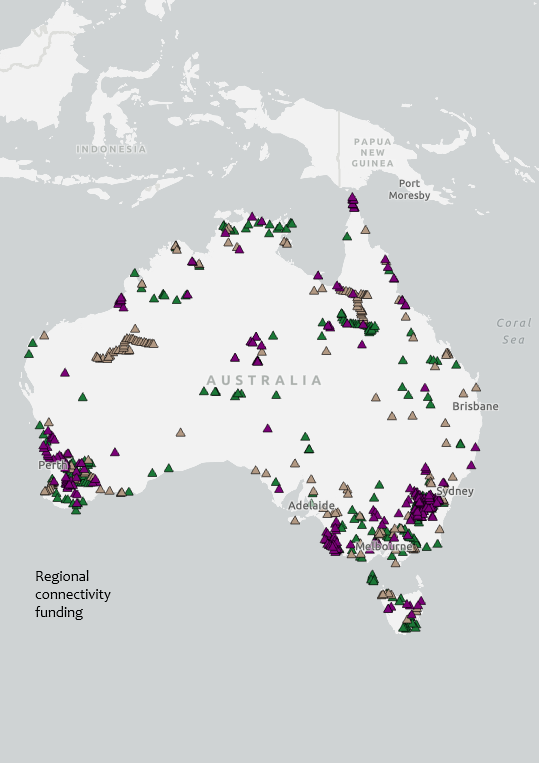
Have your say on our new interactive mapping tool which lets you search for digital connectivity across all different technologies in your area.
Digital connectivity is part of everyday life—it’s how we access information, jobs, and essential services. But until now, it’s been hard to find clear, local data on connectivity.
That’s why we have created easy-to-use interactive maps showing digital connectivity indicators across Australia. These maps let you explore broadband and mobile service availability in your area—so you can see what’s working, what’s not, and where improvements might be needed.
The maps show connectivity levels (from 0% to 100%) for different technologies, including mobile coverage (4G and 5G) and NBN services (fixed line, fixed wireless, and satellite). There’s also data on services provided by non-NBN Statutory Infrastructure Providers (SIPs).
Our maps complement DITRDCSA's communications programs mapping tool which lets you search for funded communications projects in your area.
We’re releasing these maps as a BETA version to share this information widely and get your feedback before the final release. Your input will help us make the maps even better.
Check out the maps and tell us what you think.
Demand for broadband
BCARR research informs forecasts of peak bandwidth demand.
The latest research looked at the decade to 2028 and estimates that in 2018, 95% of Australian households had peak bandwidth demand of 24 megabits per second (Mbps) or less, but that this will increase to 56 Mbps by 2028.
For small businesses (with 1 to 19 employees), we estimate that 95% had bandwidth demand of 24 Mbps or less in 2018, which is forecast to rise to 37 Mbps in 2028.
Growth in household bandwidth demand is expected to be driven by video streaming and uptake of higher resolution formats such as 4K and 8K television. Increased adoption of streamed gaming and virtual reality will add to this demand.
Small business bandwidth demand will also be driven by video streaming and other applications such as file transfers and web browsing. Industries that provide guest WiFi, such as education and accommodation, are forecast to have the greatest bandwidth demand among small businesses.
The research also examined household data downloads and found that household data downloads are estimated to increase from 199 gigabytes (GB) per month in 2018, to 767 GB in 2028. This represents an average annual growth rate of 14% over the forecast period, with the increased uptake of higher resolution video streaming being the main driver for this growth.
Broadband productivity

Over the past decade the rollout of the National Broadband Network (NBN), the deployment of extensive 4G and 5G mobile networks and the emergence of Low Earth Orbit (LEO) satellites have increased access to high-speed broadband services right across Australia. The rapid changes in broadband have seen households and firms take up internet services that are faster and of a much higher quality than ever before.
We undertake research projects to examine the economic and productivity benefits from improved broadband in Australia.
Use of digital technologies among First Nations children

Access to quality and reliable telecommunications services has become a central part of modern life. Digital technologies are essential for everyday living and a primary means of accessing information, employment, markets and key services. For children, it is particularly important as these technologies can support their education, social connectedness and their ability to participate in an increasingly digital economy.
For some Australians, however, their lower level of digital inclusion means that they are less able to enjoy the benefits of being online. This includes First Nations people and communities, older Australians, and low-income households.
In the first report of this series 'Use of digital technologies among First Nations children—Findings from the Longitudinal Study of Indigenous Children' (2024) BCARR analyses survey data of First Nations children and families to understand how their use of telecommunications has changed over time. The research also identifies socioeconomic characteristics that impact digital technology use and ownership.
With the continued transition of services and opportunities online, supporting digital inclusion will continue to be a critical part of ensuring all Australians can access those benefits, particularly people living in regional and remote areas.