
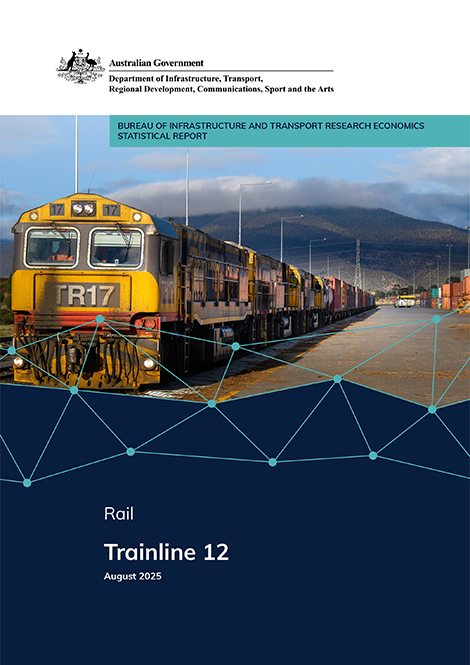
This compendium provides insights, analysis, and an understanding of the railway industry. Australia's railways are evolving due to changes outside and within the industry. These changes include logistics, commodity flows, technology, urban patronage, and regional passenger services. The publication presents an overview and data on railway transport tasks performed, characteristics of the railways and train operators' rolling stock that runs and aspects of railway performance including safety, environment and reliability.
Trainline 12 gives an overview of freight, urban and non-urban passenger rail. The report analyses traffic levels, the provision of infrastructure and rolling stock, and railway performance. It is the twelfth in the publication series.
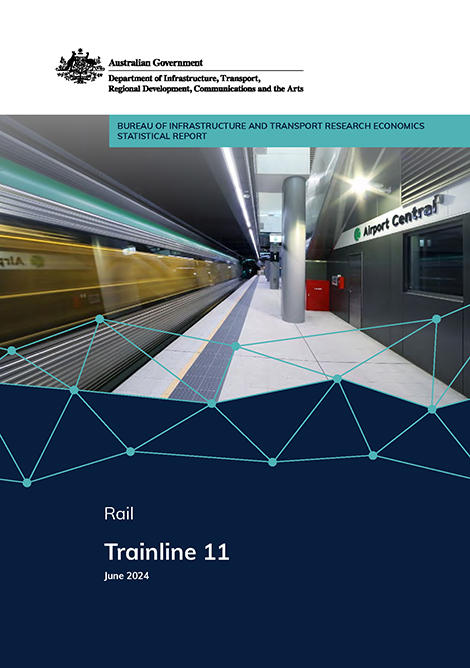
Trainline is a compendium of Australia's railways, providing insights, analysis and an understanding of the railway industry. Australia's railways are evolving, with changes within and outside the industry. These changes include logistics, commodity flows, technology, urban patronage and regional passenger services. The publication presents an overview and data on railway transport tasks performed; characteristics of the railways and train operators' rolling stock that runs; and aspects of railway performance including safety, environment and reliability.
Trainline 11 gives an overview of freight, urban and non-urban passenger rail. The report analyses traffic levels, the provision of infrastructure and rolling stock, and railway performance. It is the eleventh in the publication series.
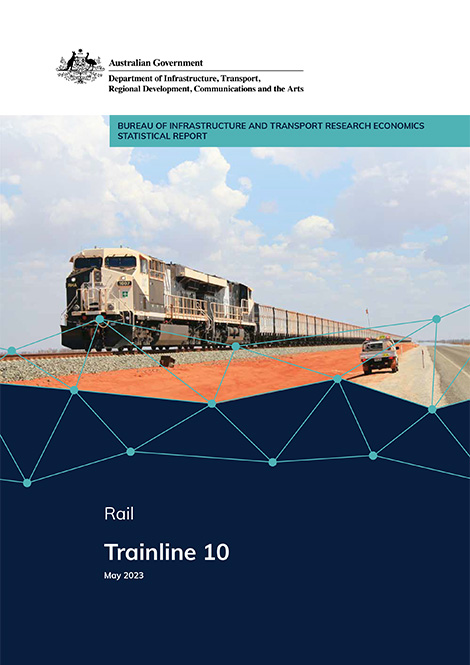
Trainline is a compendium of Australia's railways that provides insights, analysis and an understanding of the railway industry. Australia's railways are evolving, with changes within and outside the industry. These changes include logistics, commodity flows, technology, urban patronage, and regional passenger services. The publication presents an overview and data on railway transport tasks performed; characteristics of the railways and train operators' rolling stock that runs; and aspects of railway performance, including safety, environment and reliability.
This is not the latest release. View the latest Working zones update
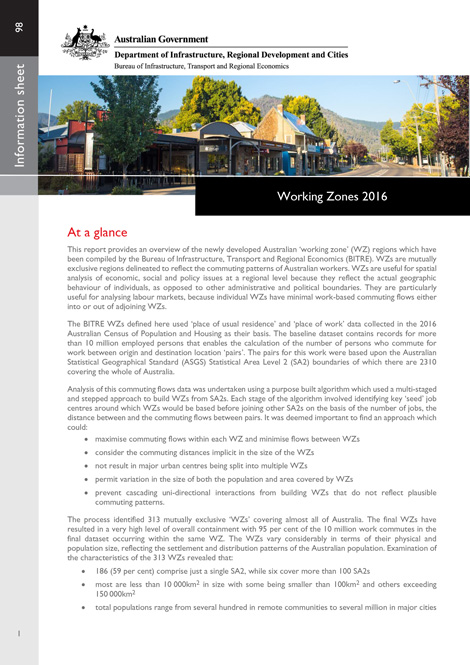
This report provides an overview of the newly developed Australian 'working zone' (WZ) regions which have been compiled by the Bureau of Infrastructure, Transport and Regional Economics (BITRE). WZs are mutually exclusive regions delineated to reflect the commuting patterns of Australian workers. WZs are useful for spatial analysis of economic, social and policy issues at a regional level because they reflect the actual geographic behaviour of individuals, as opposed to other administrative and political boundaries. They are particularly useful for analysing labour markets, because individual WZs have minimal work-based commuting flows either into or out of adjoining WZs.
- Working Zones 2016
- Working Zones 2016 Data
- Working Zones 2016 to SA2 Concordance
- Working Zones 2016 Shape File

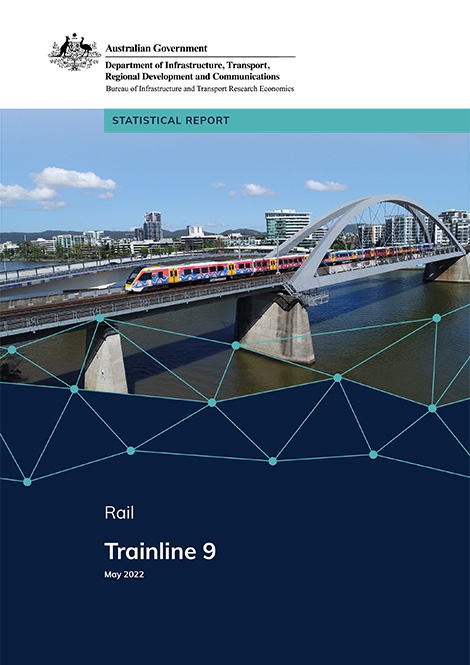
Trainline is a compendium of Australia's railways, providing insights, analysis and an understanding of the railway industry. Australia's railways are evolving, with changes within and outside the industry. These changes include logistics, commodity flows, technology, urban patronage and regional passenger services. The publication presents an overview and data on railway transport tasks performed; characteristics of the railways and train operators' rolling stock that runs; and aspects of railway performance including safety, environment and reliability.
Review of the National Cities Performance Framework – Final paper
The National Cities Performance Framework (NCPF) was launched in 2017 with the commitment to conduct reviews every 3 years. This report covers the feedback received and the approach for the future of the NCPF. The conclusion of the NCPF review is that alternate departmental data and research products better meet the needs of stakeholders and that the Framework should be phased out. Targeted research will focus on issues of the highest priority to the government and cities’ stakeholders.
Australia’s light vehicle fleet - some insights
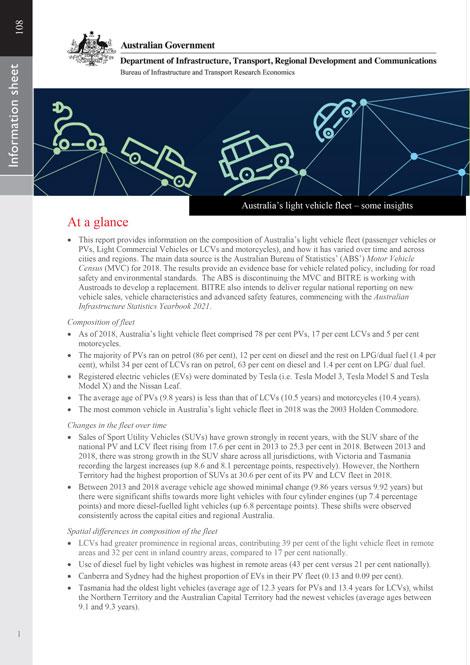
This Information Sheet investigates how the characteristics of Australia’s light vehicle fleet vary across different types of regions, including States/Territories, major cities, city sectors, region types, and small areas. Vehicle characteristics considered include fuel type, average age, cylinders and tare weight. Specific types of vehicles, such as electric vehicles, sports utility vehicles and utilities are also examined. The study also identifies recent changes in the composition of Australia’s light vehicle fleet.
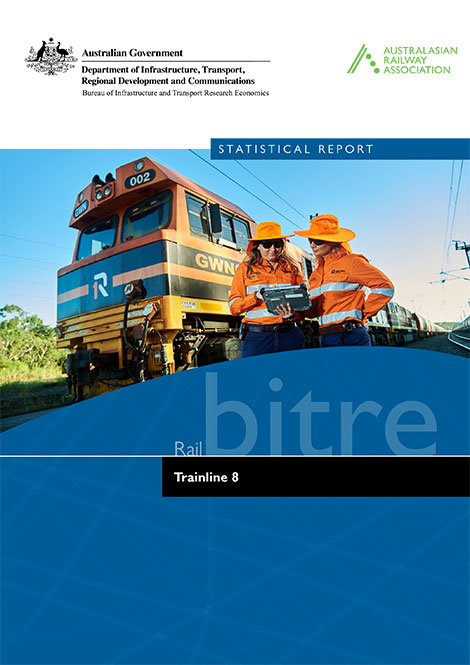
Trainline is a compendium of Australia's railways, providing insights, analysis and an understanding of the railway industry. Australia's railways are evolving via changes within and outside the industry. These changes include logistics, commodity flows, technology, urban patronage and regional passenger services. The publication presents an overview and data on railway transport tasks performed; characteristics of the railways and train operators' rolling stock that runs; and aspects of railway performance including safety, environment and reliability.
Review of the National Cities Performance Framework - Consultation paper
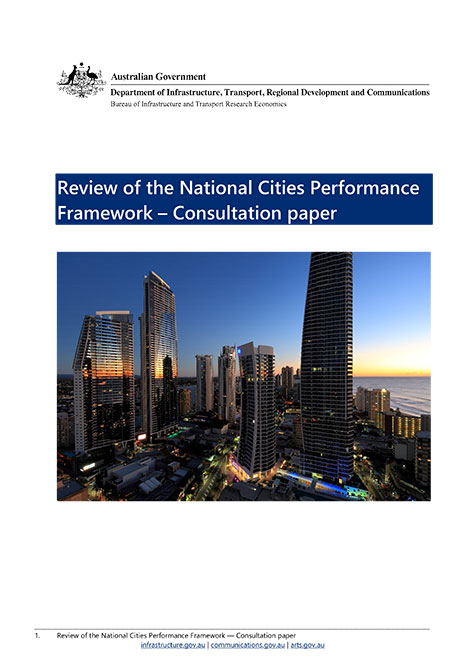
The National Cities Performance Framework (NCPF) was launched in 2017 with the commitment to conduct reviews every 3 years. The first 3 Year Review will examine what improvements can be implemented in the 2021 update and future years. This consultation paper is the start of the public consultation process, conducted over January-February 2021. It details the 3-year review process, the issues being considered, and the proposed approach for each issue. Some of the topics covered include potential new indicators, a review of the geographies, and improving the structure of the framework.
Population synthesis for travel demand modelling in Australian capital cities
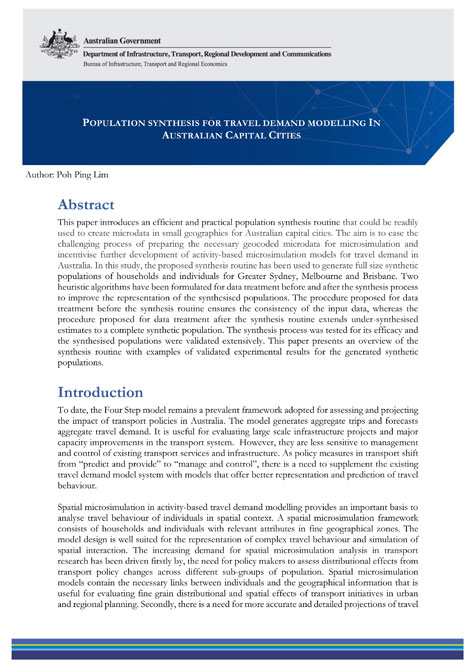
In this research, the proposed synthesis routine has been used to generate full size synthetic populations of households and individuals for Greater Sydney, Melbourne and Brisbane. Two heuristic algorithms have been formulated for data treatment before and after the synthesis process to improve the representation of the synthesised populations. The procedure proposed for data treatment before the synthesis routine ensures the consistency of the input data, whereas the procedure proposed for data treatment after the synthesis routine extends under-synthesised estimates to a complete synthetic population. The synthesis process was tested for its efficacy and the synthesised populations were validated extensively. This research contributes in setting up a replicable population synthesis routine that can be included into a standard methodological toolbox for transport researchers and mainstream social scientists to produce Australian synthetic populations that is essential to microsimulation analysis.
- Population Synthesis for Travel Demand Modelling in Australian Capital Cities