
Assessment of road improvements in remote and regional areas
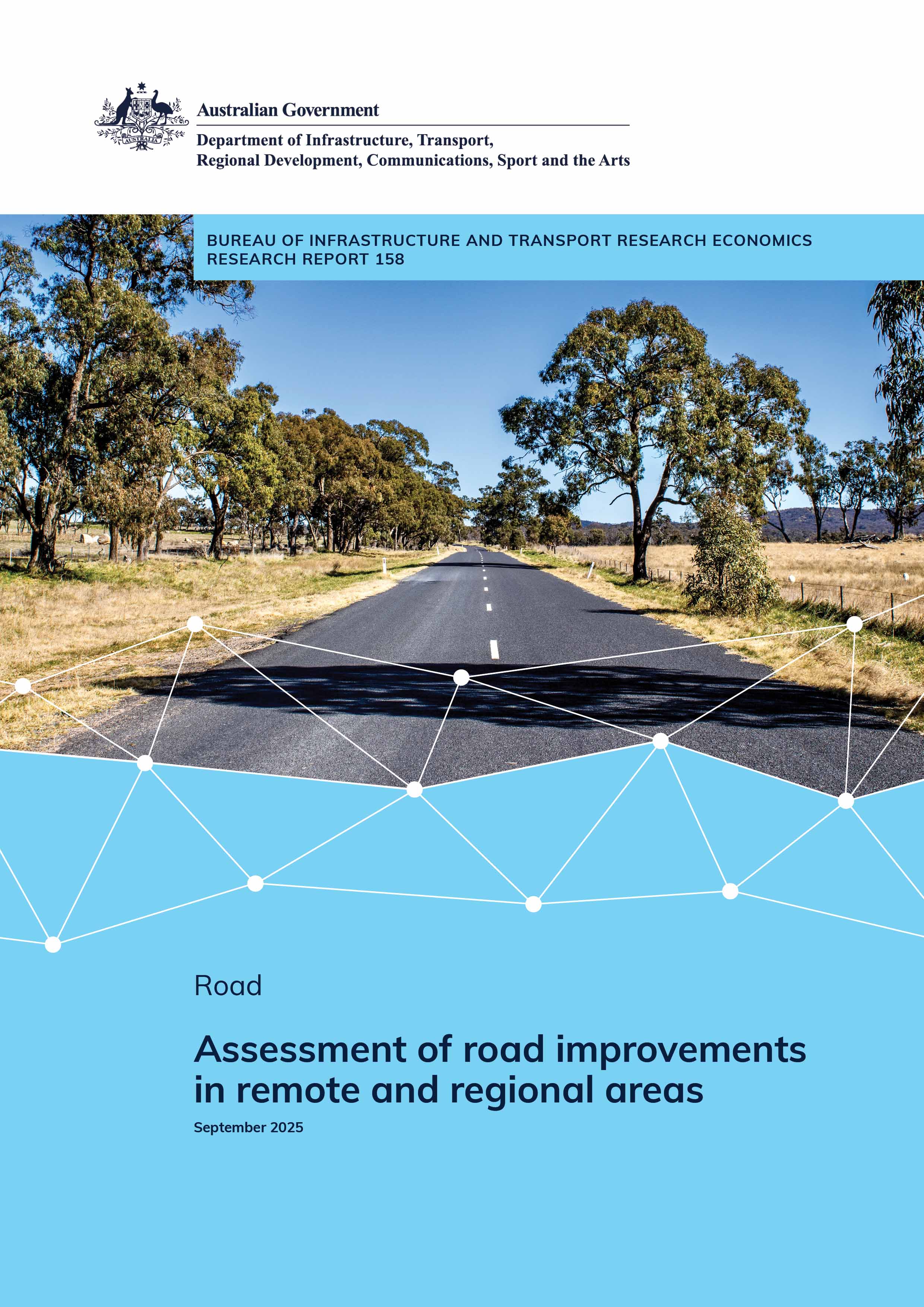
The report addresses the challenge that low traffic volumes in remote and regional areas pose to traditional cost–benefit analysis (CBA) methods to support road improvements in these areas in line with community expectations and government policy objectives. Roads in remote and regional areas are often provided at standards above what would be considered economically efficient levels under traditional CBA methods, but there is currently no clear way to make a recommendation as to an acceptable standard. This report develops ways to improve the efficiency, equity and transparency of decision-making for road funding in remote and regional areas. CBA is retained as the core appraisal tool with the additions of social benefits, wider economic benefits and equity weights. The development of the equity weights draws on recent thinking about equity and distributive justice from literature in the disciplines of philosophy, economics and transport planning.
Economic measures of general aviation in Australia
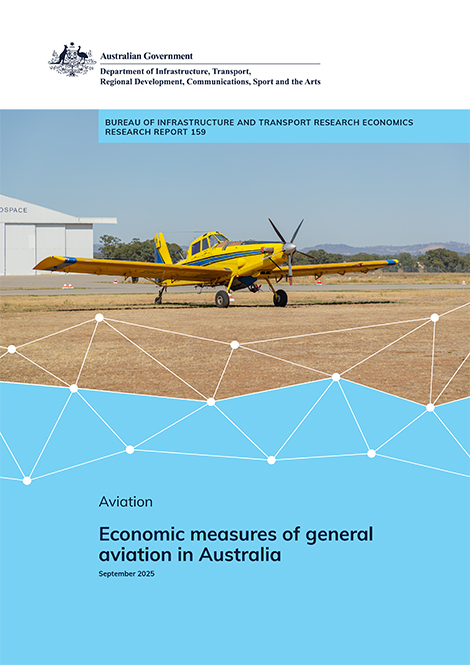
General aviation (GA) plays a range of essential roles in Australia including servicing regional communities, delivering education and health services, regional freight and transport, tourism, recreation, agricultural mustering and spraying, instructional flying, sport and pleasure flying, and emergency services. However, GA is not a stand-alone category in Australia’s System of National Accounts. Instead, it makes up a small subset of a very wide range of economic activities, making it difficult to estimate its actual economic impact. This study considers a range of sources, including innovative methods of matching aircraft registrations to business activity, to estimate the contribution of GA to Australia’s economy.
Consultation Draft Tasmanian Freight Equalisation Scheme Monitoring Report 2024
Consultation Draft Tasmanian Freight Equalisation Scheme Monitoring Report 2024.
Australian aviation forecasts—2024 to 2050
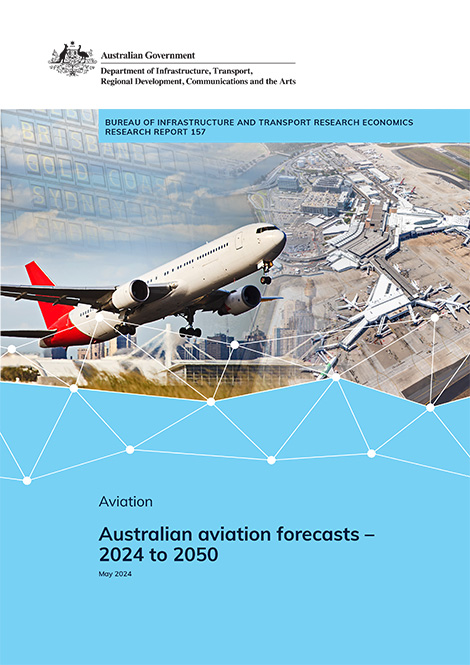
Aviation plays a key role in Australia’s transport system, providing regular scheduled services between Australia's highly dispersed major population centres and vital connectivity for rural and remote communities. As a large island nation, located significant distances from our nearest neighbours, aviation is also the primary means of access for international visitors and for domestic residents travelling overseas.
This report presents long-term forecasts of Australian commercial air passenger and freight activity, and forecasts of air passenger numbers through Australia’s 14 busiest airports / air catchments – i.e. Australia’s eight capital cities and six busiest non-capital city airports – and air freight volumes through Australia’s mainland state capital city airports. The forecasts are based on econometric models of Australian domestic and international air passenger and air freight demand, and the most recent long-term economic outlooks for Australia and developed and major developing countries. The forecasts are intended to help inform long-term Australian aviation policy development and planning.
The economics of road maintenance
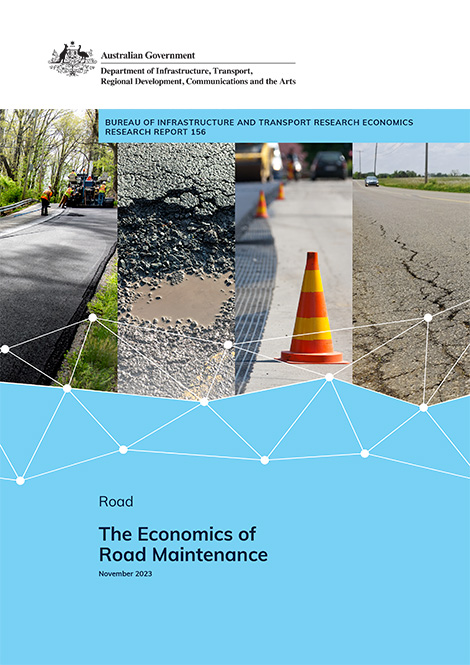
This report discusses the economics of road maintenance. It develops analytical approaches to help ensure that road expenditure is used in the most efficient and cost-effective manner both in terms of dividing funds between construction and maintenance and allocation of maintenance funds between locations, treatment types and treatment timing. The focus is on the impact of timely and adequate maintenance expenditure on the overall costs to society — that is, costs to road agencies, road users and externalities. The analytical approach and case studies demonstrate the potential costs of delayed or deferred maintenance expenditure, which can result in much higher overall costs, reinforcing the adage: ‘a stitch in time save nine’. The report also provides a computer modelling approach to optimising road maintenance expenditure over time so as to minimise the overall cost to society, without and with constraints on road agency spending levels.
Australian aggregate freight forecasts – 2022 update
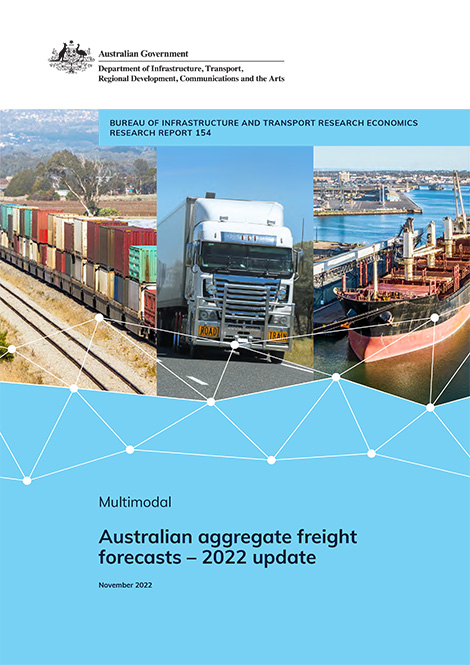
Freight transport plays a significant and wide-ranging role across Australia’s economy. It includes the movement of Australia’s major bulk export commodities to ports for export, the transport of raw materials and semi-processed commodities to businesses for further processing and finished products to household consumers.
This report presents long-term forecasts of total Australian freight volumes for road, rail, coastal shipping and aviation between 2020 and 2050. The forecasts are based on a combination of statistical models relating to historical trends in freight volumes and economic activity and on informed assumptions about likely future long-term economic and demographic trends and international assumptions about likely future world demand for key Australian export commodities. This report updates BITRE 2019 aggregate freight forecasts.
Australian interstate, intrastate and capital city road freight forecasts – 2022 update
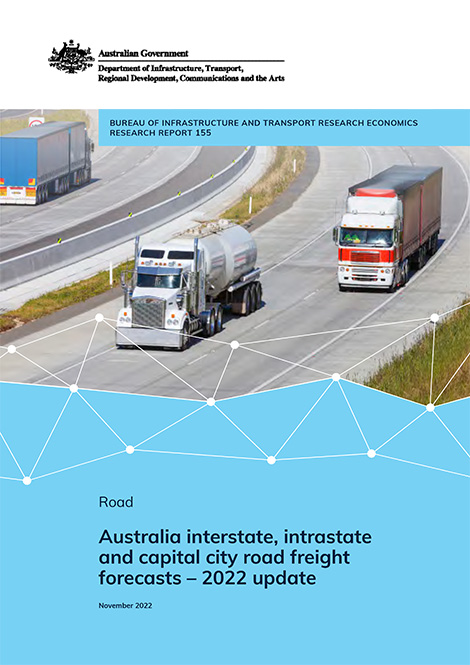
In Australia, road transport is the predominant mode for moving freight between and within states. It is a vital link in various logistics chains, providing access for freight to ports and terminals and urban freight distribution between warehouses and retail outlets. It is also the dominant mode for moving freight over relatively short distances and where other alternatives are not readily available.
This report presents estimates and forecasts of interstate, intrastate and capital cities freight volumes for each state and territory in Australia. Estimates cover the period 1970 to 2020 and forecasts from 2020 to 2040. The forecasts are based on a combination of statistical models relating historical trends in road freight volumes and economic activity, informed by assumptions about likely future long-term economic and demographic trends.
Forecasting uptake of driver assistance technologies in Australia
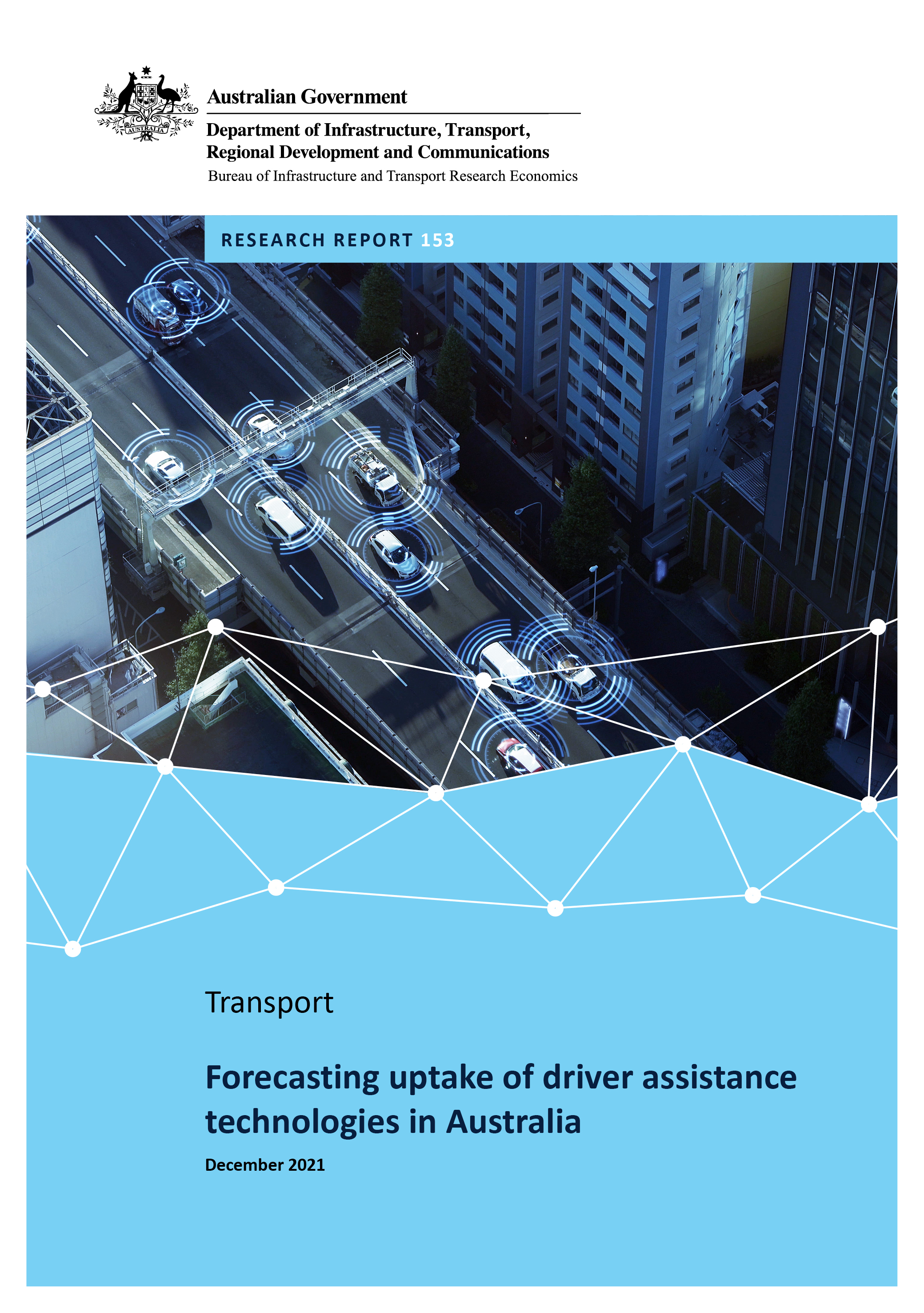
This report uses an established modelling framework for forecasting the uptake of technologies that assist drivers and full vehicle automation in Australian light vehicles. Taking uncertainties into consideration, the report provides sensitivity analysis, based on several assumptions, to estimate the possible uptake of sales and fleet penetration till 2070. BITRE will maintain a watch on automated vehicles (AVs) as they are deployed and use the modelling framework to update its estimates when new information to inform forecasts becomes available.
- Forecasting uptake of driver assistance technologies in Australia [PDF: 7029 KB]
Australian aggregate freight forecasts—2019 update
This report presents long-term forecasts of total Australian freight volumes for road, rail, coastal shipping and aviation between 2018 and 2040. The forecasts are based on a combination of statistical models relating historical trends in freight volumes and economic activity, informed assumptions about likely future long-term economic and demographic trends, and international assumptions about likely future world demand for key Australian export commodities. This report represents the first issue in BITRE's revamped forecasting series, which aims to provide regularly updated long-term forecasts of Australian freight activity by major transport mode at national, state, territory and regional scales.
Electric Vehicle Uptake: Modelling a Global Phenomenon
This report describes an approach to estimating likely electric vehicle uptake for each of 22 countries around the world. Models of electric vehicle uptake were derived for Australia, Austria, Belgium, Britain, Canada, China, Denmark, Finland, France, Germany, India, Ireland, Italy, Japan, Korea, the Netherlands, New Zealand, Norway, Spain, Sweden, Switzerland, and the United States (as well as for the 'Rest of Europe').
- Electric Vehicle Uptake: Modelling a Global Phenomenon
- Data